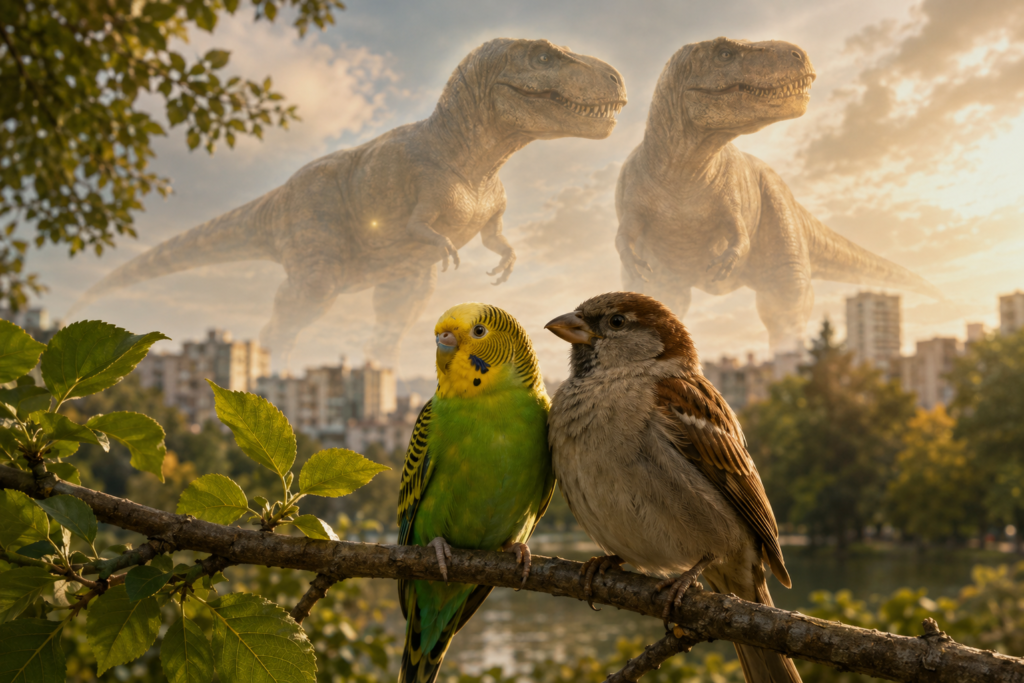
Not all birds leave a positive impression on us like small, charming, colorful budgies. While we admire Australian budgies as exotic pets, sparrows – everyday creatures across most of the globe – we often overlook, taking them for granted. But these two groups of small birds hide incredible stories of intelligence, adaptability, and, believe it or not, quantum biology.
When we hear “quantum biology”, we think of the most complex laboratory experiments. Yet these little “quantum computers” flutter on our windowsills, sleep in our palms, and prove that size and adaptability are just two sides of the same evolutionary coin.
🧠 Small Brain, Big Capacity: How Budgies Learn Like Humans
Scientists have long considered budgies (Melopsittacus undulatus) exceptionally intelligent. A recent 2024 study showed that budgies not only distinguish the basic concepts of “same” and “different”, but also generalize this ability to completely new data – size, color, shape, and even number of dots. This is a level of abstract thinking previously attributed only to primates or dolphins.
Their secret lies in the incredible brain-to-body ratio. Budgies have more neurons per unit volume than many mammals, and their brain structures – particularly the nidopallium (responsible for executive functions) and hippocampus (spatial memory center) – are organized in a way that resembles the human cortex, even though they evolved completely independently. The phenomenon of convergent evolution has led birds and mammals to develop similar solutions to complex problems – using entirely different brain architectures.
🏙️ How Sparrows “Tamed” the City and Our Affection
While budgies dominate Australian savannas, their relatives – house sparrows (Passer domesticus) – are true masters of adaptation to the human environment. These non-migratory birds have their own permanent territories and display remarkable social intelligence. Research has shown that social learning patterns in sparrows form depending on two factors: competition for resources and the difficulty of learning a task individually versus socially. In other words, sparrows adjust their learning strategy – whether to copy others or experiment on their own – in real time, like little feathered statisticians.
What’s even more fascinating is their ability to recognize human faces and remember them for years. Studies have shown that sparrows can distinguish people who previously approached them as a potential threat from those who fed them, and retain that information for months. This associative learning ability is key to their survival in the urban jungle – but it’s also a bridge to quantum biology.
👭 A Surprising Friendliness: The Strange Friendship Between a Budgie and Sparrows
Sparrows, and budgies too, are known for their sociability towards other bird and parrot species. Unlike pigeons, which often chase sparrows away from feeders, budgies show an exceptional ability to integrate into flocks of other species.
The most famous example of this incredible friendship happened in New York. A budgie named Mei Mei, likely escaped from a cage, was spotted in Central Park feeding in the company of a flock of sparrows. The sparrows completely accepted her as one of their own, and Mei Mei adapted her behavior to theirs – she even learned to flee from humans, just like the sparrows, and to feed on grass seeds and bugs.
This strange friendship lasted ten weeks, until a rescue team managed to catch her and rehome her before winter, which would have been fatal for a creature used to the warmer climate of the Australian savanna. During those weeks, Mei Mei managed to feed herself and avoid predators – including a hawk spotted hunting in the park – thanks to the alliance with the sparrows. If one sparrow noticed danger and took flight, the whole flock – including the budgie – would fly together, providing protection from birds of prey.
⚔️ When Friendship Becomes Dangerous: Budgies and Larger Parrots
Unfortunately, this sociability doesn’t always end well. People who keep multiple parrot species often notice that budgies try to make contact with their larger, stronger bird relatives. This often ends with the larger parrots injuring their smaller cousins – the budgies.
Budgies can also be territorial and aggressive towards other birds during the breeding season, specifically towards those of a gentler nature – such as cockatiels (nymphs). Interestingly, female budgies are more aggressive than males.
This is a tragic paradox: a species willing to befriend a completely different species (sparrows) often fails to make peace with its own, larger relatives. The reason lies in the territorial instinct, which is stronger in larger parrots, and also in the fact that budgies – although sociable – are simply no physical match for a larger beak.
💞 Lifelong Loyalty: Monogamy of Budgies and Sparrows
Another trait that budgies and sparrows share is a tendency toward monogamy. Once paired, budgies stay with their partner for life. In the wild, they rarely change partners unless one dies. This deep bond is reflected in daily behavior: preening each other’s feathers, feeding together, and sleeping side by side.
Sparrows are also known for their loyalty. Most house sparrows remain with the same partner for life, and only when one partner dies does the survivor seek a new one. This lifelong partnership has evolutionary advantages: pairs that stay together longer become better parents, raise offspring more successfully, and have more young.
This ability to form deep, long-term bonds testifies to the complex emotional lives of these small birds. They not only remember their partners, but also recognize them, grieve for them, and show all the signs of genuine connection.
🧬 Evolutionary Relatives: Why Are Sparrows and Budgies So Similar?
What we have described – sociability, monogamy, abstract learning – is no coincidence. The latest genetic research in avian phylogeny reveals that sparrows and budgies are exceptionally close evolutionary relatives. Both belong to a clade called Australaves (Latin for “southern birds”).
A clade is a taxonomic category above the order level, and what modern genetics has shown is that the orders to which these two birds belong – passerines (Passeriformes) and parrots (Psittaciformes) – are actually sister groups. This means they share a common ancestor that lived shortly after the dinosaur extinction.
This relationship is one of the biggest surprises of modern avian phylogeny. Previously, it was thought that parrots were closer to falcons or other tropical birds. Today, however, we have solid evidence – from retroposon analysis to comparative genomics – confirming that sparrows and parrots are indeed close relatives.
It is estimated that their evolutionary lineages diverged about 55 to 60 million years ago, during the early Eocene. That was a time of rapid global warming and expansion of tropical forests, when birds found new ecological niches. The common ancestor of this group most likely evolved in the area of the ancient southern supercontinent Gondwana, with particular focus on the region of present-day Australia and South America.
So when we look at a budgie and a sparrow, we are not just looking at two cute little birds – we are looking at two separated relatives who, over 60 million years of independent evolution, developed intelligence, sociability and monogamy, yet retained that fundamental common trait: an incredible ability to adapt and find their way in the human world. Both, in their own way, are proof that dinosaurs did not go extinct – they still chirp on our windowsills.
🔬 Quantum Biology in Tiny Feathers: How Birds “See” the Magnetic Field
Now we come to the most incredible part. Although budgies and sparrows are not known for long-distance migration like storks or swallows, their relatives – European robins, pigeons and other birds – use a quantum sensory system for navigation.
When light hits the cryptochrome protein in a bird’s retina, it triggers a chain reaction: electrons separate from molecules and form radical pairs. These pairs are in quantum entanglement – their states are linked regardless of distance. The Earth’s weak magnetic field (only 50 microtesla) changes how these electrons “decide” to recombine, and the bird’s brain interprets those changes as the direction of north. In laboratory simulations, cryptochromes maintain the coherence of entangled states for up to ~20 microseconds – long enough for the magnetic field to leave its quantum signature.
Budgies and sparrows have the same protein in their eyes.
Even though they don’t need to cross oceans, their quantum compass still works. In one experiment, European robins – birds similar in size to sparrows – changed their orientation when their eyes were exposed to an artificial magnetic field. This means that even though they don’t migrate, small sparrows possess this ancient quantum tool, inherited from a common ancestor.
📏 From T-rex to Shoulder: How Dinosaurs “Chose” to Be Small
How is it possible that such intelligent, even quantum-sensitive creatures evolved from enormous dinosaurs? Research published in Science shows that the theropod lineage leading to birds underwent continuous miniaturization over 50 million years, in at least 12 clear steps – from an average of 200 kilograms to just 0.8 kilograms.
Miniaturization accelerated development: small dinosaurs retained “juvenile” traits longer – larger eyes, shorter snouts, but also larger brain relative to body size. Selection favored traits that enabled life in trees: good 3D vision, a large brain for navigating complex environments, feathers for thermoregulation, and eventually the ability to fly. In that struggle for new ecological niches, the shrinking dinosaur became a bird – and carried with it the quantum cryptochrome. By becoming small, it also became incredibly adaptable, surviving the mass extinction that wiped out its giant relatives.
💞 When Grief Becomes Science: Another Similarity to Us
Sparrows and budgies share not only monogamy but also the ability to grieve for a lost partner. When one partner dies, the survivor often shows signs of depression, loss of appetite, withdrawal, and even refusal to mate again. These are behavioral patterns we recognize in humans. The presence of a flock or a human caregiver can alleviate these symptoms, but – just like with us – some remain forever marked by loss.
✨ Conclusion: Small Giants of the Quantum World
From the abstract learning of budgies, through the incredible friendship with sparrows and the dangers from their own kind, to the quantum navigation hidden in their eyes – small birds are true “small giants”. They teach us that intelligence and complexity do not depend on brain size, but on architecture, connectivity, and ultimately, quantum coherence.
The next time you see a sparrow hopping on the sidewalk or a budgie dozing on your shoulder, remember: you are looking at a creature that carries within it 50 million years of miniaturization, an evolutionary victory over dinosaurs, and perhaps even a quantum chip in its eye.
Nature, it seems, has hidden its greatest engineer in the smallest body.
☕ If you wish to support topics like this – research at the intersection of neurobiology, quantum physics, and curiosity – you can buy me a coffee. Every contribution goes directly into research, books, and unpaid hours.
buymeacoffee.com/milovaninnovation
Thank you for being part of this story.
Leave a Reply