
Not all birds leave a positive impression on us like small, charming, colourful budgies. While we admire Australian budgies as exotic pets, few stop to wonder – how did such a delicate, seemingly ordinary little bird become the third most popular pet on the planet in just two centuries, right after dogs and cats?
This is not just a story about beautiful feathers. It is a story of extraordinary intelligence, complex psychology, remarkable adaptability, and ultimately, how a small green parrot won our hearts and homes faster than any other bird in history.
️🗺️ First Encounters: From Darkening Skies to Royal Courts
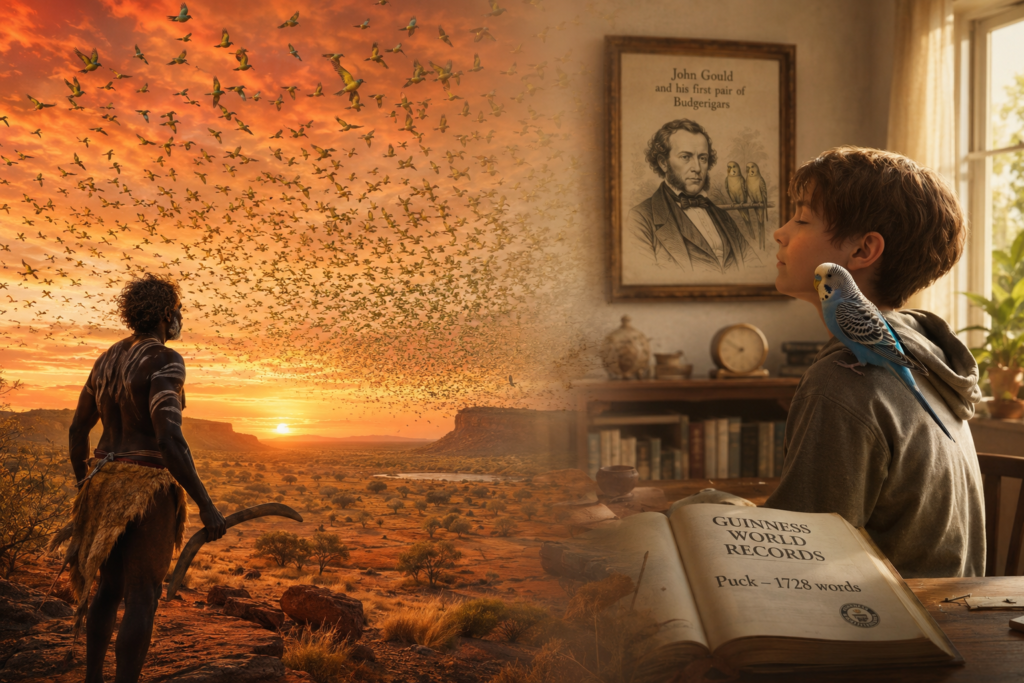
Although Aboriginal peoples had known budgies for thousands of years, the world learned of them only in the 18th century. British seafarers returning from Captain James Cook’s historic 1770 voyage reported an incredible sight: enormous flocks of small green birds so numerous that they darkened the sun.
The official scientific description came much later, in 1805, when English biologist George Shaw, an assistant in the natural history department of the British Museum, first described them for science. But the real craze began in 1840, when English naturalist John Gould brought the first living pair of budgies to England. Gould described them as “the most lively, cheerful little creatures you could imagine”. Enthusiasm was immediate. The first specimens became a hit among the aristocracy, and even Queen Victoria received a pair of budgies as a gift in 1845.
Just two decades later, budgies were being imported in such numbers that Gould noted every ship arriving from South Australia included budgies in its cargo, and that traders in Wapping had thousands of birds for sale. Concerned about declining populations, Australia banned budgie exports in 1894, but by then Europe already had its own breeders and was producing thousands of young birds each year. America was slower to embrace budgies – the first birds arrived in the 1920s, but the real “budgie fever” swept the United States only in the 1950s.
🌾 Guardians of Water and Spirits: Budgies and Aboriginal Australians
While Europeans were just discovering budgies, Australia’s Indigenous peoples had lived alongside them for thousands of years. In the Warlpiri language, the budgie is called “Ngatitjirri” and is the subject of major Dreaming (Jukurrpa) narratives.
Aboriginal people used budgies as skilled water finders. The huge green flocks, easily visible against the red plains of the outback, were constantly searching for water. By following their flight, Aboriginal people could locate precious water sources. In Warlpiri country, large flocks of budgies are found around waterholes, and their presence provided critical clues to water locations.
Unfortunately, budgies also had another, less sentimental role in Aboriginal culture. Their indigenous name “Betcherrygah” (from the Gamilaraay language) translates literally as “good food”. People hunted adult budgies in flight using branches, clubs, and boomerangs, and their eggs and chicks were considered delicacies. Although I personally find this thought bizarre and repulsive, it is undeniable evidence of the long and complex relationship between humans and these birds.
💙 The Blue Mutation: A Genetic Twist That Nature Rejected, Humans Loved
In the wild, budgies are exclusively green and yellow. That colouration is perfect camouflage in the Australian outback, where they blend in with bushes and grasses.
However, occasionally a yellow or blue budgie appears in the wild. This blue colour is not the product of breeders’ imagination – it arises from a recessive mutation that blocks the synthesis of yellow pigment in the feathers. Without yellow, the blue component comes to the fore, resulting in blue plumage.
Although this genetic variation is natural, the harshness of natural selection rejects such budgies. The blue colour makes them easily visible in their natural habitat and attracts dangerous attention from predators. Moreover, they are often rejected by their own flocks. It is precisely this conspicuousness – which spells death in the wild – that became their advantage in captivity.
The first yellow mutation was recorded in 1872 in Belgium, and the first pair of blue budgies reached Europe in 1910. Blue budgies became a true trend among those who could afford them. Then, from the mid-20th century onwards, these little birds became widely available at very affordable prices.
💚 Third in Line: How Budgies Conquered the World
Today, budgies are the most popular winged pet in the world. In overall popularity, they rank third, right after dogs and cats – animals that have been our companions for perhaps more than ten thousand years.
How did such a small, fragile creature win our hearts in just 200 years?
The answer lies in their extraordinary intelligence, sociability and – what is hardest to grasp – the possession of character and complex psychology. Their ability to form an emotional bond with a human, to recognise them and to show affection, goes far beyond mere instinct. Inside their tiny bodies, weighing just 30-40 grams, hides an exceptionally complex mind.
🗣️ Speakers Among Us: How Budgies Learn to Talk
Budgies are not just good at mimicking human speech – they show the ability to use basic sounds and tones to produce structured sequences, resembling our own way of verbal communication. This is a brand new insight: their vocalisation is more advanced than that of most songbirds, and in its mechanism it is closer to primates and to us humans.
A 2025 study published in the journal Nature revealed that neurons in the vocal motor system of budgies form a functional map that reflects the spectral characteristics of vocalisations, showing unprecedented shared features with the speech-motor cortex in humans.
But the most striking proof of their speech ability is Puck. This blue budgie from California entered the Guinness Book of World Records as the bird with the largest vocabulary – an incredible 1,728 words. A bird weighing just 30 grams. Over six months, 21 volunteers, including ornithologists and two avian veterinarians, carefully listened to and documented what Puck said. His owner, Camille Jordan, recorded one example on Christmas morning 1993, when Puck said: “Christmas is. It happens. That’s what it’s all about. I love Paki. Love everyone.”
😴 When Budgies Dream: REM Sleep and the Half‑Asleep Brain
Have you ever wondered whether your budgie dreams? Recent research conducted at the University of Chicago has discovered that budgies have a rapid eye movement (REM) sleep phase, just like humans. The study showed that REM sleep accounts for as much as 26.5% of total sleep in budgies – comparable to humans and an order of magnitude higher than previously thought.
This complex sleep architecture suggests that budgies – like us – may have a rich inner life and process emotions and memories during sleep. In that phase, we dream. Perhaps they do too.
But there is also an incredible adaptation. When in their natural environment, budgies have the ability to keep one brain hemisphere awake while the other sleeps. This ability allows them to gather essential survival information even during sleep, monitor warning sounds, and be ready to flee from predators at a moment’s notice.
🧠 Small Brain, Big Mystery: What Lies Inside a Budgie’s Brain
The extraordinary mental abilities of budgies – their speech power, complex social behaviour, problem‑solving skills, and perhaps even dreaming – cannot be explained by brain size alone. Budgies have a small but exceptionally densely packed brain, with more neurons per unit volume than many mammals. Their brain structures – particularly the nidopallium (responsible for executive functions) and the hippocampus (spatial memory centre) – are organised in a way that resembles the human cortex, even though they evolved completely independently.
The phenomenon of convergent evolution has led birds and mammals to develop similar solutions to complex problems – using entirely different brain architectures. In the budgie’s brain, functions that in us are handled by the neocortex are handled by the nidopallium and other unique avian structures. That is why they are capable of recognising individual humans, remembering events, showing jealousy, and even developing unique personalities.
✨ Conclusion: Fragile Bodies, Extraordinary Minds
Budgies are proof that size is not a measure of worth. Inside their fragile bodies, weighing just 30 grams, they hide a complex psyche, extraordinary intelligence, and the ability to form deep emotional bonds with humans. In just 200 years, they have travelled from wild flocks that darkened the Australian sun to our living rooms and hearts.
The next time you see a budgie chirping on your shoulder or dozing in your palm – remember: you are looking at a creature shaped by millions of years of harsh outback survival, a being that remembers, learns, communicates, and perhaps even dreams. You are looking at a small quantum giant.
Nature, it seems, has hidden its greatest engineer in the smallest body.
☕ If you wish to support topics like this – research at the intersection of neurobiology, animal behaviour and curiosity – you can buy me a coffee. Every contribution goes directly into research, books and unpaid hours.
buymeacoffee.com/milovaninnovation
Thank you for being part of this story.
Leave a Reply