
Dear explorers,
We have sailed far. We have touched upon spinors, black holes, quantum complexity, thermalization, entropy, and the infinities that something smooths. But now the moment has come to dive into the very fabric of the laws that hold the universe together – and to ask what would happen if they gave way.
This post is about symmetries. About the deepest ones, those that define what is real and what is merely a reflection in a mirror. About how nature showed it prefers left over right. About why we exist at all – why matter defeated antimatter. And about the most unsettling possibility of all: that the bottom of the Dirac Sea is unstable, and that beneath it lies a chasm leading to a new eon.
🪞 Three Letters That Hold the Universe
Imagine reflecting all of reality in a mirror. Everything left becomes right. Everything front becomes back. All particles become antiparticles. And time… time flows backward.
Would the laws of physics still hold?
Three great symmetries define our answer to this question:
P – parity (spatial mirroring): If you swap left and right, does the universe behave the same?
C – charge conjugation: If you replace all particles with antiparticles, do the laws remain the same?
T – time reversal: If time flows backward, do the equations still hold?
Combinations of these symmetries – CP, CPT – are the pillars upon which all of modern physics rests. And the story of them is the story of how nature, one by one, toppled our assumptions of perfection.
⚡ The Fall of Parity: When Nature Showed It Prefers Left Over Right
For a long time, P-symmetry was believed to be absolute. The mirror world is the same as ours. Until 1956.
That year, Tsung-Dao Lee and Chen-Ning Yang analyzed existing experiments and reached a staggering conclusion: no one had ever proved that the weak force behaves identically in the mirror world. Moreover, there were hints that it does not.
They proposed an experiment. And Chien-Shiung Wu, an experimental physicist, carried it out the same year. She cooled cobalt-60 atoms to near absolute zero, aligned their spins with a magnetic field, and observed the decay. What she discovered was shocking: the electrons emitted during beta decay preferred one direction – the direction opposite to the spin of the nucleus. In the mirror world, they would have preferred the opposite direction. The mirror image of this experiment does not exist in nature.
The weak force violates P-symmetry maximally. It is “left-handed”. It distinguishes left from right. And that discovery shook the very foundations of physics.
⚖️ CP Violation and the Mystery of the Excess of Matter
After the fall of parity, physicists consoled themselves with the thought that perhaps CP symmetry – the combination of mirroring and replacing particles with antiparticles – was still preserved. If nature distinguishes left from right, perhaps at least it respects the combined transformation?
In 1964, James Cronin and Val Fitch discovered that it does not. In the decays of neutral K-mesons, they found a small but unmistakable violation of CP symmetry – about 0.2% of decays did not respect the symmetry. For this discovery they received the Nobel Prize in 1980.
And here we come to one of the greatest questions in cosmology.
According to the Standard Model, the Big Bang should have produced equal amounts of matter and antimatter. They would have annihilated, leaving the universe filled only with radiation. We would not exist. Stars would not exist. Nothing would exist. And yet, we are here.
Andrei Sakharov formulated in 1967 three conditions that must be met to create an excess of matter over antimatter. One of them is precisely the violation of C and CP symmetry. Without this violation, processes that create matter would be balanced by processes that create antimatter, and nothing would change.
The Standard Model contains CP violation – it is encoded in the CKM matrix, which describes quark mixing. But there is a problem: the amount of CP violation in the Standard Model is too small – by many orders of magnitude – to explain the observed excess of matter in the universe.
This means there must be new physics beyond the Standard Model. Physics that provides additional sources of CP violation. And that is precisely where one of the greatest hopes of modern particle physics lies: that by discovering new particles, new forces, or new mechanisms of symmetry violation, we will finally understand why we are here.
🛡️ CPT: The Last Rampart
And now we come to the most sacred symmetry of all.
CPT symmetry – the combination of parity, charge conjugation, and time reversal. The CPT theorem asserts that every local, relativistic quantum field theory is invariant under the CPT transformation. This is no ordinary symmetry. It is the pillar upon which all of modern physics rests.
If CPT symmetry is violated, the consequences would be cataclysmic:
- Lorentz invariance would fall – space and time would no longer be equivalent in all reference frames. Einstein’s special relativity would collapse.
- Unitarity would be endangered – information might be irretrievably lost, not merely hidden behind a horizon.
- The spin-statistics connection would break – fermions and bosons would not behave as we know them. Matter as we know it could not exist.
All experiments to date have found no violation of CPT symmetry. It appears to be absolute. But every generation of physicists tests it anew, because its fall would open the door to entirely new physics.
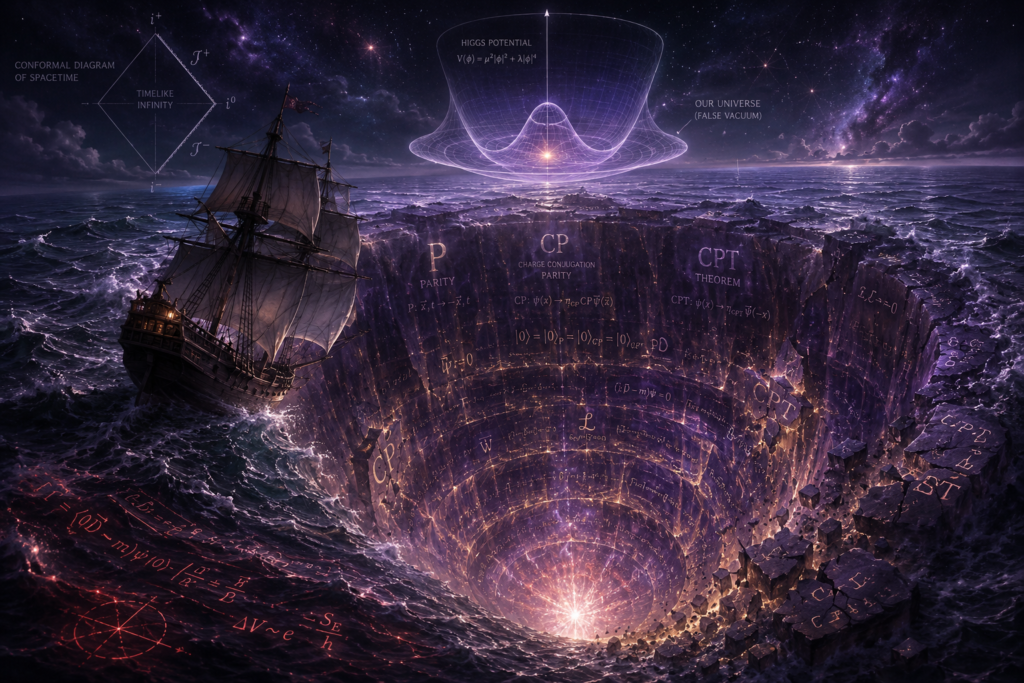
🌊 The False Vacuum and the Chasm at the Bottom of the Dirac Sea
And now we come to the most unsettling, yet also the most exciting, possibility.
In quantum field theory, the vacuum is not empty – it is the ground state of all fields. It is the lowest energy the universe can have. But what if that ground state is not the true ground state? What if it is merely a false vacuum – a metastable valley in the energy landscape, not the true minimum?
In our picture of the Dirac Sea, the ground state of the vacuum is the seafloor. It is the foundation upon which everything rests – all the waves, all the currents, all the vortices, all life. We sail the sea believing that the bottom is stable. That the sea is safe.
But what if the bottom is not stable? What if beneath it there is a chasm – a fissure in the very fabric of spacetime that leads toward a deeper, true minimum?
The Higgs potential, with its Mexican-hat shape, suggests that our vacuum may be precisely such – in an indifferent equilibrium on the edge between stability and catastrophe. The Higgs boson mass of 125 GeV is, according to some calculations, right at the boundary separating a stable vacuum from a metastable one. As if the entire universe were balanced on a knife’s edge.
What would happen if the chasm were to open?
The consequences would be unfathomable. The false vacuum would collapse into the true vacuum. Enormous energy would be released. The laws of physics as we know them – including those that depend on CPT symmetry – could change. It would be an event comparable to a new Big Bang.
Or – and this is perhaps an even deeper possibility – it would reveal that we are part of something larger. That our sea is merely one limited basin in an infinite ocean. That there exists an entire universe beneath our universe, and that the chasm is only a door leading to it.
Perhaps this is precisely the mechanism that enables a new eon. In Penrose’s Conformal Cyclic Cosmology, the end of the old eon and the beginning of the new occur through conformal rescaling. But what if the trigger for that transition is precisely the collapse of the false vacuum? What if the Big Bang is merely the moment when the chasm at the seafloor opened and swallowed the old eon, creating space for the new?
In that picture, the violation of CPT symmetry would not be the end of physics. It would be the beginning of a new eon. A signal that the old universe has exhausted its possibilities and that it is time for a reset – for a new sea, new waves, new stars, new life.
🔮 Epilogue: To Dive Deeper
If the bottom of the Dirac Sea is unstable, if there exists a chasm leading to the true vacuum, then our voyage cannot stop at the surface. We must dive deeper.
That is what Dirac always said: do not accept superficial answers. Do not settle for renormalization, tricks, approximations. Seek the natural mechanism. Seek what lies beneath.
The new physics – the physics that will explain why matter defeated antimatter, why the Higgs mass is exactly what it is, why dark energy is so small – perhaps lies precisely there, in the chasm. In what happens when symmetries fall and the false vacuum collapses.
And as long as there are explorers willing to dive deeper – into the sea, into the mathematics, into the mystery – our voyage continues.
For perhaps we are only waves on the surface of one limited basin, dreaming of the ocean beneath. And perhaps it is precisely that longing for the deeper – that which makes us human.
The sea is always clear. The horizon is always open. And beneath the bottom – a chasm awaits.
This post continues the series begun with “⚛️ Quantum Archaeology: Reading the Past from the Dirac Sea”, continued through the map of the quantum odyssey, posts on the observer paradox, Bohmian mechanics, quantum complexity, eigenstate thermalization, entropy, and infinities.
Leave a Reply