
When we think of human ancestors, the first things that come to mind are Neanderthals or “primitive” people from the Stone Age. But there is one species that, although less known to the general public, was far more successful and long‑lived than all the others – Homo erectus.
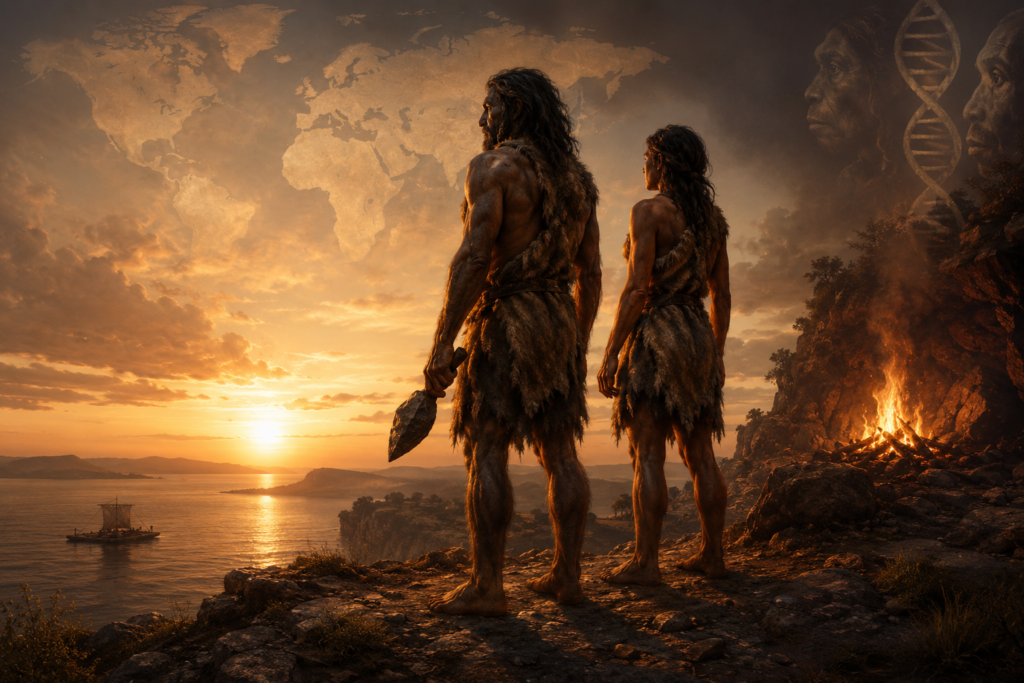
This fascinating species, which dominated the planet for almost 2 million years, was the first true “global traveller”, the first firefighter, the first raft builder, and perhaps even the first warrior. And what is most incredible – its traces still live on in us.
⏳ The Longest‑Lived Human Species: From Africa to the Pacific
Homo erectus first appears in Africa around 2 million years ago, and the youngest known fossils come from the Indonesian island of Java, dating to just 108,000 years ago. This means the species survived an incredible 1.9 million years – making it the longest‑lived hominin species in the fossil record.
For comparison, our own species, Homo sapiens, is currently “only” about 300,000 years old.
Mark Maslin of University College London points out that H. erectus was “by many measures an extremely successful species – in terms of longevity, population size, geographic spread and its ability to adapt to new environments”.
This longevity was no accident. H. erectus possessed a range of traits that allowed it to survive and thrive in diverse environments – from African savannas to Asian forests and cooler European regions.
🗺️ The First True Explorer: How Homo erectus Conquered the World
Homo erectus was the first human species to leave Africa. Its fossils have been found across Asia, Europe and Africa, and its presence has even been confirmed on remote islands such as Java.
The oldest evidence of H. erectus outside Africa comes from Dmanisi in Georgia, dated to 1.8 million years ago – only 200,000 years after the species first appeared in Africa. By 1.5 million years ago, H. erectus had already reached Java in Indonesia, and later China.
This was an unprecedented feat in the history of life on Earth. To cross thousands of kilometres through different climates, H. erectus had to develop adaptability, intelligence and social organisation unseen until then.
⚒️ Master of the Stone Age: The Acheulean Revolution
Homo erectus did not use just any tools. It produced Acheulean stone tools – characteristic bifacially worked handaxes (bifaces) that represented a huge technological leap compared to the simple Oldowan tools of earlier hominins.
These tools, which appear about 1.76 million years ago, were standardised, symmetrical and specialised. They were not only for cutting and scraping – they were the first purpose‑designed tools in history.
Some scientists believe that Acheulean handaxes also had a symbolic function, perhaps as status symbols or trade items, pointing to a more complex consciousness and social relations than previously thought.
🔥 Controlling Fire: When Did H. erectus Light the First Campfire?
The question of fire use by H. erectus is one of the most debated in palaeoanthropology. Most scientific evidence indicates that early humans (H. erectus) began to use fire controllably at least 400,000 years ago (sites in China and Kenya).
But there are much older claims. Finds from Richardsfeld in South Africa suggest that hominins (probably H. erectus) used fire controllably as early as 1.7 to 2.0 million years ago. This discovery has attracted great attention, but scientists cautiously note that it still needs to be confirmed by detailed geochemical analyses to rule out the possibility of bushfires.
Regardless, the fact is that H. erectus, especially in the later phases of its existence, certainly knew how to use fire. Fire allowed it to keep warm, cook food (which reduced digestive costs and enabled brain growth), protect itself from predators and expand its range into colder areas.
🚣 The First Seafarer: Rafts to Lost Islands
Perhaps the most astonishing ability of Homo erectus is its seafaring skill. Fossils of H. erectus have been found on remote islands that were always separated from the mainland by water – most notably on Flores in Indonesia.
To reach Flores, early humans had to cross sea channels, which required deliberate construction of rafts and journey planning. Most scientists today believe that H. erectus indeed developed the ability to build simple watercraft as early as around 700,000 years ago.
This was not an isolated feat. Traces of H. erectus have also been found on some Mediterranean islands, further confirming its incredible ability to adapt and overcome the greatest natural obstacles.
⚔️ Wars and Cannibalism: The Dark Side of Prehistory
Although we have no direct evidence of “wars” among H. erectus, scientists believe that competition for resources and territories may sometimes have led to conflict. Physical evidence (e.g., mass graves with signs of violence) for H. erectus does not exist, but indirect indicators suggest the possibility of intergroup violence.
On the other hand, there is somewhat clearer – though still indirect – evidence for cannibalism. At the site of Gran Dolina in Atapuerca (Spain), remains of several hominins (most likely Homo antecessor) with cut marks were found, interpreted as evidence of survival cannibalism. Although these remains are not directly H. erectus, they belong to a related species and indicate that cannibalism may have been present among early humans as well.
🧬 Traces in Our DNA: How H. erectus Still Lives in Us
One of the most exciting discoveries of modern palaeogenetics is that modern humans carry genes from Neanderthals, Denisovans and other ancient hominins.
Eurasians carry 1–4% Neanderthal DNA, while some populations (e.g., Melanesians) carry 3–6% Denisovan DNA. In addition, genomic studies have revealed several other unidentified ancient components in the DNA of modern humans.
Although there is no direct evidence of interbreeding between Homo sapiens and Homo erectus, the DNA of some modern humans (especially from Asia and Oceania) contains fragments that cannot be explained by interbreeding with Neanderthals or Denisovans alone. Some scientists claim that up to 2.5% of the genome of South Asians comes from an ancient hominin, possibly H. erectus.
This is an area of active research, and as DNA sequencing technology advances, we can expect even more surprises.
🔬 Why Was H. erectus So Successful?
The success of H. erectus lay not only in its technology but also in its brain and social organisation.
Its brain was significantly larger than that of earlier hominins (on average 850–1100 cm³, compared to 400–500 cm³ in Australopithecus). This brain expansion enabled it to develop more complex behaviour patterns, including planning, cooperation and communication.
H. erectus probably lived in larger and more complex social groups than earlier species. These groups may have had division of labour, coordination in hunting and transmission of knowledge across generations – key characteristics of human culture.
🔄 From H. erectus to Us: A Complex Graph, Not a Linear Path
For a long time we thought human evolution was linear: Australopithecus → Homo habilis → Homo erectus → Homo sapiens. Today we know that reality is far more complex.
Instead of a linear sequence, we have a complex graph in which multiple hominin species lived simultaneously, interbred, competed and went extinct. In that graph, H. erectus occupied a central place: it was the “axis” around which many other species revolved.
Some scientists now consider H. erectus to have been an extremely variable species, including several subspecies (H. e. georgicus, H. e. pekinensis, H. e. soloensis). Recent skull analyses from Dmanisi show great morphological diversity, leading some to propose that African and Asian specimens of H. erectus should be classified as separate species: Homo ergaster (Africa) and Homo erectus (Asia). Nevertheless, most palaeoanthropologists still use the name H. erectus for all these fossils, acknowledging their great internal diversity.
✨ Conclusion: The Forgotten Giant That Shapes Our World
Homo erectus was not just another “primitive” human. He was the first true global traveller, the first firefighter, the first raft builder, the first master of stone tools, and perhaps even the first warrior. His incredible longevity, adaptability and technological innovation laid the foundations for everything we are today.
Although his species died out more than 100,000 years ago, his traces still live in us – in our DNA, in our intelligence and in our ability to explore, adapt and conquer new worlds.
The next time you look at the starry sky, remember: before humans flew into space, before they built the first cities, before they wrote the first books – Homo erectus was already conquering the world, step by step.
Nature, it seems, hid its most persistent explorer in the distant past, but his spirit still lives in each of us.
☕ If you wish to support topics like this – research at the intersection of palaeontology, genetics and curiosity – you can buy me a coffee. Every contribution goes directly into research, books and unpaid hours.
buymeacoffee.com/milovaninnovation
Thank you for being part of this story.
Leave a Reply