
When we say “canary in the coal mine,” most of us think of a metaphor – an early warning, a signal that something is wrong. But before it became part of our language, the canary was a living alarm, a small, yellow guardian that paid for miners’ safety with its own life.
This is the story of how one bird, thanks to its extraordinary sensitivity, became the most reliable gas detector in mines around the world – and how its role shaped not only the history of industrial safety, but also our language, culture, and the way we think about danger.
⚒️ Why the Canary? The Science Behind the Small Body
Canaries were chosen for this dangerous duty for one simple but essential reason: extraordinary biological sensitivity.
These small birds have a very fast metabolism and a more efficient respiratory system than humans. They breathe more frequently and transfer gases into the bloodstream more effectively. This makes them extremely sensitive to:
- Methane (CH₄) – the main component of “firedamp”. It is not poisonous in itself, but displaces oxygen from the air, causing suffocation, and is highly explosive when mixed with air.
- Carbon monoxide (CO) – a colourless, odourless and deadly gas produced during fires or explosions. It binds to haemoglobin in the blood much more strongly than oxygen.
While a miner might breathe in dangerous gases without noticing, the canary would react much faster. Its small body simply could not tolerate what the human body could still endure.
🗓️ History: From 1896 to 1986
The idea of using animals for gas detection in mines was first seriously considered after a series of mining disasters in the late 1890s. Scottish physiologist John Scott Haldane examined the bodies of miners killed in explosions and determined that the cause of death was carbon monoxide poisoning. In 1895, he first proposed using warm-blooded animals to detect this insidious gas.
The first canaries in mines appeared as early as 1896. By 1906, English miners were already regularly using canaries to safely enter mines after explosions. Soon after, British law required miners to “take two small birds in cages” with them into the pits.
The practice lasted for decades. Canaries were the only gas detectors miners had. It was not until 1986 that this practice was officially ended in the United Kingdom, when the birds were replaced by electronic detectors with digital readouts. More than 200 canaries were then retired from service.
🔬 How Did It Work? The Living Alarm
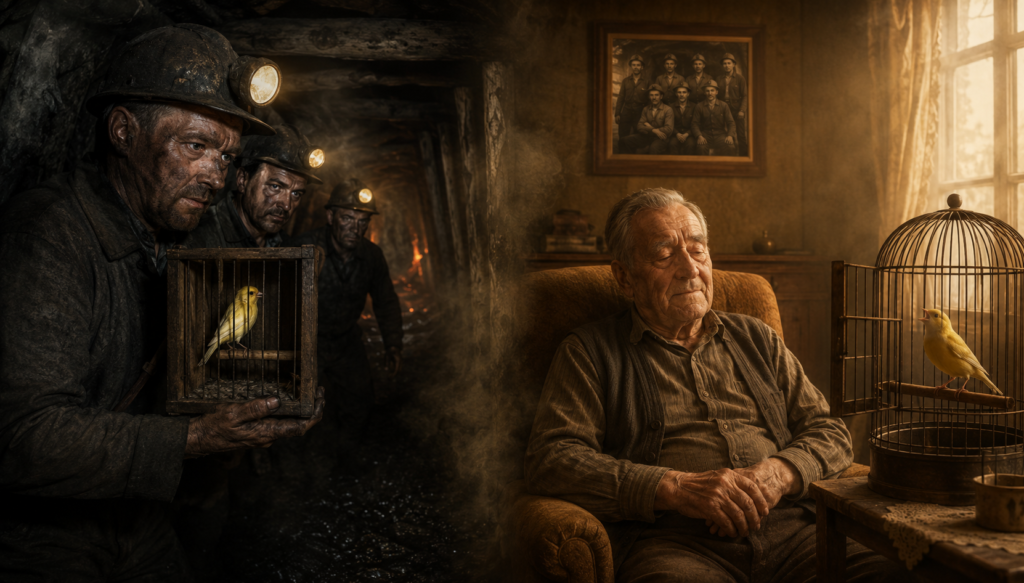
A miner would take a canary in a small cage to the front of the working face. The cage was often designed so that it could be closed with a glass lid for emergencies.
The principle was simple but harsh:
- As long as the air was clear, the canary would sing – a sign that all was well.
- When methane or carbon monoxide appeared, the bird would stop singing and become restless.
- Then it would stagger and fall from its perch.
- Finally, it would lose consciousness or die.
The fall of the canary was an immediate and clear warning. Miners then had seconds or minutes to react – to rush out, activate ventilation, or try to extinguish a possible fire.
Sometimes they managed to close the cage and revive the bird in fresh air – if the exposure had been brief. But many canaries died in service.
💔 A Sad Duty: When an Animal Became a Colleague
Miners often developed an emotional bond with their canaries. They did not see them just as tools, but as colleagues and rescuers. Stories of canaries that survived several “accidents” became legendary within their teams.
This bond was not just sentimental – it was practical too. A miner who loved his canary paid closer attention to its behaviour, noticed signs of danger earlier, and thus increased the chances of survival for the whole group.
🐭 Not Only Canaries: Other Animals in Mining Service
Although the canary became the symbol, it was not the only one. In some mines, particularly in Colorado, mice were used. In other regions, other small birds were occasionally used. But the canary was the most common – partly because of its availability, partly because of its sensitivity, and partly because its singing was a clear sign that the air was good.
📖 The Metaphor That Outlived the Practice
Although canaries were withdrawn from mines in 1986, their metaphor remained.
“Canary in the coal mine” today means an early warning – something that first shows signs of trouble in any system or environment. It is used in economics, politics, ecology, technology and the arts.
But unlike the metaphor, the real canaries were not symbols – they were living beings that paid the ultimate price.
🕊️ A Family Story: When the Canary Sang to the End
Finally, I cannot help but share a personal story.
My grandfather, towards the end of his life, had a canary. Since in his youth he was a partisan and a fighter for workers’ rights, this bird was in tune with his beliefs – working-class, mining, fighting. The canary died before my grandfather did. As if it had been a warning for him too.
What was particularly interesting was the canary’s behaviour in those last days. It sang beautifully, but could not stop. Almost manically. Constantly, as if it sensed something.
Science today can explain this. Birds are extremely sensitive to changes in barometric pressure, electrostatic fields, infrasound and chemical changes in the air. My grandfather may have been very ill, and his body emitted specific biochemical signals that humans do not notice, but which could have agitated the bird. “Manic” continuous singing may have been the bird’s equivalent of anxiety – ritualised behaviour to calm its fear.
In our family’s narrative, the canary fulfilled its final duty. First it warned miners (my grandfather’s generation) of physical danger in the dark. And in the end, it warned my grandfather of the approach of something else. Its death was a “test alarm” for what was to come.
🏁 Conclusion: More Than a Metaphor
The canaries in the mines are not a myth – they are a harsh reality of the industrial age. They were sacrificial animals whose extraordinary biological sensitivity served as the earliest possible alarm, saving countless human lives at the cost of their own.
Their role is a powerful reminder of:
- The dangers of mining – and the price people paid to extract coal.
- The creative measures that people took to survive in extreme conditions.
- The emotional bond between humans and animals – even when that animal was a “tool”.
The story of the canary that sang to its last breath and its death as a portent of a man’s death tells us that technology, no matter how precise, cannot capture that subtle, biological, almost psychic connection that existed between a living alarm and the human it guarded.
It brings us back to respect for nature and intuition. To what we cannot measure with sensors, but can sense – if we are attentive enough.
☕ If you wish to support topics like this – research at the intersection of history, biology and curiosity – you can buy me a coffee. Every contribution goes directly into research, books and unpaid hours.
buymeacoffee.com/milovaninnovation
Thank you for being part of this story.
Leave a Reply