
Dear explorers,
In our previous voyages we have grown accustomed to questioning the very foundations. We have questioned the nature of time, the objectivity of reality, and the structure of the vacuum. But today we sail toward one of the boldest heresies of modern physics – toward the idea that gravity – the very thing that holds galaxies together and smooths the waves of the Dirac Sea – is not what Einstein described it to be.
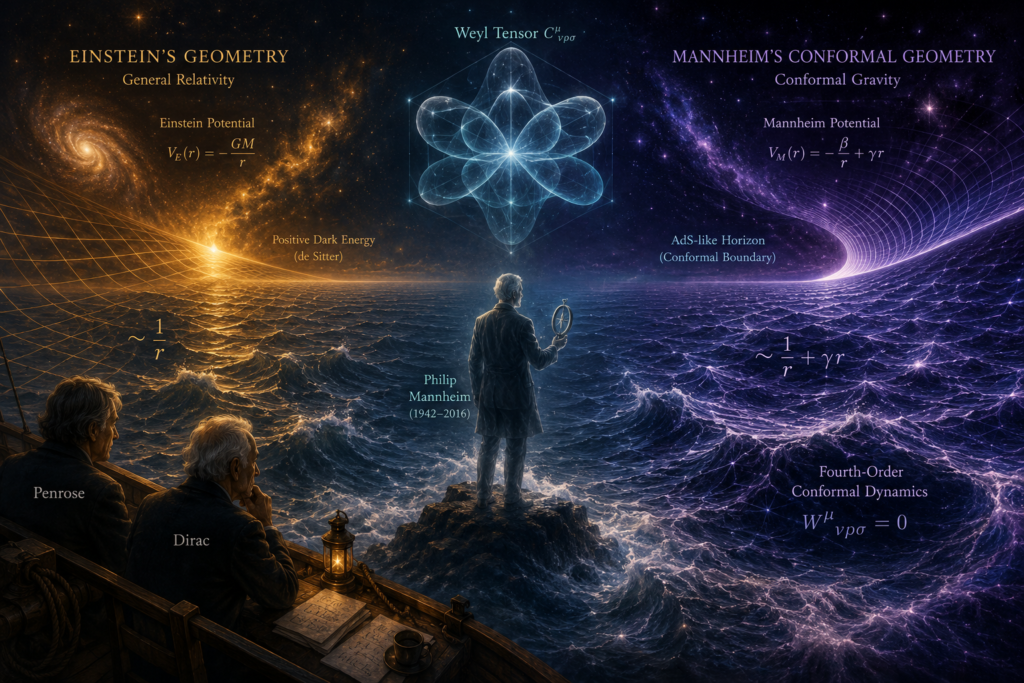
Philip Mannheim is one of those rare physicists who dares to question even the most deeply rooted assumptions. He is not merely seeking a new particle or a new energy; he is seeking a new geometry. His conformal gravity proposes a different mathematical structure for the gravitational field, and it is at once magnificent and contentious – because, as you yourself intuited, it sounds “too good to be true”.
🌌 The Status of λ in Standard Cosmology – What Do We Really Measure?
Before we set sail into Mannheim’s waters, we must recall why the current standard model of cosmology (ΛCDM) is so robust. It rests on three pillars.
The first pillar is Type Ia supernovae. At the end of the 1990s, two independent groups of scientists led by Riess, Perlmutter, and Schmidt discovered that the expansion of the universe is accelerating. Within the framework of General Relativity with a homogeneous and isotropic universe, accelerated expansion implies a positive effective cosmological constant – dark energy with negative pressure . For this discovery they were awarded the Nobel Prize in 2011.
The second pillar is the cosmic microwave background (CMB) . Data from the Planck satellite measure the curvature of space as extraordinarily close to zero (). Combined with accelerated expansion, this favours a positive Λ.
The third pillar is baryon acoustic oscillations (BAO) – remnants of sound waves from the hot plasma of the early universe, which, due to the expansion and cooling of the universe, were “frozen” into large-scale structures in the distribution of galaxies. They act as a true cosmic “ruler” and also consistently point toward .
Thus, all standard interpretations of the existing data indicate a positive effective cosmological constant. But here the key word is “effective” – for Mannheim calls into question precisely the framework within which these data are interpreted.
🎻 Mannheim’s Conformal Gravity – Why a Negative λ?
Mannheim’s theory departs from a fundamentally different gravitational action. Instead of the standard Einstein-Hilbert action:
(where is the Ricci scalar, a measure of the curvature of space, the gravitational constant, and the determinant of the metric tensor), Mannheim proposes a conformally invariant action based on the Weyl tensor:
This action is invariant under local conformal transformations . From it are derived equations of motion of the fourth order in derivatives of the metric, unlike Einstein’s second-order equations.
What does this mean for cosmology? Mannheim shows that the solutions of these equations for a homogeneous and isotropic universe naturally contain a linear potential alongside the standard Newtonian term. In the cosmological context, the effective cosmological constant can be negative – not in the sense of the standard , but as a consequence of the global conformal structure.
His key argument is that dark energy is not an independent component of the universe, but a manifestation of gravitational physics on large scales (the term) that deviates from Einstein’s. In his picture, what we interpret as in standard cosmology is actually an approximation valid only on certain scales; globally, conformal gravity favours an AdS phase (anti-de Sitter space with negative curvature).
Why is this appealing? AdS space has fantastic mathematical properties: a conformal boundary, a well-defined AdS/CFT correspondence, holographic duality. In AdS, things converge, infinities are “tame” and renormalizable, and quantum gravity becomes “tameable”. Mannheim essentially says: if we want a consistent quantum theory of gravity, perhaps the universe at a fundamental level is AdS, and what we see as accelerated expansion is an effective phenomenon.
⚖️ Elegance and Abysses – Challenges for Conformal Gravity
However appealing this picture may be, there are serious challenges.
The observational evidence for Λ>0 is enormous. Although Mannheim can reproduce some aspects of accelerated expansion without a positive (through non-trivial fourth-order effects), it is necessary to fit all the data precisely – supernovae, CMB, BAO, structure growth. Most cosmologists consider that Mannheim’s models have not yet demonstrated that they can encompass the entire data set at least as well as ΛCDM, with a comparable number of free parameters.
The problem of ghosts. Fourth-order theories in derivatives of the metric suffer from Ostrogradsky instability pointed out by Ostrogradsky as early as the mid-19th century – the appearance of ghosts, that is, degrees of freedom with negative kinetic energy, leading to vacuum instability. Recall our voyage with Turok: he boldly took the fourth derivative and placed the ghosts in Krein space, above the Dirac Sea. Mannheim claims that conformal symmetry eliminates ghosts, but this remains a subject of lively debate. Are ghosts a banishment from which gravity must redeem itself, or are they the wind that keeps the sea alive?
Susskind and the “problem of de Sitter”. Leonard Susskind spent decades building the holographic framework in AdS and was aware that our universe is not AdS. His acknowledgment that it is time to develop a theory for de Sitter (dS) space comes from the recognition that AdS/CFT is incredibly powerful, but that its application to our world is an analogy, not an identity. Susskind practically admitted that one cannot forever run from the fact that we live in a world with a positive . Mannheim’s answer – that is “actually” negative at a fundamental level – may appear as an elegant evasion of this problem.
🔗 Where Mannheim Meets Penrose and Mirror Matter
All this notwithstanding, Mannheim’s undertaking is not in vain, and his resemblance to Penrose is no accident. Both reject standard Einsteinian gravity as the final word – Penrose through OR and the modification of quantum mechanics, Mannheim through conformal gravity. Both seek a deeper principle of symmetry – for Penrose it is the conformal geometry at the beginning and end of the universe (CCC), for Mannheim it is the local conformal invariance of the gravitational action itself. And both are sceptical of string theory and seek alternative paths.
Where does this fit into our broader picture?
The Dirac Sea as a conformal film. If gravity is fundamentally conformal, the Dirac Sea (the vacuum of quantum field theory) could have a more natural place in such a geometry. Conformal transformations rescale energies, so the difference between positive and negative frequencies – and hence the definition of a particle – becomes part of the symmetry, not a fixed structure. The sea would not be absolute; it would breathe in accordance with conformal transformations.
Mirror matter and negative Λ. Tan’s models of mirror matter often use additional sectors with their own vacuum energies. If one sector (the mirror sector) has a negative contribution to the effective Λ, it is possible for the total Λ to be small and positive, but for the fundamental signature to yield an AdS picture. This would be a bridge between Mannheim and mirror theory – though for now it is a bold speculation.
Penrose’s OR and conformal gravity. If OR breaks the superposition of geometries, perhaps it is precisely the conformal degrees of freedom (those that determine the light causal cones) that undergo collapse. Mannheim’s theory, which favours conformal symmetry, could provide a natural framework for OR without the need for additional postulates. The wind that smooths the waves may be precisely the conformal wind.
🔭 Are There Hints of a Negative Λ?
The short answer: not directly. There is no credible observational result suggesting that the fundamental cosmological constant is negative. What does exist, however, are a few indirect tensions that could open up space for alternative gravitational theories such as Mannheim’s.
The Hubble tension. Different methods of measuring the Hubble constant () yield values differing by 4–5 sigma (CMB vs. supernovae/Cepheids). This may indicate the need for a modification of the standard model – either in the dark energy sector or in the gravitational sector.
The S₈ tension. Measurements of the clustering of matter on large scales (weak lensing, galaxy clusters) yield slightly lower values of the parameter than predicted by ΛCDM. This opens up space for new physics.
Thus, there are cracks in ΛCDM, but they are small and open space for various alternatives, not only for Mannheim’s. Most of those alternatives retain a positive effective .
⚠️ The Final Danger – Elegance Without Observational Confirmation
We return to your central concern: too good to be true. The history of physics is full of elegant theories that are mathematically impeccable but were simply discarded by nature. Mannheim’s conformal gravity has many virtues: it solves the problem of singularities, naturally incorporates dark energy and dark matter as effects of the same geometry, offers a potentially consistent framework for quantization. But its key problem is the same as for string theory: it has no unique, irrefutable prediction that would distinguish it from the standard model in a way we can test now or in the foreseeable future.
ΛCDM with a positive stands firm, despite the tensions. Susskind admits: we must face the positive cosmological constant, however unpleasant it may be for mathematical elegance. Nature, it seems, has chosen de Sitter – and why, that is a question that has yet to receive an answer.
⛵ Epilogue: A Sea That Recognises No Dogmas
Mannheim’s symphony is a reminder that our journey is not over. Einstein’s gravity is magnificent, but perhaps it is not the last word. Perhaps it is only the first stanza in a score yet to be played. And the Dirac Sea – that infinite, fluctuating field from which everything emerges – perhaps awaits precisely such a conformal gravity to reveal its deepest secrets.
As we sail on, let us remember that both Einstein and Dirac were mariners who dared to question dogmas. Mannheim is one of the rare ones who continues that tradition. And regardless of whether his theory is the final truth or only an elegant episode, it compels us not to sink into complacency.
For as long as there are mariners ready to sail beyond the boundaries of the known, the horizon will always be open. And the Dirac Sea – the Dirac Sea never recognises dogmas.
The sea is always clear. The horizon is always open. And true gravity – perhaps has yet to be discovered. 🌊🔮💫
This post continues the series begun with “⚛️ Quantum Archaeology: Reading the Past from the Dirac Sea”, continued through the map of the quantum odyssey and all our previous voyages.
Leave a Reply