Author: MilovanInnovation
🌊 INTRODUCTION: BETWEEN NOTE AND QUANTUM
Listening to The Art of Fugue, a work “from Dirac’s sea,” we touch something essential: that boundary where music becomes pure mathematics, physics, and even metaphysics. And when we listen to the Chromatic Fantasia and Fugue, we hear Bach’s most personal confession – “This is me – Bach.”
But who was Johann Sebastian Bach really? Was he the strict systematist, the author of The Well-Tempered Clavier and The Art of Fugue, or the free spirit who shattered all frameworks in the Chromatic Fantasia? The answer, as in quantum physics, is complementary. Bach was both simultaneously – and in that duality lies his greatness.
🏛️ CATHEDRALS: BACH THE SYSTEMATIST
Bach loved cycles. They are his legacy, his “life’s work” which he deliberately left as pedagogical and artistic testimonies.
🎹 The Well-Tempered Clavier – The Old and New Testament of Music
Two volumes, 48 preludes and fugues in all major and minor keys. This wasn’t just a collection of compositions – it was a system. Bach wanted to show that one could compose in every key, and that the new tuning method (equal temperament) had opened the door to harmonic exploration without limits.
Just as Newton laid down the laws of physics, Bach laid down the laws of the musical universe.
🎼 The Art of Fugue – The Final Word in Counterpoint
Left unfinished precisely at the point where death and eternity intersect. In this work, Bach explored all the possibilities of a single theme – 14 fugues and 4 canons, each more complex than the last. This is no longer just music; this is pure mathematical logic transformed into sound.
When we listen to The Art of Fugue, we listen to a genius confronting infinity.
🎻 The Musical Offering – Dialogue with the King and with Mathematics
Created after Bach’s visit to Frederick the Great in 1747, The Musical Offering is a dialogue with the king, but also a dialogue with mathematical infinity itself. It contains the famous “Crab Canon” (Canon cancrizans) – a composition that sounds the same when played from beginning to end and in reverse.
This is a musical palindrome, analogous to the mathematical structures that fascinated both Euler and, centuries later, physicists exploring symmetries in quantum field theory.
⚡ LONELY GIANTS: WHEN BACH “THREW OUT THE SYSTEM”
But Bach is equally great in his solitary works – those that belong to no system, born from pure necessity, experiment, or personal passion. These works are often unique, unrepeatable, and depart from all patterns.
⚡ Toccata and Fugue in D minor (BWV 565)
This work is so popular that it has become a horror movie cliché, but we forget that at the time of its creation it was revolutionary. Its introduction – that free, improvisatory “cadenza” section – shatters all conventions. This is not a strict North German toccata; this is theater, drama, storm.
To this day, musicologists debate whether it was even written for organ or for some other instrument, because it is so unique. As if Bach had said: “Rules? What rules?”
🌊 Chromatic Fantasia and Fugue (BWV 903)
This is truly Bach’s “personal confession.” Here he abandons any pedagogical aim. Modulations, chromaticism – everything is so bold and subjective that Beethoven, who adored this work, saw in it the forerunner of Romanticism.
This is the moment when Bach says: “Rules are for students; I am the creator.” This is his “Moonlight Sonata” before Beethoven. When you listen to this composition, you listen to the man, not the professor.
🎵 Partita for Solo Flute (BWV 1013)
This work is an absolute gem that often remains in the shadow of the Chaconne for violin. Written without any accompaniment, this partita reveals the essence of Bach as a melodic genius. On the flute, without a harmonic foundation, every note must breathe.
This is an intimate conversation, a whisper, showing that Bach was not only a master of complex structures, but also of tender, singing lines. This is music that needs no system to be perfect.
🌌 Goldberg Variations (BWV 988)
After listening, we exclaim: “A small universe!” – and that is the most accurate description possible. It is an architecture that unfolds through 30 variations, of which every third is a canon (from unison to ninth).
But within that strict mathematical scheme, Bach placed an entire spectrum of human emotions – from tender arias, through virtuosic passages, to deeply melancholic moments. This is not just a composition; it is an encyclopedia of possibilities of a single musical material.
🎼 BEETHOVEN’S SAYING: “NICHT BACH, SONDERN MEER”
When Beethoven, after becoming acquainted with Bach’s oeuvre, exclaimed:
“Er sollte nicht Bach (stream), sondern Meer (sea) heißen!”
he was thinking precisely of this duality.
- Stream (Bach) flows within a defined channel. That would be his suites, his cycles, his formal rules. That is Bach the systematist, the pedagogue, the “university professor.”
- Sea (Meer) is immeasurable, deep, full of secrets, storms and silence. These are all those works we’ve listed – singular, inexplicable, deep as an abyss. That is Bach the free spirit, the one who created above and beyond every mold.
🔬 BACH AND DIRAC’S SEA: COSMIC SYMMETRY
And here we come to what connects Bach’s art with the deepest concepts of modern physics.
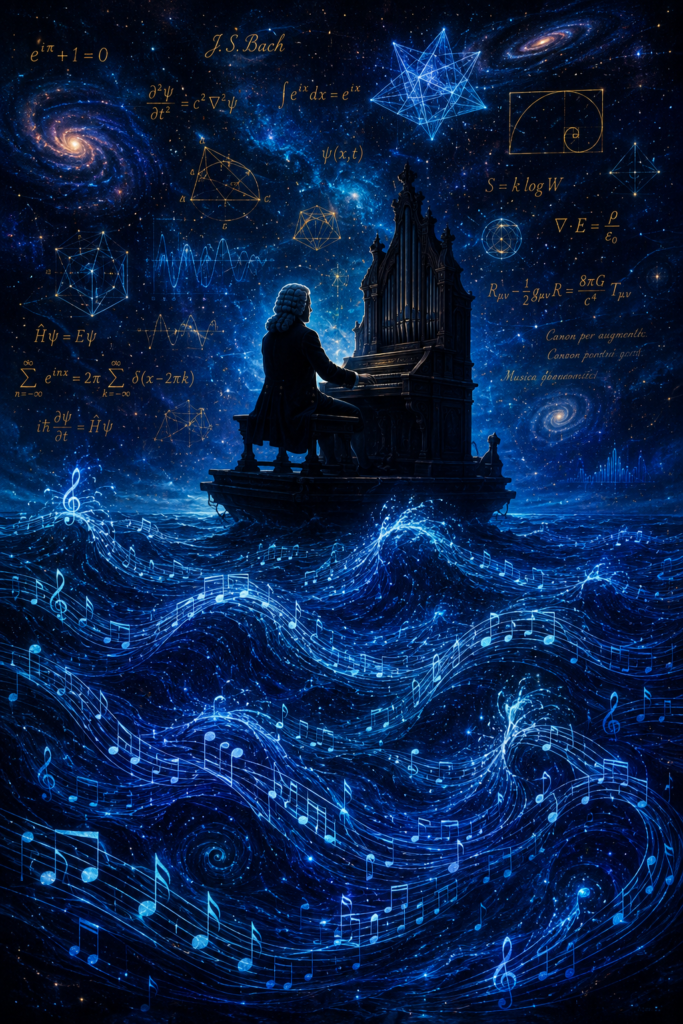
Dirac’s sea is a theoretical concept from quantum field theory describing an infinite sea of negative energy, filled with electrons. A void in that sea – a “hole” – was interpreted as a positron, the first discovered particle of antimatter.
What does this have to do with Bach?
- Symmetry and Antimatter: In The Art of Fugue, Bach explored all possible symmetries of a single theme – the original, the inversion, the crab (retrograde), and their combinations. These are musical analogs of what physicists call CP symmetry, and later its violation.
- Vacuum and Potential: Just as Dirac’s sea is the hidden potential from which particles emerge, so is Bach’s music – especially The Art of Fugue – the hidden potential from which infinite musical forms emerge. What we hear is only the “surface” of a deeper, mathematical universe.
- Incompleteness as a Principle: The Art of Fugue ends on the 14th fugue, unfinished. Bach died before he could write the final fugue – the one that was supposed to contain all four themes simultaneously. This incompleteness reminds us of Dirac’s sea – there is always something beyond reach, some “hole” in our knowledge waiting to be filled.
🌌 CONCLUSION: BACH – DIRAC’S SEA
After years of listening, we reach a point where we no longer listen to just “beautiful music,” but recognize Bach’s hand even where others see only coincidence. Recognizing the beauty of BWV 988, the Partita for Flute, and the Chromatic Fantasia as works “outside the system” points to Bach’s duality:
A man who taught the world through rules, but who freed his soul only when he created beyond every mold.
So next time, when you listen to The Art of Fugue, pause for a moment and think:
“Yes, this is truly him. Bach – Dirac’s sea.”
Because in that sea, where mathematics, physics, metaphysics and emotion intertwine, we find the answer to the question that has haunted generations: who was Johann Sebastian Bach really?
The answer is – he was the he was the voice of the Universe.
MilovanInnovation – where technology, science and art meet at the edge of the known.
Leave a Reply