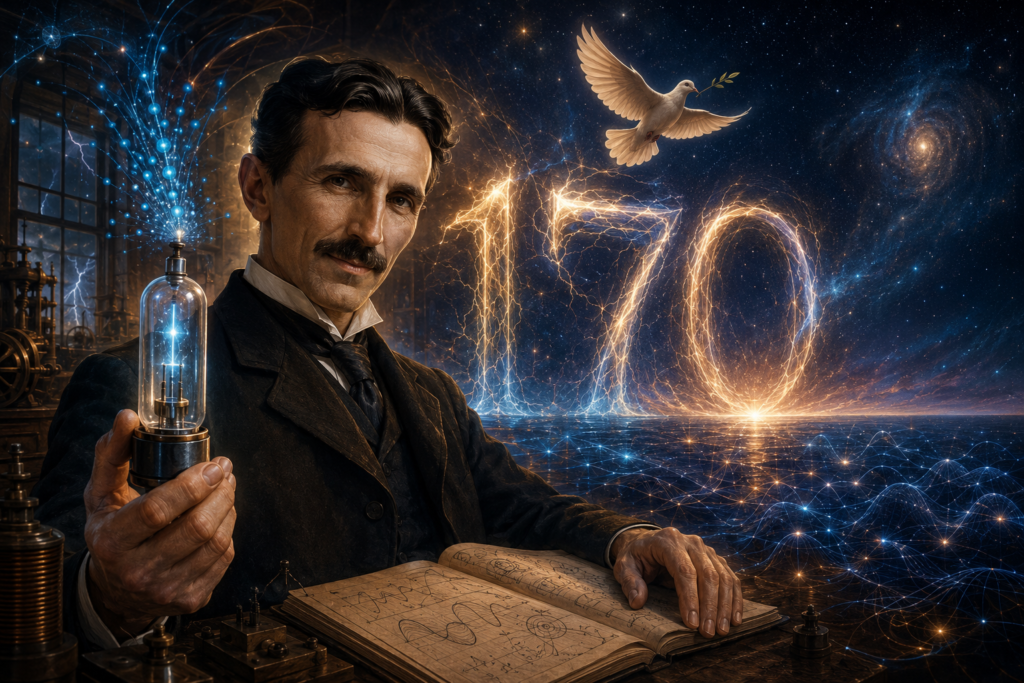
Today, July 10, 2026, marks the 170th anniversary of Nikola Tesla’s birth. Instead of a conventional celebratory text, I dedicate this birthday special to the real Tesla – a man whose experimental genius outpaced his era, but whose theoretical limitations were, paradoxically, part of his greatness. In this omnibus narrative, we blend human warmth and scientific grounding, just as we built the entire series.
🔬 The Electron: Prophetic Experiment and Rejected Theory
Few know that Tesla, experimenting with his vacuum tubes as early as 1891, observed particles carrying current – what would later be called the electron. He published observations of “molecular bombardment” by charged particles inside high-voltage tubes in a professional journal. It was a crucial hint at subatomic particles.
Yet, the official discovery of the electron is credited to J.J. Thomson, Tesla’s peer born in the same year, 1856. In 1897, Thomson made precise measurements of the charge-to-mass ratio and confirmed a particle smaller than the atom, earning the 1906 Nobel Prize.
The irony is that Tesla, who had contributed to that discovery with his own hands, rejected the idea of the electron as a constituent of every atom to the end of his life. Trained in the classical physics of the Austro-Hungarian Empire, for him the atom was the smallest, indivisible particle of matter – as defined by 19th-century physics. Electricity could not be a stream of tiny balls hopping from atom to atom; it was a fluid, a strain in the ether. What he observed in his tubes he considered a byproduct of gas ionization under extreme voltage, not a fundamental building block of nature.
This gap between his experimental genius and the theoretical formalism he refused to accept defines the entire Tesla. He knew how to build the future, but he didn’t always know how to name it.
🌊 Ether, Waves, and the Quest for Infinite Range
Tesla’s understanding of the world rested on Faraday’s concept of fields and Maxwell’s equations – but in their original form, which assumed the existence of the ether, an invisible medium through which electromagnetic waves propagate. Like sound through air, light for Tesla was a wave in a fluid ether. This ether, he believed, possessed elasticity, viscosity, and dynamics – properties which, by analogy with classical fluid mechanics, could explain not only electrical and magnetic phenomena but also gravity and inertia.
That is why Tesla fiercely opposed Einstein’s general theory of relativity, which reduced gravity to the curvature of spacetime. For Tesla, a force had to cause acceleration, not geometry. He also refused to accept that the speed of light was an ultimate limit – at least not for all types of waves. He acknowledged the limit for transverse, Hertzian waves, but believed in the existence of longitudinal waves, which propagate through the ether like sound, do not decay with the square of distance, and whose speed has no upper bound.
His experiments in Colorado Springs and the later work on Wardenclyffe were, essentially, attempts to excite these longitudinal modes – using principles of resonance, standing waves, and the elasticity of a classical fluid. Tesla was no mere dreamer. His approach was based on the physics he had learned and on experimental confirmations he deemed sufficient. And herein lies his uniqueness: his “wrong” ether theory is not pseudoscience, but the last great attempt to describe the universe in the language of classical physics.
Ironically, today’s quantum field theory, with its vacuum seething with virtual particles, the Higgs field, and the Casimir effect, resembles Tesla’s ether more than the empty space of special relativity. But Tesla would not have accepted quantum physics either – because it introduced probability and indeterminism into its heart, which for him, a convinced determinist in the Newtonian spirit, was unacceptable.
🧠 A Materialist Who Sought a Measurable Soul
Although often labeled a mystic, Tesla was a scientific materialist. His interest in Akasha, Prana, and Vedantic philosophy was not an escape into the irrational, but a search for a vocabulary to describe what he felt in his experiments – a single energy field pervading all. When he spoke of spirituality, he believed it could be touched and measured. He famously ridiculed spiritualists and attempts to weigh the human soul. For him, such phenomena were worthy of investigation, but not of blind faith.
Here lies Tesla’s deepest greatness: he embodied the free human spirit – curious, skeptical, liberated from dogma. That is why today one can safely say he would disagree equally with that part of the scientific establishment that behaves like a new inquisition guarding inviolable dogmas, and with the apologists who approach him uncritically, turning him into an idol. Tesla was a man of science in the service of humanity – science that is an open book, whose truths can be verified, proven, but also refuted. His achievements belong to the whole human race, not to a single generation or ideology.
🎯 A Lighthouse That Never Fades
Today, on his 170th birthday, we do not celebrate only a genius. We celebrate a man who knew how to be wrong, how to hold to his convictions even when everyone abandoned him, and how to remain faithful to his vision of a world where energy flows freely and knowledge belongs to all.
His ether may have been discarded, his electrons became someone else’s discovery, and his deterministic picture of the universe was shaken by quantum mechanics. But his method – intuition rooted in experiment, the courage to go against the current, and a love for truth – still shines. Like that lighthouse in the Dirac Sea we wrote about.
Happy birthday, Nikola Tesla. Your story continues – on MilovanInnovation, and wherever curious minds exist.
Join us in continuing this voyage.
Leave a Reply