Dear explorers,
Our long voyage across the Dirac Sea has been a journey through the deepest secrets of quantum reality. We have plunged into negative frequencies, passed through the looking glass of dark matter, and witnessed how the gravitational wind smooths the waves. But now, after touching both the seafloor and the chasm beneath it, it is time to lift our gaze to the sky. For in order to understand why the sea is as it is, we must understand the laws that shape it from above.
Today we return to the very beginning. Not to the Dirac Sea of 1930, but to Dirac’s sky – his formalism of gravity from 1958 and 1959. Papers that laid the foundations for everything that followed in quantum gravity, yet remained in the shadows for decades. This is the story of how Paul Dirac, our quiet captain, set the sails for a voyage that is still unfinished. And of how his old maps may hold the key to escaping the dead end in which contemporary theoretical physics finds itself.
🧭 Dirac as the Silent Architect of Quantum Gravity
In 1958, Paul Dirac published the paper “The Theory of Gravitation in Hamiltonian Form”, and then in 1959 “Fixation of Coordinates in the Hamiltonian Theory of Gravitation”. These papers laid the foundations for everything that followed. The ADM formalism (Arnowitt, Deser, Misner) of 1962 – which remains the standard tool for canonical quantum gravity to this day – directly relies on Dirac’s decomposition of the metric and his identification of primary and secondary constraints. Had history been more just, we would today speak of the Dirac-ADM formalism.
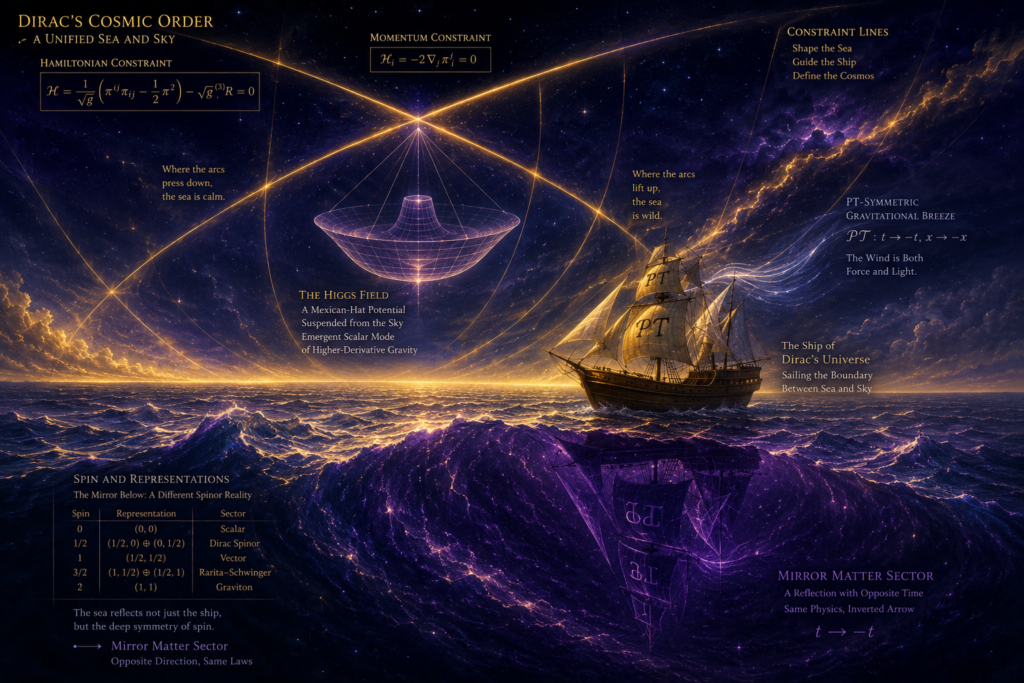
His key innovation was the treatment of general covariance as a gauge symmetry. Unlike internal symmetries (such as SU(2) or U(1)), diffeomorphisms are spacetime symmetries – they mix coordinates. Dirac recognised that this means the Hamiltonian of gravity must be a constraint, not a genuine dynamical quantity. More precisely, he showed that the total Hamiltonian is a sum of four constraints: the Hamiltonian constraint (one per point of space) – the generator of time diffeomorphisms, and the momentum constraint (three per point of space) – the generator of spatial diffeomorphisms.
This directly led to the Wheeler-DeWitt equation , which we have already dealt with in our earlier voyages. But what Dirac truly anticipated with this is that time is not fundamental – it is emergent from the relations among the constraints. In our picture, while the Dirac Sea is the infinite ocean of quantum fields, Dirac’s sky is precisely this set of constraints – the laws that shape the waves from above, the gravitational wind that smooths them. Sea and sky are inseparable.
⚛️ Dirac’s Legacy and PT Symmetry
Here our earlier voyage through the Bermuda Triangle – through Hermiticity and PT symmetry – gains an entirely new dimension. In his constraint formalism, Dirac required that all physical states be annihilated by the constraints. These are the so-called Dirac states: and . Dirac also required that observables be Hermitian and commute with the constraints. He chose Hermiticity as a condition.
But his own work on constraints leaves room for a radically different choice. If the Hamiltonian constraint is non-Hermitian – as suggested by Mannheim’s conformal gravity with higher derivatives – then the Dirac state is no longer defined by the standard inner product. Instead, one introduces the CPT inner product, the very same one we spoke about in the context of Bender’s PT-symmetric quantum mechanics. Physical states are those that have a positive norm in this modified product.
This means the Wheeler-DeWitt equation can be reformulated in a PT-symmetric framework, where the wave function of the universe is not Hermitian in the Dirac sense, but is PT-symmetric. This opens the door to a consistent quantum gravity without ghosts – for what were ghosts in the Hermitian formalism become, in the PT-symmetric one, legitimate degrees of freedom with real energies. Dirac’s sky, then, is not merely Hermitian – it is PT-symmetric. And its “stability” comes from the CPT inner product, not from a rigid demand for Hermiticity.
🎻 Dirac, Mannheim, and Higher Derivatives
Dirac had already worked on conformal transformations back in 1936. His later classification of spin 2 for gravity does not necessarily require Einstein’s second-order action. Mannheim’s theory with the square of the Weyl tensor – with an action of the fourth order in metric derivatives – fits naturally into this framework.
Dirac’s constraint formalism is particularly suited to treating theories with higher derivatives. In the standard formulation, higher derivatives create additional degrees of freedom and complicate the canonical structure. But Dirac developed a general method for such cases – a method that has waited decades to be applied to gravity.
In Mannheim’s theory, instead of a single metric with two polarizations (spin 2 gravitons), we obtain additional degrees of freedom: a scalar mode (spin 0) and a vector mode that can be eliminated. This scalar mode is precisely what can play the role of the Higgs field in conformal gravity. The Higgs is not fundamental, but an emergent manifestation of gravity. Recall our previous voyage: we asked whether the salt of the Dirac Sea (the Higgs) is fundamental or emergent. Dirac’s formalism, applied to Mannheim’s theory, suggests that it is emergent – that the Higgs is merely the scalar shadow of the tensorial dynamics of gravity.
This is the deeper connection we were seeking: the experimental confirmation of the Higgs boson (spin 0) in 2012 can be interpreted as indirect confirmation that gravity possesses higher derivatives, or at least that it is deeply connected to scalar degrees of freedom. Dirac’s sky and Dirac’s sea are one.
🪞 Dirac’s Representations and Mirror Matter
For the continuation of this voyage, Dirac’s classification of relativistic particles by representations of the Lorentz group is crucial. From that classification directly follows the hierarchy: spin 0 – scalar fields (Higgs, possibly the inflaton); spin 1/2 – fermions (leptons, quarks); spin 1 – vector bosons (photon, W, Z, gluons); spin 3/2 – gravitino (supersymmetry); spin 2 – graviton.
But what about the mirror sector? If mirror matter exists, it must obey the very same classification – only in a different, parallel state space. That means there exist mirror Higgs (spin 0), mirror photons (spin 1), mirror gravitons (spin 2). The mixing between sectors (kinetic photon mixing, neutron oscillations) is then the interaction between two identical sets of representations of the Lorentz group.
Dirac derived this classification back in the 1930s, but he never speculated about its doubling. That was done by Kobzarev, Okun, and Pomeranchuk in 1966. But the logic is the same: if Lorentz symmetry is fundamental, then its representation structure is universal. The mirror world simply repeats the same structure, just as the Dirac Sea repeats the structure of particle states for negative energies.
⛵ Epilogue: Dirac’s Maps for Uncharted Waters
Dear explorers, our central metaphor – the Dirac Sea – now reveals itself to be far deeper than a mere historical footnote. It is an archetype for everything we seek.
Quantum gravity, in our picture, is not just the wind above the surface. It is Dirac’s sky – the set of constraints that defines how the sea behaves, how waves grow, and how they break.
Mirror matter is an extension of Dirac’s picture of the world – a parallel world of particles that are CPT partners of our own, arranged according to the same spin classification.
And PT symmetry is an extension of the sea and the sky themselves: they are not (merely) Hermitian; they are PT-symmetric. Their stability rests not on a rigid axiom from the 1920s, but on a deeper, more flexible structure.
And finally: Dirac anticipated all of this. Not explicitly, but through his method. His constraint formalism, his classification of particles, his sea – all are parts of the same puzzle. The present dead end in which contemporary theoretical physics finds itself – the landscape of string theory, the problem of the cosmological constant, dark matter – perhaps exists precisely because we have forgotten Dirac’s lesson: do not be afraid to question the fundamental postulates. Hermiticity was a working hypothesis, not a dogmatic truth. Higher derivatives are not “dirty” – they may be necessary for consistency. And the Dirac Sea is alive – and its waves carry far more information than the Standard Model dreams of.
That is why today we raise the sails once more. Not to circumnavigate the known, but to be guided by Dirac’s maps, to sail further than ever before.
The sea is always clear. The sky is always above us. And Dirac – Dirac is still at the stern. 🌌🧭🌊
This post continues the series begun with “⚛️ Quantum Archaeology: Reading the Past from the Dirac Sea”, continued through the map of the quantum odyssey and all our previous voyages.
Leave a Reply