
Dear explorers,
In our previous voyages we have encountered many wonders of the Dirac Sea. We have seen how the Higgs field acts as salt, how the gravitational wind smooths the waves, and how beneath the seafloor lies a chasm of metastability. But there is one creature in this ocean that deserves special attention. It is all around us, yet almost invisible. It is the most numerous, yet the least understood. It is the stone in the shoe of modern physics, a constant rebel that refuses to obey the rules.
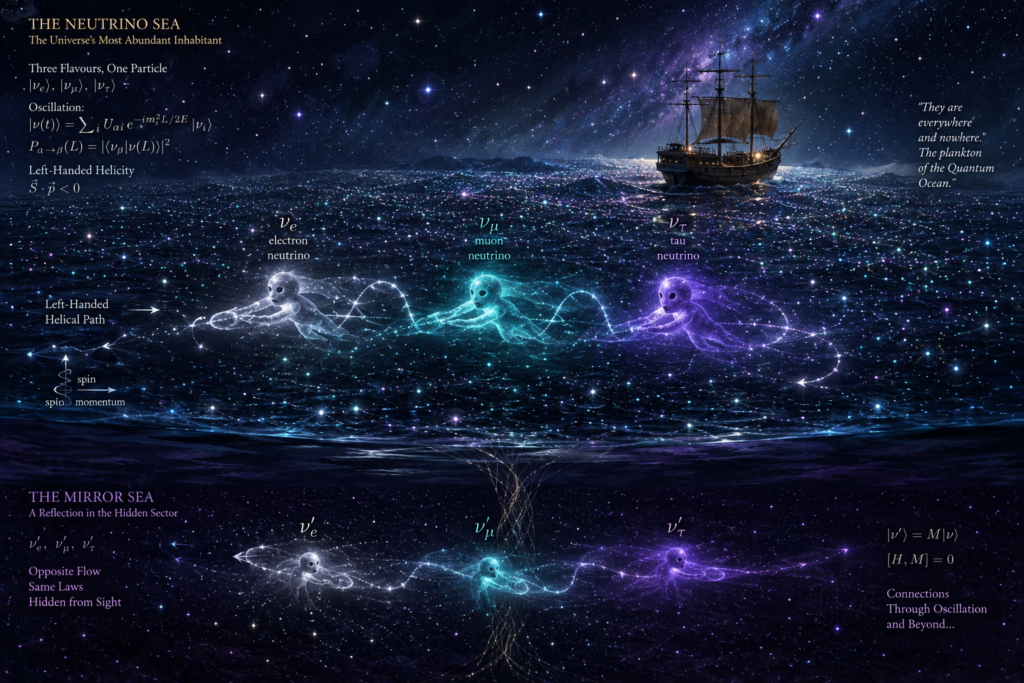
Today we sail to meet the neutrino – the plankton of the Dirac Sea. A particle born of despair, that breaks symmetries, oscillates between identities, and perhaps holds the key to escaping the deepest dead end of contemporary physics.
📜 Born of Necessity: Beta Decay and the Conservation of Energy
The story begins in 1930, at a moment when it seemed that one of the pillars of physics – the law of conservation of energy – was about to collapse. The problem was beta decay: a neutron decays into a proton and an electron, but the energy of the electron was not fixed – it had a continuous spectrum. This meant either that energy was not conserved (which Niels Bohr was prepared to accept), or that an invisible particle was carrying away part of the energy.
That year, Wolfgang Pauli wrote his famous letter “Dear radioactive ladies and gentlemen”. In it, he put forward a “desperate remedy”: the hypothesis of a neutral particle with spin 1/2, of very small (or zero) mass, which would carry away the “missing” energy and at the same time preserve the law of conservation of angular momentum. He initially called this particle the “neutron”, but after Chadwick’s discovery of the true neutron in 1932, Fermi renamed it the “neutrino” – the little neutral one.
Fermi incorporated the neutrino into his theory of beta decay in 1934, and from then on began one of the most incredible sagas in the history of physics: a particle that interacted so weakly that many considered it pure fiction – until it was finally detected in 1956 by Reines and Cowan. The neutrino was real. And only then did the true mysteries begin.
🚩 Left-Handedness and the Fall of Parity: A Rule-Breaker in Action
The neutrino’s first great rebellion against the established order took place in 1957. In beta decay, the neutrino is always emitted with left-handed chirality (spin opposite to the direction of motion), while the antineutrino is always right-handed. This is a manifestation of the maximal violation of parity in the weak interactions – the very discovery that Lee and Yang had predicted, and that Wu confirmed experimentally.
But here begins a mystery that persists to this day: why is the neutrino exclusively left-handed? The Standard Model explains the mass of particles through Yukawa coupling with the Higgs field. But the neutrino has no right-handed partner in the Standard Model (unlike the electron, which has both a left-handed and a right-handed chiral component). A Dirac mass for the neutrino – the very same that works for all other fermions – is not possible without extending the model.
This is one of the greatest cracks in the Standard Model and the reason why the neutrino remains the “stone in the shoe” of modern physics. It is a reminder that our most precise theory is incomplete.
⚖️ A Mass That Should Not Exist: Majorana and the Seesaw
And then, in 1998, came a blow that changed everything. The Super-Kamiokande experiment in Japan discovered that the neutrino oscillates – it spontaneously transitions from one “flavour” to another: from electron to muon, from muon to tau neutrino. This discovery (Nobel Prize 2015 for Kajita and McDonald) brought with it a revolutionary consequence: the neutrino has mass. For oscillations are possible only if at least two of the three types of neutrino have a non-zero mass.
But these masses are fantastically small. The total sum of the masses of all three neutrinos is less than 0.1 eV, which is a million times smaller than the mass of the electron, the next lightest massive particle. How can we explain this minuscule mass?
Here two fundamental possibilities enter the stage, and both lead towards new physics:
Dirac neutrino: like all other fermions, it has a distinct particle and antiparticle. It requires the existence of a right-handed neutrino (a sterile neutrino) that has not been detected so far. Its mass arises through Yukawa coupling, similar to the electron – but requires an incredibly small Yukawa coupling (), which is “unnatural” and demands an explanation.
Majorana neutrino: the particle is identical to its own antiparticle. This is possible only for neutral fermions – yet another example of the “rule-breaking” nature of the neutrino. A Majorana mass directly violates the conservation of lepton number.
The seesaw mechanism connects these two possibilities in an elegant way. It postulates the existence of a very heavy right-handed Majorana neutrino (), whose interaction with the ordinary left-handed neutrino generates a very small mass for the ordinary neutrino:
where is the Dirac mass (on the order of a GeV), and is the mass of the heavy Majorana neutrino. The heavier the right-handed partner, the lighter the ordinary neutrino. This elegantly explains why the neutrino is so incredibly light – because its partner is ultra-heavy and hidden at the grand unification scale.
🧲 The Magnetic Dipole Moment: Yet Another Rebellion
As if all this were not enough, the neutrino has yet another trick up its sleeve. It has no electric charge, yet it possesses a magnetic dipole moment – another example of how this particle refuses to obey the usual rules.
In the minimal Standard Model, a Dirac neutrino has a magnetic dipole moment proportional to its mass – which means it is fantastically small ( Bohr magnetons), far below experimental limits. But if the neutrino has a Majorana mass, its magnetic dipole moment is zero, because a Majorana fermion cannot have a diagonal electromagnetic moment (it is identical to its antiparticle, so the moment would have to be zero).
If future measurements reveal a neutrino magnetic dipole moment significantly larger than the Dirac prediction, that would be a signal of new physics: additional interactions, mirror particles in the loops, or PT-symmetric effects generating an anomalous magnetic dipole moment. The neutrino would, once again, be a herald of the unknown.
🪞 The Neutrino and Mirror Matter: Plankton in Both Seas
Recall our voyages through mirror matter – through Tan’s models with neutron oscillations and a hidden sector. If a mirror sector exists, it naturally contains mirror neutrinos as well. They are “sterile” with respect to our weak interactions – they do not feel the W and Z bosons – but they can mix with our neutrinos through small mixing amplitudes.
This is precisely what some models, including Tan’s, predict: there exist sterile neutrinos that manifest themselves through anomalies in the neutron lifetime and through subtle effects in neutrino oscillations.
In this picture, the neutrino is truly plankton in both seas – that tiny organism that swims in both our sector and the mirror sector, and whose oscillations may be the first hint of the existence of the other side of the Dirac Sea, the one “on the other side of Alice’s looking glass”. The neutrino recognises no boundaries. It is a messenger of the unity of two worlds.
🔭 Why the Neutrino Matters for Escaping the Dead End
At the end of this voyage, we must ask ourselves: why is it precisely the neutrino – this tiny, elusive particle – that is so important for the future of physics?
- Its mass is direct proof that the Standard Model is incomplete. Whether Dirac, Majorana, or a combination, the mass of the neutrino requires new degrees of freedom – sterile neutrinos, mirror fermions, or PT-symmetric partners.
- Its nature (Majorana or Dirac) will determine the fate of lepton number and perhaps explain why there is more matter than antimatter in the universe (leptogenesis).
- Its left-handedness and tiny mass are natural candidates for testing Mannheim’s conformal gravity: if masses are emergent from gravity, the neutrino should have a special place in that hierarchy.
- Its oscillations are a quantum phenomenon on macroscopic scales (hundreds of kilometres for solar neutrinos), making them ideal for studying decoherence, quantum complexity, and perhaps even Penrose’s objective reduction over large distances.
⛵ Epilogue: The Plankton That Changes the Ocean
Dear explorers, the neutrino truly is what we said it is – the most abundant particle about which we know the least. Every second, about 100 billion neutrinos from the Sun pass through your thumb. They are everywhere, yet almost invisible.
In our metaphor of the Dirac Sea, the neutrino is truly plankton – invisible to the naked eye, yet without it the whole ecosystem could not function. It carries information from the deepest layers of stars, from supernovae, from the Big Bang. It breaks symmetries, refuses to be Dirac or Majorana, oscillates between flavours, and perhaps communicates with the mirror world.
And just as real plankton in the oceans produces most of the oxygen we breathe – without us even being aware of it – so too does the neutrino, that tiny rebel, perhaps breathe life into new theories, into new horizons, into new voyages.
The sea is always clear. The horizon is always open. And the plankton – the plankton is what makes the sea alive. 🦠🌊⚛️
This post continues the series begun with “⚛️ Quantum Archaeology: Reading the Past from the Dirac Sea”, continued through the map of the quantum odyssey and all our previous voyages.
Leave a Reply