Dear explorers,
In our previous voyages we have come to know the Dirac Sea through its deepest secrets – from negative frequencies and mirror matter to the Higgs salt and the neutrino plankton. But now it is time for one of the most exciting voyages in the history of our Odyssey. Today we shall connect three seemingly unrelated worlds: Maxwell’s original quaternion equations, Tesla’s visionary experiments, and modern quantum field theory. And we shall pose a question that Tesla sensed intuitively, and that modern physics is only now able to formulate: what if the Dirac Sea can be excited not only at the point of a particle collision, but also globally – on a macroscopic scale?
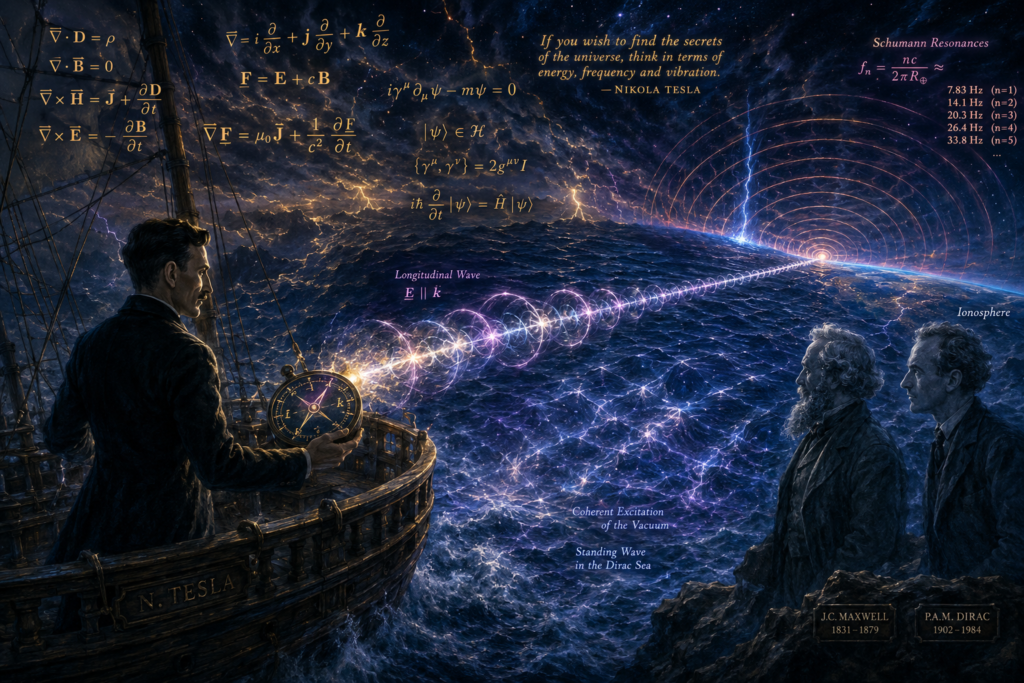
Our chief navigator on this voyage shall be none other than Nikola Tesla. His experiments with high voltages, steep pulses, and terrestrial resonance no longer appear as mere attempts at wireless energy transmission. They appear as the first – and perhaps the only – attempt to excite the Dirac Sea at its fundamental frequency.
🧮 Why Quaternions? Maxwell’s Lost Language
To understand Tesla’s intuition, we must return for a moment to the history of mathematics – to the time when James Clerk Maxwell wrote his famous equations. What most of us learn in school are Heaviside’s and Gibbs’s simplifications of Maxwell’s original work. But Maxwell wrote his equations in a form that is almost forgotten today – in the language of quaternions.
What is a quaternion? It is a mathematical object of the form , where is a scalar, and behaves as a vector. What William Hamilton, the inventor of quaternions, realised, and Maxwell adored, is that a quaternion naturally unites scalar and vector into a single mathematical object.
In standard vector calculus we have two separate products: the scalar (dot) and the vector (cross) product. In quaternions, the product of two “pure” vectors (where the scalar part is zero) simultaneously yields both the scalar and the vector product:
For Maxwell, this was no mathematical game. He believed that physical quantities – the electric and magnetic fields, potentials, currents – possess both a scalar and a vector nature and ought to be treated as a unified whole. When Heaviside and Gibbs “cut” that product into two separate parts, they gained simplicity – but they potentially discarded the physical reality described by the scalar part.
⚡ Where Does the Longitudinal Degree of Freedom Hide?
The key lies in the generalisation of the source of the electromagnetic field. In classical Heaviside electrodynamics, everything is derived from charges and currents ( and ), which are connected by the continuity equation
However, in the quaternionic formalism, the nabla operator () is not applied only to the fields; its interaction with the complete quaternionic source is also considered. Imagine a generalised four-dimensional current vector as , where is not merely the charge density, but a general scalar source of the field.
When the quaternionic operator is applied to a quaternionic field, two kinds of “currents” emerge from the resulting terms:
- Vector (transverse) current: the standard , whose divergence is linked to the time variation of the charge density.
- Scalar (longitudinal) current: a term arising from or , but treated in a way that allows the existence of a current not arising from a variation of . This is a current whose curl is zero (), but whose divergence is non-zero and independent of .
In empty space without charges, the Heaviside form sets and the solutions are transverse waves. The quaternionic form allows a fluctuating scalar potential to exist and propagate even in the absence of classical charges.
📐 Deriving the Longitudinal Wave
Let us take the generalised Maxwell equations in a vacuum, but with an additionally postulated scalar source . This source may be connected to the time variation of some scalar field . The generalised Ampere’s law can be written as , where is the usual transverse current. Alongside it, one postulates the existence of a longitudinal component of the field, , for which and , where is some scalar source/excitation that can exist even without particles.
If we take the divergence of the generalised Ampere’s law, we obtain . If also includes a longitudinal part that is not tied to charge transport, it can happen that is not zero, but is balanced by the time variation of the scalar excitation. This directly leads to a wave equation for that scalar (longitudinal) component: , where v is not necessarily . The solution to this equation is a plane wave in which the electric field vector and the direction of propagation are parallel: . This is a longitudinal wave. It generates no magnetic field and does not carry energy in the same way as a transverse wave; it is a pure oscillation of the potential, a “pressure” in the medium.
🌌 The Weyl Tensor and Longitudinal Modes: a Structural Analogy
This is not merely abstract mathematics. There is a deep structural analogy with the Weyl tensor in general relativity. The Riemann tensor is decomposed into the Ricci tensor (directly connected to energy and matter via Einstein’s equations) and the Weyl tensor (whose trace is zero, but which carries information about curvature propagating through empty space – gravitational waves). LIGO confirmed the existence of gravitational waves in 2015, thereby proving that the Weyl tensor is no mere mathematical abstraction – it is a generator of real, measurable perturbations of spacetime.
In generalised electrodynamics, the Heaviside form of Maxwell’s equations is like observing only the Ricci tensor – it is tied to sources and yields only transverse solutions. The quaternionic generalisation unlocks additional degrees of freedom – the “Weyl part” of electromagnetism – that allows the existence of longitudinal modes even in the absence of classical sources. Gravitational waves have been confirmed. Longitudinal EM waves – not yet.
🔬 From Point to Resonator: Why an Accelerator Is Not Enough
Here we arrive at the crucial difference between standard particle physics and what Tesla was trying to do. A particle accelerator (the LHC, for example) creates collisions at a point. The energy is enormous (up to 13 TeV), but it is localised in a space of metres and in a time of seconds. That is ideal for creating massive particles such as the Higgs boson – because their Compton wavelength matches that scale.
But if a light scalar field exists – massless or with a very small mass – its Compton wavelength is huge. It cannot be excited at a point. It requires a coherent excitation on a macroscopic scale.
Tesla had no accelerator. He had coils. He had the Earth. He had the ionosphere. And he was trying to create a macroscopic standing wave – to turn the entire planet into a resonant cavity. His frequency of around 8 Hz (the Schumann resonance) was no accident. That is the fundamental mode of the Earth-ionosphere cavity.
Imagine this now: if a light scalar field exists (let us call it ) that is weakly coupled to the EM field, then a global standing EM wave at the Schumann frequency could – through nonlinear coupling – excite a corresponding standing wave in the scalar field as well. That is no longer a localised particle. That is a collective, coherent oscillation of the vacuum on a planetary scale.
That is what is necessary – the excitation of the Dirac Sea on a macroscopic scale.
🧲 The Higgs Field and Longitudinal Waves: Where Is the Connection?
The question arises: are the oscillations of the Higgs field precisely those longitudinal waves? The Higgs field is indeed a fundamental scalar field (spin 0) that permeates the entire universe. When it oscillates, that is a wave – and since it is scalar, its oscillations are longitudinal in the sense that they lack transverse polarisation.
But there is a problem. At energies below 246 GeV, electromagnetism is separated from the weak force, and the Higgs field is “frozen” in its vacuum state. Its oscillations are massive (125 GeV) and do not propagate as long-range waves. Thus, it cannot be the solution we seek as a Tesla longitudinal mode.
But what if there exists another, as yet undiscovered scalar field – far lighter, perhaps even massless – that is coupled to the EM field in a similar way? That is precisely what van Vlaenderen, Waser, and others propose. That field would be responsible for longitudinal EM waves in the generalised theory. And that is what Tesla may have intuitively sensed as the “ether” – not a mechanical fluid, but a fundamental scalar field.
⛵ Epilogue: Tesla’s Melody of the Dirac Sea
Dear explorers, at the end of this epic voyage, Tesla appears not as a mere engineer or dreamer, but as a mariner who sensed the depth before anyone possessed instruments to measure it. He knew nothing of the Dirac Sea. He knew nothing of spontaneous symmetry breaking. But he knew that there exist frequencies at which “something significant is excited”. And he was trying to strike them.
His experiments no longer look like mere attempts at wireless energy transmission. They look like the first – and perhaps the only – attempt to excite the vacuum at its fundamental frequency, not at a point of particle collision, but globally, on a macroscopic scale. As though he were trying to turn the entire planet into a musical instrument, and the Dirac Sea into a symphony.
And perhaps that is the path we shall one day take. Not only to measure particles in accelerators, but to listen to the resonances of the vacuum itself. To seek invisible scalar fields not through point-like collisions, but through global, coherent oscillations. To play, like Tesla, the Dirac Sea – and wait for it to answer us.
The sea is always clear. The horizon is always open. And the melody – the melody awaits to be played. ⚡🌊🔮
This post continues the series begun with “⚛️ Quantum Archaeology: Reading the Past from the Dirac Sea”, continued through the map of the quantum odyssey and all our previous voyages.
Leave a Reply