This post continues our series on Nikola Tesla, in which we seek to examine his visions and patents with respect for historical context, but also with openness to modern achievements. Today we turn to one of Tesla’s most far-sighted ideas – the collection of radiant energy, or poetically put, its “harvesting.”
🔬 Patent 685,957: Apparatus for the Utilization of Radiant Energy
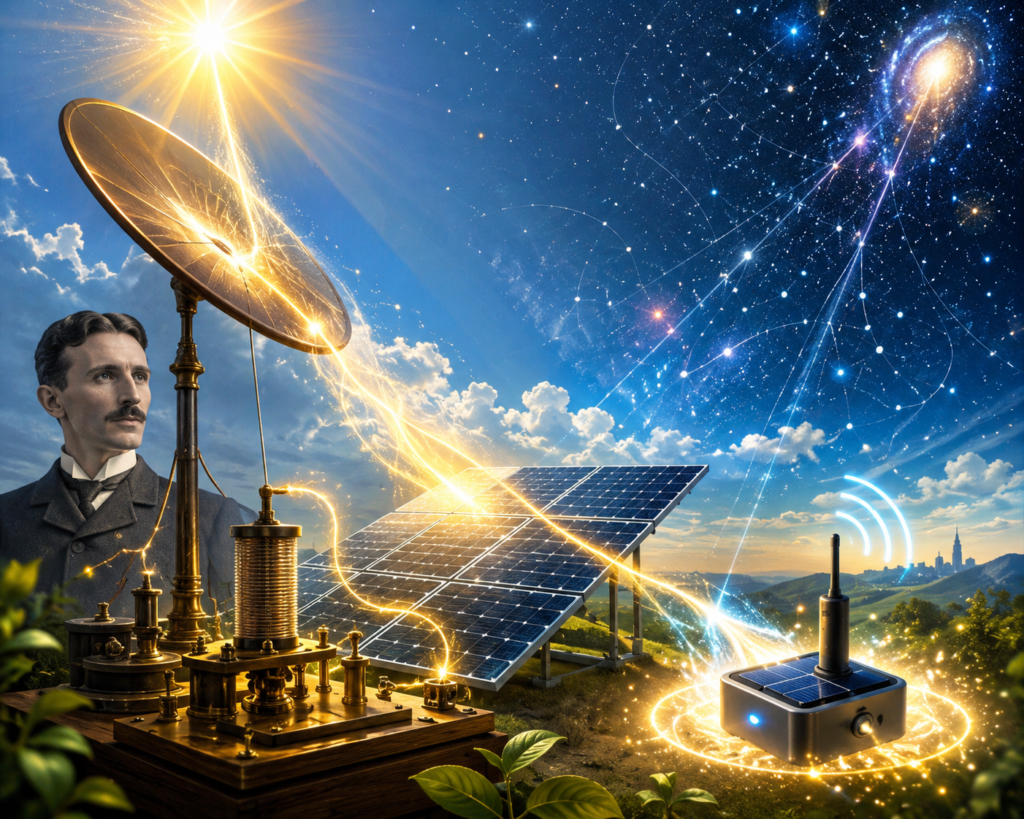
In 1901, Tesla filed patent number 685,957 – “Apparatus for the Utilization of Radiant Energy.” This patent describes a device consisting of a raised metal plate (antenna), a capacitor, and a specially designed switching circuit. According to Tesla’s concept, the antenna would be exposed to sunlight and other rays from space, accumulating charge that could then be used to power electrical devices.
Today, we recognize this “radiant energy” under the name cosmic rays – high-energy particles that continuously bombard Earth’s atmosphere from all directions of the universe.
🌌 Tesla as a Pioneer of Cosmic Ray Research
It is difficult to dispute that Tesla was one of the first researchers of the cosmic ray phenomenon. These were the years when the science of atoms and atomic nuclei was just forming – elementary particle physics and nuclear physics were not even on the horizon. Despite this, with his vacuum tubes, antennas, and capacitors, Tesla drew conclusions that were exceptionally perceptive for his time:
- He understood that these rays come from all directions of the universe, most abundantly from stars and from the Sun itself. Since the Sun is the nearest stellar source, he concluded that their intensity is greatest during the day.
- He noticed that these rays are often of ultra-short wavelengths, that they can carry a charge, but can also be neutral, and that in passing through a medium and the atmosphere they cause ionization.
- He also understood a fundamental engineering principle: that the power is proportional to the surface area of the antenna collecting this radiation – a principle that still holds true today for all receivers of EM energy.
Therefore, it is not fair to be overly critical of some of Tesla’s conclusions, such as the idea that these rays might be faster than light, and to mock them – as some contemporary historians of science and scientists sometimes do. Tesla worked with tools that were incredibly limited compared to today’s detectors, accelerators, and satellite observatories. What he achieved with his tubes and antennas deserves deep respect, even when his conclusions – in light of today’s knowledge – were incomplete or incorrect.
⚠️ Between Uncritical Quoting and Complete Rejection
On the other hand, uncritical quoting of Tesla’s works and ideas about the possibility of using these rays for practically free and unlimited energy represents the other extreme. This is especially true of his later 1932 patent, in which he speaks of the possibility of using radiant energy for powering motors.
Tesla himself was aware of the limitations. He himself pointed out that the technical possibilities for better utilization of this energy did not exist in his time. Nevertheless, especially in his later years, he always liked to encourage research attempts – regardless of how currently feasible or profitable they might be. This spirit of curiosity and openness is what makes him great, but it should not be confused with ready-made technical solutions allegedly “hidden” from the public.
☀️ From Tesla’s Antenna to Solar Panels
It is interesting that such attempts have never ceased. Today’s solar panels are the most commercialized form of collecting truly free energy – direct descendants of Tesla’s idea of “harvesting” solar radiation. Although the Sun’s energy is free, the space occupied by the panels, the equipment, and the maintenance are not – but the principle is the same one Tesla sketched over a century ago. In this sense, solar energy is one of the most tangible incarnations of Tesla’s visions from the early 20th century.
And there are also more subtle forms of “harvesting.” Modern devices based on the nonlinear Hall effect enable the collection of energy from Wi‑Fi signals (2.4 GHz, 5 GHz) and radio waves that are all around us – because our communication devices emit them. True, the power density is very small (on the order of μW/cm²), sufficient to power miniature sensors and IoT devices, but not to run motors. But the principle is there. And this principle is Tesla’s.
🎯 Conclusion: Visions That Continue to Live
Tesla’s visions continue to live on long after his death – through the work of contemporary engineers and scientists, and not through podcasts of false “Tesla experts” who collect followers, donations, and likes. And that would have pleased Tesla more. For Tesla was not a man who sought blind followers. He was a man who wanted to inspire those who would continue to build.
Today, as solar panels charge batteries and miniature sensors power themselves from Wi‑Fi signals, Tesla’s “harvest” of radiant energy is no longer just a patent on paper. It is a reality. And like many other Tesla ideas, it was not the end of the road – but a signpost.
What do you think? Will the next step in “harvesting” radiant energy be the efficient collection of cosmic rays, or will we rely on solar energy and small devices for ambient wave collection for a long time to come?
Leave a Reply