
Dear explorers,
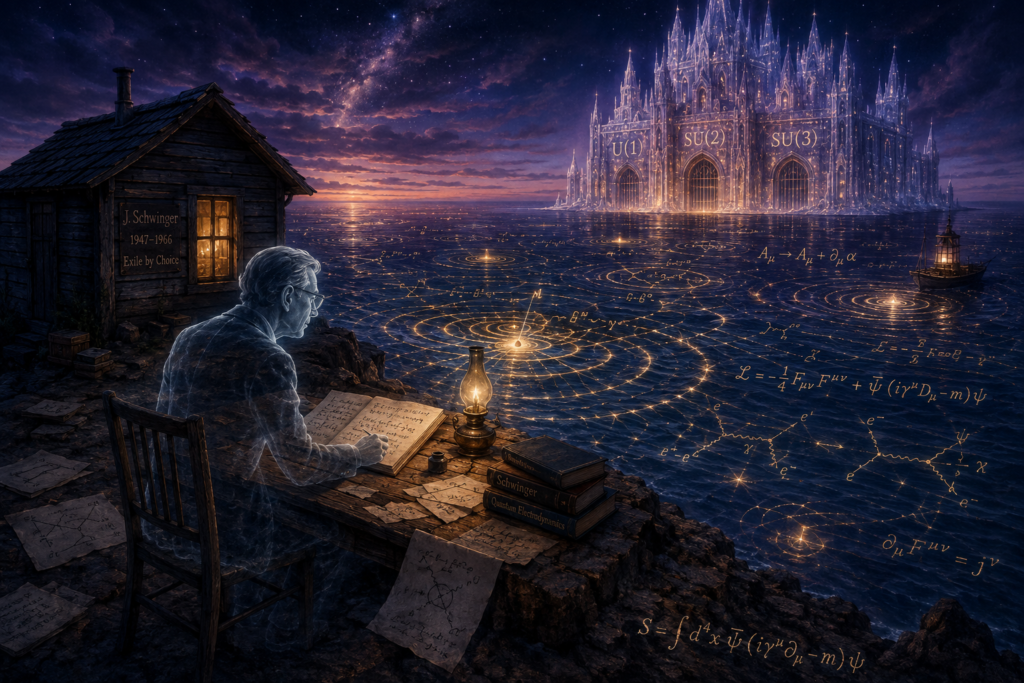
In our previous voyages, the Dirac Sea revealed many secrets to us – from negative frequencies and mirror matter to the Higgs salt and the neutrino plankton. The lighthouses on this journey were the great minds who dared to think differently. But today we sail toward one of the saddest and most instructive stories in the history of physics. The story of Julian Schwinger, a Nobel laureate who, at the peak of his fame, was banished to a desert island in the Dirac Sea because he dared to question the very foundations of what he had helped to build.
This is not just a story about a physicist and his theory. It is a story about the fate of original thought in a world that has grown fond of its dogmas.
🏛️ From Celebrant to Outcast
Julian Seymour Schwinger (1918–1994) was a child prodigy of physics. He published his first paper at 16. He defended his doctorate at 21. At 28 he was a full professor at Harvard. At 47 he shared the Nobel Prize with Feynman and Tomonaga for the creation of quantum electrodynamics (QED) – the theory that describes how light and matter interact with incredible precision.
And then, at the height of his fame, he was rejected. In the late 1960s, Schwinger began developing Source theory – a new way of formulating the whole of quantum field theory, not just QED. His colleagues, including those who had once celebrated him, turned their backs on him. Physical Review refused to publish his papers. Not because they were wrong – no one claimed they were wrong – but because they were “unnecessary”, “nothing new”, “too philosophical”. A Nobel laureate cannot publish a paper in the leading journal.
In 1972 Schwinger resigned his membership of the American Physical Society. In his letter he wrote of “intellectual censorship” and “closed-mindedness toward ideas that do not fit the ruling paradigm”. He spent the rest of his life publishing in smaller journals. He died in 1994 of pancreatic cancer, embittered and marginalised. His last great work, Source Theory, remained unfinished.
💡 What Is Source Theory? – First Principles
To understand Schwinger’s heresy, we must start from the basics. In standard quantum field theory, the fundamental entities are fields – operator-valued quantities that create and annihilate particles at every point of spacetime. The theory is built by postulating a Lagrangian, deriving the equations of motion from it, and then quantising the fields by imposing commutation relations.
Schwinger considered this path logically wrong. Fields are invisible, unobservable, and their quantisation creates endless problems with divergences. He proposed starting from something directly measurable: from the very acts of emission and absorption, that is, from sources and detectors.
His central object is the source functional , defined as:
This is not just a formal expression. It is the probability amplitude for the vacuum in the distant past ( to transition into the vacuum in the distant future () in the presence of external sources . In other words, it is the probability that something happens in the universe when sources are present.
What is brilliant is that all physical information – all scattering amplitudes, all collision cross-sections, all probabilities – can be extracted from this single functional. It is the “mother of all amplitudes”. Fields, particles, operators – all are derived entities, useful for calculation, but not fundamental.
🧭 The Source J – A Four-Vector Current or Something More?
An experienced mariner on the Dirac Sea will ask: when Schwinger says “source “, does he mean the same four-vector current from standard QFT? The answer is: yes and no.
In standard QED, the electromagnetic current is an operator-valued quantity – it is made of fermion fields and is itself subject to quantisation. When it appears in the Lagrangian as , it is an interaction term coupling fermions to the photon field.
In Source theory, Schwinger introduces an external, classical source . It is not an operator. It is a prescribed source – like the charges and currents we control in a laboratory. The functional tells us how the vacuum responds to the presence of this prescribed source. From this external source, Schwinger derives the photon field as a functional derivative:
Thus, the field is not fundamental; it is a measure of the system’s response to a change of source. Just as in classical electrodynamics magnetisation is not fundamental, but is the response of a material to an external magnetic field, so too is the photon field a response of the vacuum to an electric source.
⚖️ The Variational Principle – The Heart of the Theory
Schwinger set up the quantum action principle as the foundation of everything:
where is the action, and an infinitesimal variation of the system’s parameters. This principle replaces the whole apparatus of canonical quantisation. From it directly follow the equations of motion for the fields (Maxwell’s, Yang-Mills, Einstein’s), the commutation relations (they are no longer postulates, but consequences), and the functional derivatives connecting sources and fields.
In Source theory, the field Lagrangian is not the starting point; it emerges from the structure of the system’s response to sources. This is a radically different approach: instead of postulating fields and their interactions, we postulate how sources affect the vacuum, and from that we extract everything else.
🌊 The Connection to the Dirac Sea: A Sea That Responds
In Dirac’s picture, the sea is an infinite reservoir of negative-energy states; particles are excitations of those states, and unfilled states are positrons. But that sea is static, fixed.
In Schwinger’s Source theory, the Dirac Sea becomes dynamic. It is not just a background; it is an entity that responds to the presence of sources. The functional is the mathematical measure of that response. When you turn on a source , the sea “ripples” – and those ripples are what we detect as particles.
Fields are not beings that exist in themselves; they are rhythms of the sea, excited by sources. And sources and detectors are, in the end, what we are – experimenters, detectors, atoms, stars. We are the ones casting pebbles into the sea, and the waves we see are the particles.
⛪ The Standard Model as Cathedral and as Cage
The Standard Model, with its U(1)×SU(2)×SU(3) symmetry group, is one of the greatest intellectual achievements in the history of the human race. It is a cathedral – magnificent, precise, built of the finest mathematical marble. Every arch, every rose window, every pillar corresponds to some experimental fact with incredible accuracy.
But – and this is what even Schwinger, one of its builders, felt – a cathedral can also become a cage. When all the faithful sit in the pews and repeat the same prayers, who dares to say that something is missing? Or that the foundations of the cathedral are built on sand?
Schwinger dared. He said: “Fields and operators are auxiliary tools, abstractions, not physical reality.” This was not a technical critique of the Standard Model – it was an ontological heresy. For if fields are not real, what then? Sources? Events? Relations? These are questions that lead into the unknown, and the unknown is frightening to institutions built upon recognised truths.
🏝️ Epilogue: The Outcast Who Showed Us the Way
Dear explorers, the ostracism of Julian Schwinger was not just a personal tragedy – it was a symptom of a systemic disease. When one of the architects of QED, a Nobel laureate, a man whose mathematical rigour was unsurpassed, cannot publish a paper in the leading journal because his approach “is not in the spirit of the times” – then we know something is wrong.
His Source theory was not tested and shown to be false – it was undesirable. And precisely because it was undesirable, it gains importance today, for it reveals cracks in the cathedral that no one dared to look at.
On our map of the Dirac Sea, Schwinger’s desert island is not a place of defeat. It is a lighthouse. It reminds us that fields and operators are only tools, that “virtual particles” and “gauge bosons” are but shadows on the surface of the sea, and that the true reality – a sea that responds to our presence – is far deeper and more mysterious than the cathedral allows us to see.
Dirac believed in mathematical beauty, but he knew it was a signpost, not the destination. Schwinger knew that fields and operators are only tools, not reality. Both were brave enough to question the foundations. And both, each in their own way, ended up on the margins – not because they were wrong, but because they thought deeper than their time could bear.
The sea is always clear. The horizon is always open. And the truth – the truth sometimes waits on a desert island to be rediscovered. 🌊🏝️🔬
This post continues the series begun with “⚛️ Quantum Archaeology: Reading the Past from the Dirac Sea”, continued through the map of the quantum odyssey and all our previous voyages.
Leave a Reply