
Dear explorers,
In our previous voyages across the Dirac Sea, we encountered many mysteries – from negative frequencies and mirror matter to emergent gravity and the unfinished symphony of general relativity. But today we sail toward one of the deepest and most dangerous points on our map. Toward an equation that has given physicists the most precise predictions in the history of science, and handed mathematicians one of the hardest headaches.
This is the Yang-Mills equation – the foundation of quantum chromodynamics (QCD) and, in a broader sense, of the entire Standard Model of elementary particles. It is a perfect example of what we have been discussing: a formalism that works extraordinarily well, yet whose ontological foundations remain unresolved.
🌊 Introduction – One Equation, Two Worlds
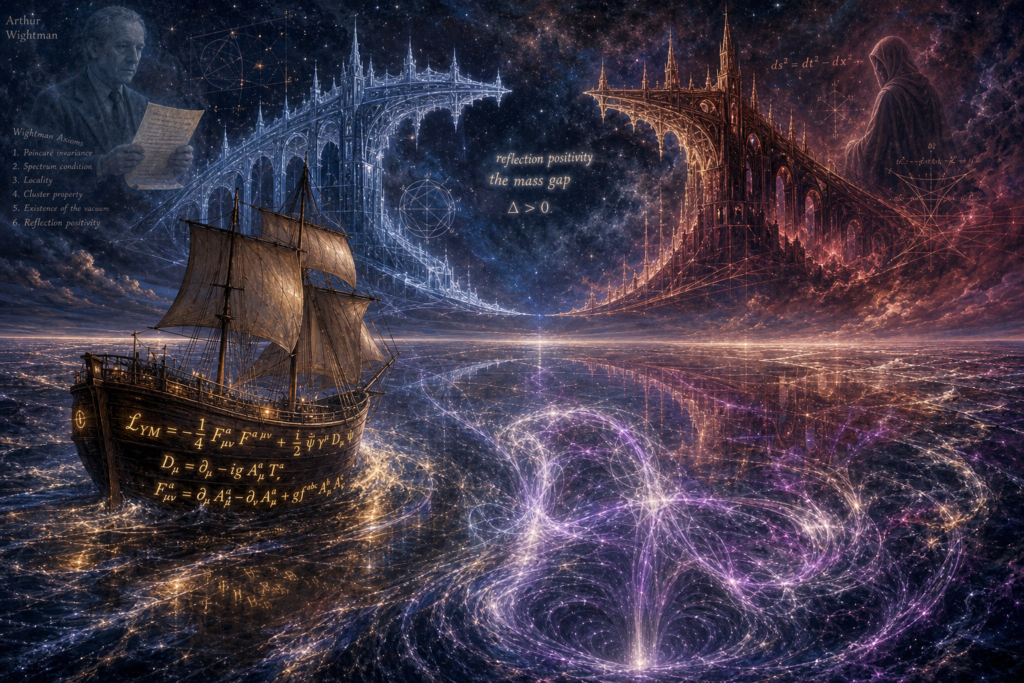
In 1954, Chen Ning Yang and Robert Mills formulated a generalisation of Maxwell’s electrodynamics to non-abelian gauge groups. It describes how interaction fields behave when the carriers of force are themselves carriers of charge – as gluons are in QCD. Its beauty lies in the simplicity of its expression:
where the field tensor is:
The last term – – makes all the difference. It describes the self-interaction of gluons, what makes QCD fundamentally different from QED. And precisely that term is the source of both its beauty and its problems.
In our picture of the Dirac Sea, the Yang-Mills equation describes how waves in the sea interweave and how they shape themselves. While photons in QED are like solitary waves passing through one another without interaction, gluons are like vortices colliding, merging, and separating – constantly creating new patterns in the sea.
🏆 The Millennium Problem – Two Demands
In 2000, the Clay Mathematics Institute declared Yang-Mills theory one of the seven Millennium Problems, with a prize of one million dollars. The problem is formulated in two parts:
Part One – Existence (Axiomatic Existence):
To prove, with mathematical rigour, that quantum Yang-Mills field theory exists at all on four-dimensional space and satisfies the standard axioms of quantum field theory – above all, the Wightman axioms.
Part Two – Mass Gap:
To prove that the mass of the lightest particle predicted by this theory is strictly greater than zero (). Physically, this means that in the spectrum of Yang-Mills theory there are no massless particles – that all excitations above the vacuum are massive.
What makes this problem so hard is not only mathematical complexity, but a fundamental gap between physics and mathematics. Physicists use QCD daily, with incredible precision. Mathematicians, however, still have no proof that this theory exists in a strictly defined sense.
In our picture, it is as if we sail the sea every day, yet cannot prove that the sea truly exists – that it is not merely a product of our collective mind.
📜 The Wightman Axioms – Training in Mathematical Rigour
The first serious attempt to place quantum field theory on firm mathematical foundations came from Arthur Wightman in the 1950s. Inspired by Hilbert’s sixth problem – the demand that physics be axiomatised – Wightman formulated a set of rules that every mathematically consistent quantum field theory in flat spacetime must satisfy.
In condensed form, the Wightman axioms require:
- A unitary representation of the Poincaré group on the Hilbert space of states, with a vacuum state fixed by that representation.
- Quantum fields as operator distributions – fields are not ordinary functions, but operators acting on a dense, invariant domain in Hilbert space.
- A transformation law for the fields under the action of the Poincaré group.
- Locality and canonical commutation relations – fields commute or anticommute at spacelike separations.
- Asymptotic completeness – the space of states equals both the in and the out scattering spaces.
The Wightman axioms were the foundation for many spectacular developments in QFT during the 1970s – from the CPT theorem to the spin-statistics theorem. But they are abstract and hard to verify. No non-trivial example of an interacting quantum field theory in four dimensions satisfying all the Wightman axioms is known.
In our picture, the Wightman axioms are like rules the sea must obey to be a “true” sea – but we are still not sure whether our Dirac Sea truly obeys them.
🔄 The Osterwalder-Schrader Axioms – A Euclidean Path to Rigour
The Wightman axioms are formulated in Minkowski space, where time is real and the metric has signature . But a problem arises there: the Feynman path integral – the basic tool of QFT – contains oscillatory factors which mathematically do not converge. Formally, it is an “integral” that is not well defined.
The solution came through analytic continuation from Minkowski space to Euclidean space. If we replace time by imaginary time:
then the Minkowski metric transforms into a Euclidean metric. In that space, the Feynman factor becomes , where is the Euclidean action – and that factor converges. Mathematically, this is the transition from an oscillatory integral to a Wiener measure – a well-defined measure on the space of paths.
Osterwalder and Schrader, between 1973 and 1975, formulated a set of axioms describing how to reconstruct a physical theory in Minkowski space from a Euclidean theory. Their axioms include:
- A stochastic process that is symmetric and stationary.
- Osterwalder-Schrader positivity – integrals of test functions must be non-negative.
- Reflection positivity – the key condition ensuring that a unitary theory in Minkowski space can be reconstructed from the Euclidean theory.
Reflection positivity is the bridge between the Euclidean and Minkowskian pictures of the world. Without it, the Euclidean approach would be merely a mathematical game – with it, it becomes physically relevant.
In our picture, it is as if we are observing the sea through a mirror: Euclidean space is the sea’s reflection in the mirror, and reflection positivity is the property guaranteeing that the reflection is faithful – that the sea in the mirror truly corresponds to the real sea.
🔗 The Connection to Lie Group Representations – A Deeper Structure
What is especially interesting – and shows how deep this mathematics is – is that the Osterwalder-Schrader axioms have influenced the theory of unitary representations of Lie groups.
One can traceably connect the Osterwalder-Schrader approach with a duality between complementary series representations of a group and highest-weight representations of its -dual group . That duality involves an analytic continuation generalising , and the reflection positivity of the Osterwalder-Schrader axioms.
This is fascinating because it shows that reflection positivity is not merely a technical condition for the reconstruction of QFT – it is deeply connected with the structure of the symmetries of spacetime themselves. It is a bridge between the Euclidean and Minkowskian pictures of the world, but also between different representations of the same symmetry group.
In our picture, it is as if we discover that different parts of the sea – those we see directly and those we see in the mirror – are connected by a deeper symmetry that transcends the very division into “real” and “reflected”.
🧗 Why Is the Yang-Mills Equation So Hard?
We can now understand why the Millennium Problem is so hard. It is not only that Yang-Mills theory is nonlinear – so is general relativity. It is not only that it contains infinities – so does QED. The problem lies in a combination of several factors:
(a) Nonlinearity and the non-perturbative regime.
The Yang-Mills equation is highly nonlinear. At high energies, perturbation theory works – asymptotic freedom allows us to calculate. But the mass gap and confinement are essentially non-perturbative phenomena. They occur at low energies, where the coupling constant becomes large and the entire perturbative approach collapses.
In our picture, it is as if we tried to describe vortices in the sea using only small waves – but vortices are essentially nonlinear phenomena requiring an entirely different description.
(b) The problem of renormalisation.
Quantum field theory is full of divergences removed by renormalisation. For physicists, this is an extraordinarily successful tool. For mathematicians, it is a “dubious” procedure involving the subtraction of infinities, and it is not clear whether the theory can be defined in a mathematically rigorous way without it.
(c) The lack of a rigorous example.
One of the deepest reasons why the problem is hard is that no interacting quantum field theory in four dimensions has been fully constructed in a way that satisfies all the Wightman axioms. Constructive field theory has succeeded in building rigorous models only in lower dimensions ( in 2D and 3D, Yukawa in 2D and 3D). Yang-Mills theory in 4D would be the first.
(d) The problem with the Osterwalder-Schrader axioms.
Even if we proved that Euclidean Yang-Mills theory exists and satisfies reflection positivity, that would still not be enough. One must prove that a physical theory in Minkowski space with a mass gap can be reconstructed from it. And that reconstruction involves limiting processes () that are extraordinarily hard to control.
🔭 Is There Progress?
Although there is officially no solution, the field of research is active and there are numerous approaches:
Lattice QCD.
This is the most successful numerical approach. Spacetime is discretised onto a lattice, and the theory is solved by Monte Carlo simulations. These simulations provide strong numerical evidence for the existence of a mass gap and confinement. They predict masses of particles such as the glueball (a state made of gluons alone) at around 1.5-1.8 GeV, in agreement with experimental data. However, numerical evidence is not mathematical proof. The main challenge is to show that these results converge to the correct continuum (as the lattice spacing goes to zero) and infinite volume.
In our picture, it is as if we studied the sea by observing it through a net – we see patterns, but cannot be sure the net is fine enough to capture everything.
Constructive field theory.
This approach attempts to build the theory from first principles, using precisely the Osterwalder-Schrader axioms. The idea is first to construct a Euclidean theory as a stochastic process, prove reflection positivity, and then reconstruct the theory in Minkowski space. Although successes have been achieved in lower dimensions, extension to 4D Yang-Mills theory remains out of reach.
New theoretical frameworks.
Various proposals are emerging claiming to solve the problem. Some introduce additional fields or principles, such as Unified Information-Density Theory (UIDT), which introduces a scalar information-density field and claims to derive a mass gap of GeV, in agreement with lattice QCD results. Others propose entirely new mathematical approaches, such as Spectral-Fractal Theory or Srinivas Bounded Mathematics. These works are often speculative and have yet to pass the strict scrutiny of the scientific community, but they indicate lively activity and a search for solutions outside established frameworks.
The connection to holography.
AdS/CFT correspondence offers a new angle: instead of directly solving Yang-Mills theory in 4D, we can regard it as a boundary theory dual to gravity in 5D. This duality has enabled numerous insights into non-perturbative phenomena, including confinement and the mass gap. But it has still not led to a rigorous mathematical proof.
In our picture, it is as if we discovered that the sea in 4D can be understood through its shadow in 5D – but the shadow is still not proof that the sea truly exists.
⛵ Epilogue: The Yang-Mills Equation and the Dirac Sea
The Yang-Mills equation is more than a mathematical problem. It is a test of whether our most successful physical formalism can be placed on completely firm foundations. Although physicists use QCD daily with incredible precision, mathematicians still have no proof that this theory exists in a strictly defined sense.
In the context of our series, the Yang-Mills equation is a perfect example of what we have been discussing: a formalism that works extraordinarily well, yet whose ontological foundations remain unresolved. Just as Schwinger could not accept fields as fundamental without a deeper principle, so too can mathematicians not accept Yang-Mills theory without a rigorous proof of existence.
The Osterwalder-Schrader axioms are, in that sense, a bridge between physics and mathematics – a bridge built on reflection positivity, analytic continuation, and a deep connection with Lie group representations. But that bridge is still unfinished.
The Yang-Mills equation awaits its hero – a mathematician or a physicist – who will cross that bridge and prove that the theory describing the strongest force in nature is truly grounded in a rigorous mathematical sense.
Until then, we sail the Dirac Sea, aware that even the most beautiful theories are only waves on the surface – and that the true depth is yet to be explored.
The sea is always clear. The horizon is always open. And the depth – the depth awaits its hero. 🌊🧮⚛️
This post continues the series begun with “⚛️ Quantum Archaeology: Reading the Past from the Dirac Sea”, continued through the map of the quantum odyssey and all our previous voyages.
Leave a Reply