Motherhood and the First Face We See
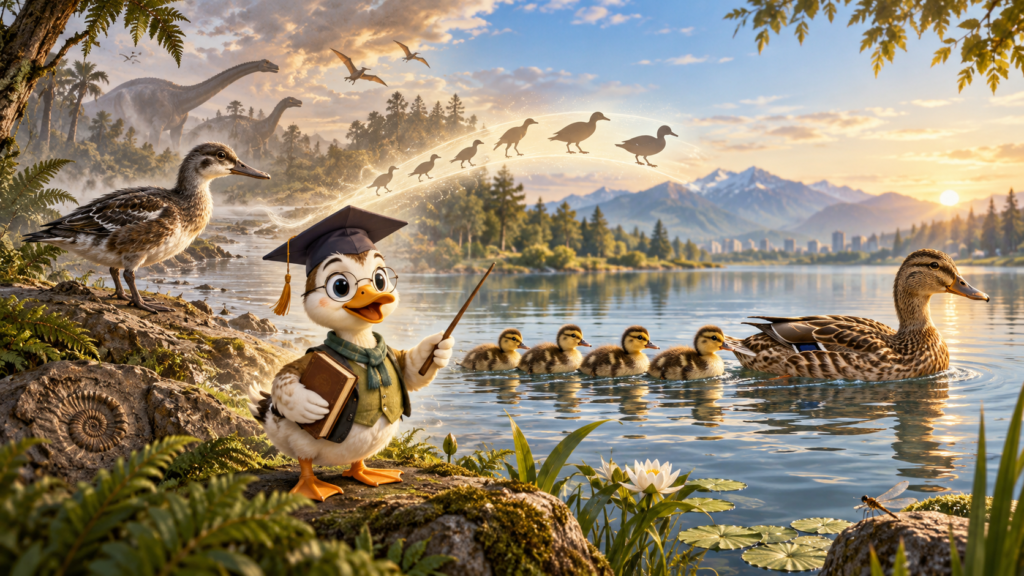
There is a scene that all of us have seen many times, so ordinary that we often accept it without giving it much thought. A female duck glides across the surface of a lake, followed by several small ducklings moving behind her in an almost perfectly ordered line. When she changes direction, they follow. When she disappears into the reeds, they disappear after her, and when she returns to open water, the little procession forms again. At first glance, it is simply a charming family scene from nature. But when we look more closely, an entire world of evolution, neurobiology, behaviour, and a very ancient bond between a young animal and its mother begins to emerge.
Ducks belong to the order Anseriformes, a large group of birds that also includes geese and swans. Their evolutionary history reaches remarkably far into the past, so far that early representatives of their broader evolutionary lineage lived alongside the great dinosaurs. At the same time, what we see today as the simple behaviour of a duckling following its mother is the result of a highly sophisticated system of early learning and recognition known as imprinting. It is precisely at this point, where deep evolutionary history meets the first hours of an individual animal’s life, that ducks become far more fascinating than they might initially appear.
🐣 Young Birds That Meet the World Almost Immediately
Unlike many birds whose chicks hatch almost completely helpless, ducklings belong to what is known as a precocial developmental type. This means that they hatch in a relatively advanced state, with their eyes open, covered in down, and capable of walking, swimming, and following their mother very soon after hatching. In the Mallard, Anas platyrhynchos, ducklings can leave the nest less than a day after emerging from the egg.
This developmental strategy has a clear evolutionary logic. A young animal moving through open terrain or across water cannot afford a long period of complete helplessness. It must quickly learn to distinguish what is safe from what is dangerous, recognise its mother, and maintain contact with her. Although ducklings can begin feeding independently very early in life, this does not mean that they are truly independent. Their mother provides protection, orientation, warnings about predators, and what we might describe in biological terms as the first stable social reference point in their world.
For this reason, one of the most important processes beginning shortly after hatching is the young bird’s ability to recognise and follow the appropriate individual, usually its mother.
👁️ Imprinting — How Do We Know Whom to Follow?
The phenomenon of imprinting became widely known through the work of Austrian ethologist Konrad Lorenz, one of the founders of the modern scientific study of animal behaviour. Photographs of Lorenz walking while a line of young geese follows behind him have become some of the most recognisable images in the history of ethology.
In its simplest form, filial imprinting is a rapid form of early learning through which a young animal acquires the characteristics of an object that it will later follow and toward which it will develop a strong social preference. Under natural conditions, that object is normally the mother. Classic experiments, however, demonstrated that during a sensitive period a young bird can develop such a preference toward other moving objects as well.
From this arose the popular simplified idea that a duckling simply “believes the first object it sees is its mother.” The reality is more complex and much more interesting. A young bird does not enter the world as a completely blank slate. It already possesses certain innate predispositions toward biologically relevant stimuli, while experience during the first hours and days of life further shapes its preferences. Behaviour therefore arises neither exclusively from genetics nor exclusively from experience, but through an interaction between inherited mechanisms and learning.
Particularly interesting experiments have suggested that ducklings may even discriminate relational categories such as “same” and “different.” In a study published in Science, newly hatched ducklings exposed to pairs of identical or different objects later showed a preference for novel objects that preserved the same relationship. The authors interpreted this as evidence for very early relational learning, although methodological criticisms were later published suggesting that these conclusions should be interpreted with some caution. Examples such as this nevertheless demonstrate how even a very young avian brain may be capable of surprisingly sophisticated information processing.
The simple question, “Why does a duckling follow its mother?” therefore leads very quickly to a much broader question: how does the nervous system of a newly hatched organism determine so rapidly what matters in the world, what should be followed, and what represents safety?
🦖 Ducks, Chickens, and the World of Dinosaurs
If we move from the first hours of a duckling’s life much deeper into the past, we encounter an even more fascinating story. Ducks, geese, and swans belong to the order Anseriformes, while chickens, pheasants, turkeys, and quails belong to the order Galliformes. Together, these two groups form the major evolutionary clade Galloanserae, one of the oldest principal branches of modern birds.
This means that the evolutionary connection between today’s ducks and chickens is by no means recent. Their divergence reaches back into the Late Cretaceous, when non-avian dinosaurs were still the dominant terrestrial vertebrates. Fossil discoveries indicate that some lineages of modern birds had already clearly separated by that time.
One of the most important fossils in this story is Vegavis iaai, a bird that lived in what is now Antarctica approximately 69.2 to 68.4 million years ago. Vegavis did not look like a modern duck. It was probably a specialised diving bird with a relatively narrow bill, but its phylogenetic position is extremely important. A new, nearly complete fossil skull described in 2025 displays features that strongly support its placement among early waterfowl, within Anseriformes. In other words, while the great dinosaurs were still alive, there were already birds that were evolutionarily closer to modern ducks and geese than to chickens.
This fact carries particular significance because it shows just how deep the history of duck-like birds extends. When we see a duck on an urban lake today, it is easy to think of it as an entirely ordinary modern animal. Yet its broader evolutionary lineage has roots in a world that existed before the asteroid impact and the mass extinction at the Cretaceous–Paleogene boundary.
Another exceptionally important fossil is Asteriornis maastrichtensis, discovered in what is now Belgium. This small bird lived approximately 66.8 to 66.7 million years ago, almost immediately before the K–Pg catastrophe. Its skull displays a combination of features associated today with both galliform and anseriform birds, placing it very close to the last common ancestor of the Galloanserae.
Asteriornis was therefore not simply “an ancestor of ducks,” nor was it closer to ducks than to chickens. Its importance lies precisely in its position near the major evolutionary branching point from which both groups emerged. Vegavis, on the other hand, is particularly interesting because it represents a lineage already situated on the anseriform side of that evolutionary tree.
When an asteroid struck the region of today’s Yucatán Peninsula approximately 66 million years ago, all non-avian dinosaurs disappeared, together with a vast number of other organisms. Some bird lineages, however, survived the catastrophe and later underwent enormous evolutionary diversification. Fossils such as Vegavis and Asteriornis show that key divergences among modern birds did not begin only after the extinction of the dinosaurs; some of their roots were already present during the Cretaceous.
In this sense, ducks provide a fascinating example of evolutionary continuity. They are not “living fossils” from the Cretaceous, nor are modern species direct copies of their extremely distant ancestors, but their lineage belongs to those avian branches that crossed the boundary between two great worlds: the world of the dinosaurs and the later world dominated by mammals and modern birds.
💧 Life on Water as an Engineering Problem
A duck appears to be an animal for which water is the most natural environment imaginable, yet from a physiological perspective, life on water demands a series of highly specialised adaptations. Water conducts heat away from the body far more efficiently than air, so a bird whose feathers became completely soaked would quickly begin losing valuable body heat.
The water resistance of feathers is not the result of a single factor. The microscopic structure of the feathers, the way their fine elements interlock, and the layer of air trapped among them all play important roles. Ducks also regularly maintain their plumage with their bills and distribute secretions from the uropygial gland, located near the base of the tail. The common explanation that “a duck stays dry because its feathers are oily” is therefore only partly correct. In reality, the structure of the feathers, trapped air, glandular secretions, and continuous maintenance work together to create an efficient insulating layer.
The problem of the legs is even more interesting. Anyone who has seen a duck standing calmly on ice in winter may wonder how it avoids losing enormous amounts of heat through feet that lack a thick covering of feathers. One of the important mechanisms is countercurrent heat exchange. Warm arterial blood travelling from the body passes close to cooler venous blood returning from the extremities, allowing heat to transfer between them. As a result, the blood reaching the feet is already partially cooled, while blood returning toward the body is warmed.
For someone with an engineering background, this principle is particularly elegant because nature is using essentially the same physical concept that we employ in counterflow heat exchangers. Evolution, of course, did not “design” this system in an engineering sense, but natural selection acting across an enormous number of generations can produce solutions that appear remarkably elegant from a functional point of view.
🪽 From the Calm Surface of a Lake to Flights of Thousands of Kilometres
A duck floating on water often appears almost static, yet many species in this group are also exceptional fliers and long-distance migrants. Seasonal migration raises another of the fascinating questions in avian biology: how can an animal with a relatively small brain travel hundreds or even thousands of kilometres and locate suitable wintering or breeding grounds?
There is no single “avian GPS.” Birds may use multiple sources of information, including the position of the Sun, the stars, landscape features, Earth’s magnetic field, previous experience, and in some groups even olfactory cues. Different species use these sources of information in different ways and in different combinations.
Migration is therefore not simply a matter of strong wings and endurance. It requires sensory integration, memory, and spatial orientation. When we see a flock crossing the sky, hidden within that almost geometric image is one of the most complex navigation problems in the animal world.
🐥 Motherhood, Protection, and Social Bonding
Let us return, however, to the original image — a female duck and her ducklings. The fact that the young are precocial can easily create the false impression that they are almost independent from the first day of life. They are not. They may be able to move and feed very early, but their survival still depends heavily on the presence of their mother.
The mother provides protection from predators, warning signals, orientation, and the social centre around which the behaviour of the young is organised. A duckling separated from the group becomes much more vulnerable. What appears to us as an emotionally touching little procession is therefore also a highly functional evolutionary strategy.
At this point we arrive at a question that is not easy to separate from human interpretation. Does a duck “love” her ducklings? Science can study parental behaviour, recognition, social preference, responses to separation, and a wide range of neurobiological and hormonal mechanisms associated with such relationships. It is much more difficult to answer the question of how the animal itself subjectively experiences that bond.
This does not mean, however, that we must choose between two extremes: either attributing fully human emotions to animals or treating them as automatic biological machines. A more reasonable position is to recognise that birds possess complex nervous systems, learn, remember, recognise other individuals, and form social relationships, while remaining cautious when describing their inner experiences using human concepts such as love, grief, or loyalty.
That boundary between measurable behaviour and subjective experience may be one of the most interesting questions in the modern biology of behaviour.
🌊 Seventy Million Years in One Small Procession
When we look again at a duckling swimming behind its mother, it is no longer merely a charming animal in a park. Within that small organism meet an extraordinarily ancient evolutionary history and remarkably rapid early learning. Its broader evolutionary lineage existed before the K–Pg extinction; its feathers represent a sophisticated adaptation to water and heat loss; its nervous system, only hours after hatching, is already capable of recognising and learning relevant patterns; and its survival depends on successful social bonding and maintaining contact with its mother.
The ordinary image of a female duck followed by several ducklings is therefore far richer than it first appears. Within it we can simultaneously see the result of tens of millions of years of natural selection, one of the best-known models of early learning in ethology, and a very simple biological principle: a young animal must learn very quickly whom it can trust and whom it should follow.
Science today can explain much of this process in considerable detail. We can follow the development of the nervous system, study behaviour, analyse fossils, and reconstruct evolutionary trees. We can explain how feathers, circulation, and navigation work.
And yet the scene retains something that none of these explanations makes any less remarkable.
The duckling has only just entered a world it does not know. Among all the movements, sounds, and shapes surrounding it, it very quickly recognises one living being as the most important point in that world.
Its mother.
And it follows her.
Perhaps this is why we understand the scene so easily, despite the hundreds of millions of years of evolutionary distance separating humans from ducks. Science helps us understand the mechanism of that bond. Emotion reminds us why the bond matters to us at all.
Leave a Reply