
From Weyl’s Hypothesis and Gravitational Entropy to Penrose’s Aeons: Can the Universe Preserve Traces of Its Own Past?
🎻 Prelude: The Unfinished Symphony
Dear explorers,
Throughout our long voyage across the Dirac Sea, we have repeatedly returned to one of the greatest achievements of the human mind — Einstein’s general theory of relativity.
In an earlier article, General Relativity — The Unfinished Symphony of Space, Time, and Matter, we explored its magnificent geometrical architecture, along with the questions for which we still have no definitive answers.
Einstein demonstrated that space and time are not passive stages upon which physical events unfold. They are dynamic participants in cosmic history.
Matter shapes geometry, while geometry determines how matter moves.
But is this the final score of gravitation?
Perhaps we do not need to abandon Einstein’s symphony to discover its missing movement. Perhaps the underlying theme is already present within familiar mathematical structures, although we have yet to recognize its full potential.
Just as Johann Sebastian Bach develops an entire contrapuntal universe from a single thematic foundation in his monumental Passacaglia and Fugue in C minor, BWV 582, perhaps nature reveals a deeper common structure through its seemingly diverse physical phenomena.
One candidate for this role is conformal geometry.
It leads us from Hermann Weyl, through Penrose’s hypothesis of gravitational entropy, toward the possibility that the infinitely distant future of one cosmic aeon may constitute the initial boundary of another.
And new observations of the early Universe raise a question that gives this idea particular significance.
Could the geometry of a previous aeon leave measurable traces in the cosmic microwave background and in the distribution of the first galaxies?
That is the question we shall explore on our new voyage.
📐 Hermann Weyl: The Geometry Behind Geometry
In 1918, Hermann Weyl attempted to extend Einstein’s geometrical picture of the world.
His original theory pursued an ambitious goal: the geometrical unification of gravity and electromagnetism.
Although that particular theory did not become an accepted physical description of nature, it introduced an idea with an extraordinary future — local freedom to change scale.
In modern notation, a conformal transformation of the metric tensor takes the form:
g̃μν(x) = Ω²(x) · gμν(x)
Here, Ω(x) represents a local scale factor.
Under such a transformation, lengths and time intervals are not preserved.
However, light cones remain unchanged.
This means that conformal geometry preserves the local causal structure of spacetime: the distinction between lightlike, timelike, and spacelike directions.
Our world contains massive particles, physical clocks, and characteristic length scales. Conformal symmetry is therefore not automatically a symmetry of every natural process.
But what would happen in a physical regime where masses no longer provided relevant characteristic scales?
This question becomes one of the starting points of Penrose’s cosmology.
🌊 The Weyl Tensor and the Peculiarity of the Cosmic Beginning
The Weyl tensor occupies a special place in the geometry of the gravitational field.
It represents the part of the Riemann curvature that is not determined by the local Ricci curvature and is associated with the free gravitational degrees of freedom, including tidal effects and gravitational waves.
Its conformal properties allow certain geometrical structures to remain preserved even when the metric scale changes.
Roger Penrose found in the Weyl curvature a path toward one of the deepest questions in cosmology.
Why did the early Universe possess such extraordinarily low gravitational entropy?
At first glance, this seems paradoxical.
The early Universe was hot, dense, and almost homogeneous. Matter and radiation were close to local thermodynamic equilibrium.
Yet gravity changes our conventional understanding of entropy.
For an ordinary gas, a uniform distribution of particles often represents a state of high entropy.
In a self-gravitating system, however, gravitational instability can lead to increasingly complex and highly inhomogeneous structures.
In the extreme case, black holes are formed.
Their entropy can be enormous.
According to the Bekenstein–Hawking relation, black-hole entropy is proportional to the area of its event horizon:
Sᴮᴴ = kᴮ · c³ · A / (4Gℏ)
For a nonrotating, electrically uncharged black hole, the same expression can be written in terms of its mass:
Sᴮᴴ = 4π · kᴮ · G · M² / (ℏc)
We can see that the entropy of such a black hole grows with the square of its mass.
This means that supermassive black holes represent extraordinarily large reservoirs of entropy.
Studies of the cosmic entropy budget show that black holes already dominate among the known contributions from matter and radiation within the observable Universe.
If we also include the entropy associated with the cosmological horizon, the picture becomes even more remarkable: in the relevant cosmological models, that contribution vastly exceeds black-hole entropy.
And now we return to the beginning.
If gravitational evolution allows states of such enormous entropy to form, why was the Universe initially so homogeneous?
Why did it not begin its history in a far more probable, gravitationally disordered state?
Penrose’s Weyl curvature hypothesis attempts to express this question geometrically.
According to this hypothesis, the initial state is characterized by highly constrained Weyl curvature, while gravitational dynamics subsequently allows complexity to increase throughout cosmic evolution.
The hypothesis does not constitute a complete theory of gravitational entropy. There is no universally accepted simple formula equating entropy with the Weyl tensor.
Nevertheless, it emphasizes the fundamental peculiarity of our cosmic beginning.
The early Universe was not merely hot and dense. It was gravitationally extraordinarily special.
🌠 Inflation and the Problem of Initial Conditions
Inflationary cosmology, pioneered in part by Alan Guth, offered an elegant explanation for the remarkable uniformity of the observable Universe.
A brief phase of extremely accelerated expansion can explain why distant regions of the cosmos have nearly identical temperatures and why spatial geometry appears so close to flat.
Quantum fluctuations during inflation may serve as the source of the initial perturbations from which galaxies eventually emerge.
Yet there is a difference between successfully describing the evolution of a system and explaining why the system possessed precisely the initial conditions required for that evolution.
Many inflationary models introduce a hypothetical scalar field — the inflaton.
Changes in its potential allow accelerated expansion to end, followed by the transfer of energy into particles and radiation.
But questions remain concerning the origin of the inflationary state itself, the choice of potential, and the physical nature of this field.
Penrose’s criticism focuses particularly on gravitational entropy.
Does inflation truly explain the initial degree of order, or does it already assume a sufficiently special state from which inflation can develop?
This is not proof that inflation is wrong. Different models exist, together with serious theoretical arguments supporting their possibilities.
But the problem of initial conditions remains open.
Perhaps the answer lies not only in the dynamics of the early Universe, but also in its relationship with a preceding physical epoch.
🕳️ Black Holes: From Maximum Entropy to the Last Traces of Matter
Let us now imagine the unimaginably distant future of the Universe.
The formation of new stars gradually ceases. Stellar populations age, many massive objects complete their evolution as compact remnants, and gravitational dynamics transforms the entire cosmic architecture over immense periods of time.
Not all stars will become black holes. Many end their lives as white dwarfs or neutron stars, while some matter may remain outside gravitationally bound objects.
Nevertheless, black holes — especially supermassive ones — occupy a special place in the gravitational entropy budget.
In the extremely distant future, provided the appropriate conditions are met, they will no longer merely accumulate matter.
They will lose mass through Hawking radiation.
According to quantum field theory in curved spacetime, a black hole possesses a temperature:
Tᴴ = ℏ · c³ / (8π · G · M · kᴮ)
The greater its mass, the lower its temperature.
Consequently, large astrophysical black holes are extraordinarily cold, and their evaporation takes an almost inconceivable length of time.
For an isolated Schwarzschild black hole, in a simple approximation, the characteristic evaporation time is proportional to the cube of its mass:
tₑᵥₐₚ ∝ M³
A stellar-mass black hole may survive for approximately 10⁶⁷ years, while the corresponding timescales for supermassive black holes are vastly longer.
These estimates assume particular conditions, including negligible accretion and a suitable surrounding environment.
And now we arrive at an especially intriguing question.
What happens when even the last black holes disappear?
Their evaporation does not mean that entropy has simply been destroyed. According to the generalized second law of thermodynamics, we must account for the entropy of emitted radiation and the relevant horizons.
The problem of quantum information preservation further illustrates how complex the physical description of this process remains.
Yet from the standpoint of future cosmic geometry, the disappearance of the final black holes could represent one of the most important turning points.
This is where Penrose’s CCC acquires its most dramatic physical interpretation.
♾️ The Final Cosmic Stage and a New Aeon
According to Penrose’s Conformal Cyclic Cosmology, our Universe represents only one aeon in a potentially infinite sequence of cosmic epochs.
Each aeon begins in a state resembling the hot Big Bang and evolves through a long history of expansion, galaxy formation, stellar evolution, and black holes.
In its extremely distant future, cosmic expansion becomes immense, while localized material structures gradually lose significance within the global cosmic picture.
In the idealized final phase, predominantly massless degrees of freedom remain — radiation and gravitational perturbations.
It is important to emphasize that this picture requires additional physical assumptions. Hawking evaporation alone is not sufficient to explain the disappearance of every massive particle, and the ultimate fate of dark energy has not been established.
Nevertheless, if the necessary conditions are fulfilled, an extraordinary geometrical possibility emerges.
In a world without physically relevant mass scales, absolute comparisons of size lose some of their former meaning.
Massless particles travel along lightlike, or null, geodesics. Proper time along such paths is zero.
This does not mean that a photon possesses its own reference frame or that time physically ceases throughout the Universe.
Rather, it means that conformal — or causal — structure may become a more appropriate language for describing the corresponding cosmic boundary.
And thus emerges Penrose’s remarkable idea:
The infinitely distant future of the preceding aeon may be conformally connected to the initial boundary of the next.
Finished galaxies, stars, and their material contents do not pass through this transition.
But certain geometrical relations and perturbations might.
Perhaps this is how the Universe retains traces of its previous history.
Not as material memory, but as an inheritance encoded in the structure of fields and spacetime.
🌌 Hawking Points and the Gravitational Wave Epoch
In their 2025 paper The Physics of Conformal Cyclic Cosmology, Roger Penrose and Krzysztof Meissner further develop the physics of transitions between aeons.
In particular, they introduce the Gravitational Wave Epoch.
In their framework, the final phase of the preceding aeon is connected to a conformally smooth crossover surface, with possible distinguished locations known as Hawking points.
These are associated with the final evaporation of large black holes in the preceding aeon.
The authors examine whether such events could produce observable consequences in the cosmic microwave background of the succeeding aeon.
This is a bold and still unconfirmed proposal.
But it opens the way to an important next step.
Instead of remaining within a philosophical image of an eternal sequence of aeons, we may ask:
Which physical quantities can cross the conformal boundary, and what measurable consequences would they leave behind?
Here we must distinguish between two possible forms of cosmic inheritance.
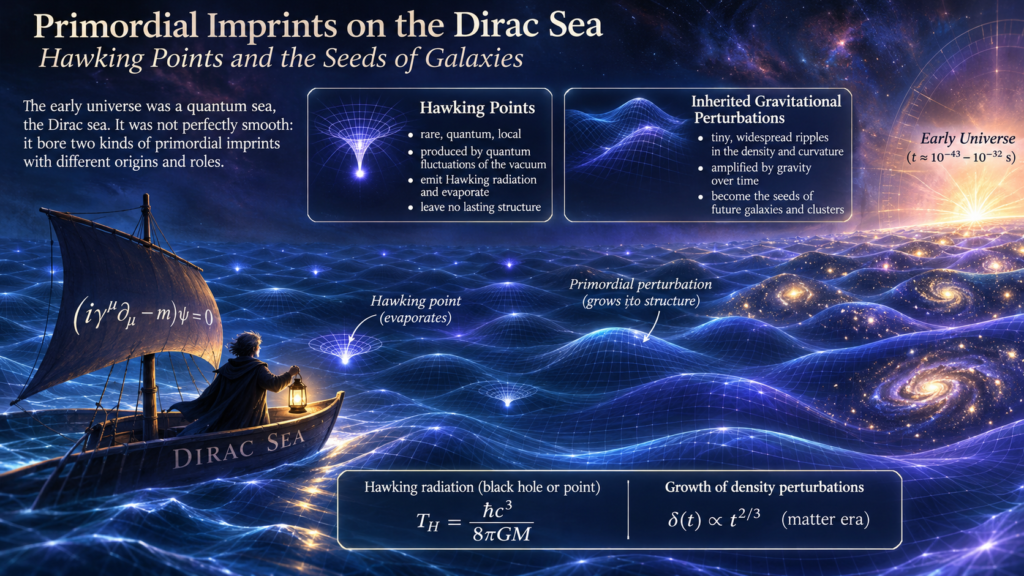
Hawking points represent Penrose’s hypothesis concerning localized traces of events from the preceding aeon. Their proposed signatures are sought primarily in particular patterns within the cosmic microwave background.
Inherited gravitational perturbations as potential seeds of future galaxies represent a different, broader hypothesis. According to this idea, certain spatial correlations might cross the conformal boundary and influence the initial perturbation spectrum and the subsequent development of cosmic structures.
The first hypothesis concerns localized events; the second concerns statistical properties of perturbations that might operate across different spatial scales.
They are not mutually exclusive, but neither follows automatically from the other.
While Hawking points form part of specific CCC proposals, a mechanism by which inherited gravitational perturbations could become the seeds of future galaxies has yet to be derived mathematically.
We must therefore distinguish a possible localized imprint from a previous aeon from a hypothetical inherited perturbation spectrum capable of influencing structure formation.
This brings us to the central research hypothesis of our discussion.
🔭 Inherited Gravitational Perturbations: Seeds of Future Galaxies?
In standard cosmology, the distribution of matter evolves from initial density perturbations.
Gravitational instability gradually amplifies particular inhomogeneities, which eventually enter the nonlinear regime and allow dark matter halos, galaxies, and large-scale cosmic structures to form.
But what if the initial perturbation spectrum did not originate exclusively from processes occurring within our own aeon?
What if the conformal boundary transmitted some geometrical correlations from the preceding one?
Such perturbations might act as nucleation centers for future structures.
We use this expression as a physical analogy, not as an established mechanism.
In linear theory, gravitational waves represent tensor perturbations, whereas the gravitational collapse of matter depends primarily on scalar density perturbations.
For inherited gravitational waves to influence galaxy formation, it would be necessary to demonstrate how their effects could be transferred into the scalar sector or otherwise modify the evolution of perturbations.
Such a conversion is not automatic.
Possible mechanisms might involve nonlinear gravitational interactions, the properties of the conformal crossover surface, or additional field dynamics.
At present, no confirmed model establishes such a process.
Nevertheless, we can formulate a testable hypothesis.
Suppose the primordial spectrum of scalar perturbations contains a standard contribution together with an additional component associated with the conformal transition:
Pζ(k) = Pₛₜₐₙ𝒹ₐᵣ𝒹(k) + ΔPᶜᶜᶜ(k)
Here, Pζ(k) represents the primordial curvature perturbation power spectrum, while ΔPᶜᶜᶜ(k) denotes a hypothetical additional component.
This equation is not a derived prediction of Penrose’s theory. It is our phenomenological way of formulating a question that could be tested.
A more general model would also need to include possible correlations between different contributions, together with the tensor perturbation spectrum.
If such an additional component exists, it might affect the amplitude of perturbations on particular spatial scales.
That, in turn, could influence the epoch when the first gravitationally bound objects begin to form.
This brings us directly to two major observational programs in modern cosmology.
📡 The CMB and JWST: Two Windows into the Same Cosmic History
The cosmic microwave background represents the earliest electromagnetic image of the Universe that we can directly observe.
Its temperature and polarization anisotropies contain information about primordial perturbations, the composition of the Universe, and its early evolution.
In standard theory, their statistics are connected to the primordial perturbation spectrum and its subsequent evolution through cosmic dynamics.
If an additional component associated with inherited perturbations from a preceding aeon truly existed, it would have to remain consistent with the already highly precise CMB measurements.
That is the first major test.
The second is provided by the James Webb Space Telescope.
JWST allows us to investigate galaxies that existed only a few hundred million years after the Big Bang.
The spectroscopically confirmed galaxy MoM-z14, with a redshift of approximately z = 14.44, belongs to an epoch roughly 280 million years after the Big Bang.
Its remarkable luminosity, compactness, and spectroscopic properties challenge certain earlier models of the evolution of the first galaxies.
But these characteristics are not automatic evidence of altered initial conditions.
They are also influenced by star-formation efficiency, chemical enrichment, dust, the stellar initial mass function, accretion processes, and radiative feedback.
This is precisely why several observables must be considered together.
Let us imagine the following research procedure.
First, we would construct a mathematical model of hypothetical inherited perturbations.
We would then calculate their effects on the CMB temperature and polarization spectra.
The same model would have to generate corresponding predictions for the initial density perturbation spectrum and its subsequent growth.
From this, we could derive the statistics of dark matter halo formation and, with appropriate astrophysical assumptions, the distribution of early galaxies.
We could then compare those predictions with JWST observations.
Of particular interest would be the abundance of galaxies at high redshift, their luminosities, spatial correlations, and inferred halo masses.
At the same time, data on large-scale cosmic structures from later epochs would have to be taken into account.
The essential requirement would be for one and the same set of initial perturbations to explain both the CMB and the later distribution of matter.
It would not be sufficient to improve agreement with JWST observations while simultaneously destroying the already achieved consistency with the CMB.
This is the difference between an attractive hypothesis and a serious physical model.
🌀 Giant Cosmic Rings and the Question of Spatial Memory
The discoveries of Alexia Lopez and her collaborators further stimulate our thinking about the largest structures in the Universe.
The Giant Arc and the Big Ring, together with more recent investigations of other enormous ring-like patterns, raise questions about the statistics of matter distribution on immense spatial scales.
These structures were identified primarily through the spatial distribution of Mg II absorption systems in the spectra of distant quasars.
They are not continuous material rings, nor has it been unambiguously established that they represent individual gravitationally connected objects.
We therefore cannot conclude that their existence alone invalidates the cosmological principle.
Still less can we claim that they are direct traces of a previous aeon.
However, if future analyses demonstrate the existence of statistically significant primordial correlations that standard models struggle to reproduce, their possible origin would become an important research question.
In that case, we could investigate whether different models of initial conditions, including conformal cosmologies, provide distinguishable predictions.
Such tests would necessarily have to account for selection effects, sample limitations, cosmic variance, and the probability of rare structures arising.
In other words, we are not merely searching for unusual shapes in the sky.
We are searching for a statistically identifiable physical signature.
🎼 Mannheim and a Possible Deeper Gravitational Symmetry
While Penrose employs conformal geometry to investigate cosmic aeons, Philip Mannheim attempts to incorporate it into the fundamental dynamics of gravitation.
His theory begins with a gravitational action based on the square of the Weyl tensor.
In abbreviated notation:
Sᵂ ∝ ∫ d⁴x √(−g) · Cμνρσ Cμνρσ
This expression assumes the appropriate contraction of tensor indices, with the necessary indices raised by the metric.
Unlike the Einstein–Hilbert action, local conformal symmetry plays a direct role in the construction of this gravitational theory.
The resulting field equations are fourth-order and permit different gravitational dynamics.
However, they also introduce serious questions concerning physical degrees of freedom, stability, quantum consistency, and agreement with observations.
Mannheim’s conformal gravity is therefore not a confirmed replacement for general relativity.
Likewise, CCC and Mannheim’s theory are not equivalent.
Nevertheless, their shared mathematical foundation raises an intriguing question.
Could conformal symmetry play a more fundamental role in gravitational physics than is currently attributed to it?
If a consistent gravitational theory were developed in which the appropriate conformal structure emerged naturally, perhaps it could also provide a deeper understanding of the conditions required for transitions between aeons.
For now, this remains a research direction rather than an established synthesis.
🔄 T-Duality and the Question of Fundamental Scales
In our earlier article, When Photons Defeat Matter: Penrose’s CCC Cosmology and T-Duality, we examined a conceptual resemblance between Penrose’s theory and T-duality in string theory.
In suitable closed-string models, T-duality relates the physics of a compact dimension of radius R to a dual description with radius:
R′ = α′ / R
This transformation also involves the exchange of momentum and winding quantum numbers.
Under particular theoretical conditions, a very small and a very large compact dimension can provide physically equivalent descriptions.
This is not the same transformation used in Penrose’s CCC.
T-duality is not evidence for conformal continuity between cosmic aeons.
But both ideas remind us of something deeply unfamiliar to everyday intuition.
Perhaps the physical size of space is not always the most fundamental information about its structure.
Perhaps certain relations, symmetries, and physical observables are deeper than the metric description we employ.
That is precisely why such analogies may have research value, provided we do not mistake them for established identities.
♾️ Existence, Transience, and Cosmic Memory
We now arrive at a question that goes beyond gravitational dynamics itself.
If each cosmic aeon is connected to the one before it, what does a beginning actually mean?
And what does an ending mean?
Penrose’s CCC does not automatically resolve the philosophical question of why there is something rather than nothing.
Even an infinite sequence of aeons does not necessarily explain the origin of the physical laws themselves.
But it changes the way we think about the temporal boundaries of existence.
Instead of an absolute beginning, the possibility of conformal continuity emerges.
Instead of complete disappearance, there is the possibility that certain geometrical relations and correlations pass into a new physical epoch.
Of course, preserving quantum information across such a transition represents a separate and highly demanding theoretical problem.
We cannot assume that conformal geometry automatically guarantees complete unitarity.
Yet perhaps somewhere in this space between geometry, thermodynamics, and quantum theory lies the possibility of a future breakthrough.
At this point, scientific thought almost inevitably encounters philosophy and poetry.
The Serbian poet Branko Miljković wrote:
“Everything that passes becomes an eternity.”
How unusual this line sounds when we contemplate Penrose’s aeons.
Not because the poet anticipated a cosmological theory, but because art and science, each speaking its own language, can explore the boundaries of our understanding of time.
In Miljković’s poetry, transience becomes eternity.
In Penrose’s cosmology, the infinite future of one aeon may become the initial boundary of another.
Both images, in their different ways, invite us to reconsider the meaning of duration.
🎹 Finale: Does the Symphony End, or Does It Transform?
At the end of our journey, we return once again to Bach.
In the Passacaglia and Fugue in C minor, a single musical motif undergoes continuous transformation.
The voices, registers, harmonic relationships, and contrapuntal structures change.
Yet through all these changes, a recognizable musical idea persists.
Perhaps this is an appropriate metaphor for the possibility of cosmic continuity.
The same material structures need not survive.
The same stars, galaxies, and black holes need not endure.
But perhaps certain physical relationships and geometrical correlations may possess a history longer than a single aeon.
Einstein revealed the dynamics of spacetime.
Weyl opened the question of local scales and deeper geometrical symmetries.
Penrose emphasized the extraordinary nature of the early Universe’s low gravitational entropy and the possibility of conformal continuity between cosmic epochs.
Mannheim developed an alternative approach to gravitation based on conformal symmetry.
Modern observations, from the cosmic microwave background to the spectra of the earliest galaxies, impose increasingly strict constraints on these and other theoretical possibilities.
Perhaps standard cosmology, with appropriate refinements, will prove sufficient to explain the new discoveries.
Perhaps evidence will emerge for radically different initial conditions.
Or perhaps a future theory of gravitation will reveal that some of today’s apparent oppositions are merely different descriptions of a deeper physical reality.
For now, we do not have a definitive answer.
But we possess something immensely valuable: questions that can be formulated mathematically and tested through observation.
If cosmic memory exists, it must not remain merely a beautiful metaphor. It must leave a trace in the measurable correlations of nature.
Perhaps such a trace will one day help us understand whether the Big Bang was the absolute beginning — or merely the beginning of our aeon.
And until then?
We shall continue our voyage across the Dirac Sea, listening to the great symphony of nature.
Perhaps its final movement has not yet been written.
Or perhaps, like a Bach fugue, it already contains the theme from which a new beginning will emerge.
The voyage continues. 🌌🌊🎼
Scientific References and Earlier Articles
Scientific sources
- Penrose, R. & Meissner, K. A. (2025). The Physics of Conformal Cyclic Cosmology. https://arxiv.org/abs/2503.24263
- Egan, C. A. & Lineweaver, C. H. (2010). A Larger Estimate of the Entropy of the Universe. The Astrophysical Journal, 710, 1825–1834. https://doi.org/10.1088/0004-637X/710/2/1825
- Naidu, R. P. et al. (2026). A Cosmic Miracle: A Remarkably Luminous Galaxy at z = 14.44 Confirmed with JWST. https://astro.theoj.org/article/156033
- NASA (2026). Webb Pushes Boundaries of Observable Universe Closer to Big Bang. https://science.nasa.gov/missions/webb/nasa-webb-pushes-boundaries-of-observable-universe-closer-to-big-bang/
- Lopez, A. M. & Clowes, R. G. (2026). Research on giant ring-like cosmic structures. https://arxiv.org/abs/2604.17534
Earlier articles on MilovanInnovation
- When Photons Defeat Matter: Penrose’s CCC Cosmology and T-Duality
- The Big Ring and the Echo from a Previous Eon
- Conformal Gravity and the Dirac Sea: Mannheim’s Symphony Beyond Einstein
- General Relativity — The Unfinished Symphony of Space, Time, and Matter
Leave a Reply