Dear explorers,
When we drew the map of our quantum odyssey in the previous post of this series and lowered our sails, the sea was calm. But every lull is only a preparation for a new wave. Today we dive into perhaps the most intimate and daring question of the entire voyage: what happens to consciousness at the moment of death? Is the I – that unique package of memories, thoughts, loves and fears – doomed to vanish, or is there a mechanism, inscribed in the very laws of quantum mechanics, that guarantees its continuity?
This is a post about quantum immortality – an idea springing from one of the most orthodox interpretations of quantum mechanics, which, on our journey, naturally merges with the picture of the Dirac Sea, the holographic principle and the Orch-OR model of consciousness.
🌀 The Root of the Idea: Everett’s Theorem and the Branching of Worlds
In 1957, Hugh Everett III, then a young physicist at Princeton, proposed an idea that remains as unsettling as it is elegant: the Many-Worlds Interpretation (MWI). According to Everett, the wave function never collapses. Instead, at every quantum measurement – at every interaction that distinguishes possible outcomes – the universe branches. Everything that can happen, happens in some branch.
From this logic directly follows what Max Tegmark later formalised as quantum immortality. Imagine Schrödinger’s cat. In one branch the cat is dead. In another it is alive. Now replace the cat with a conscious observer. If the question of life and death can be reduced to the outcome of a quantum collapse – say, whether a radioactive atom will decay or not, whether a bullet will fire or misfire – then there is always at least one branch in which the observer survives.
Consciousness, which is by definition the subjective experience of existence, will follow only those branches in which it continues to exist. From the perspective of the observer themselves, death will never occur. Others may have the experience of our death and disappearance, but we ourselves – never. In this quantum-mechanical scenario, we are all, in our own branches, immortal.
🔬 The Entropy Wall: Why Ageing Defeats Even MWI
But here, as you yourself have intuited, we encounter a huge obstacle. The second law of thermodynamics.
If death is the result of an accidental event – Russian roulette, a lightning strike – MWI offers an infinite number of branches in which the bullet misfired or the lightning missed. But what about the process of ageing? What about a disease that is not a momentary event, but a gradual, entropic march through a whole series of causally connected states?
Ageing is an entropic process. It occurs at the macroscopic level, far above the quantum scale of individual particles. There is no quantum outcome in which the entropy of a system of 10²⁸ particles spontaneously decreases and restores the body to youth. Even if we infinitely avoid the bus, cancer and stroke, entropy accumulates: the body ages, cells lose their function, microtubules lose their coherence.
Quantum immortality can prolong life indefinitely, but it cannot annul its biological end. The death of the body is the entropic boundary of MWI. When all branches in which the body can survive are exhausted, when the physiological processes that sustain consciousness in the brain and microtubules cease – the link between consciousness and body is severed.
And here our key question arises: what becomes of consciousness when the body dies?
🌊 The Moment of Transition: Return to the Dirac Sea
The answer lies in the principle we have already singled out as one of the most sacred pillars of quantum mechanics: unitarity. Information is never destroyed.
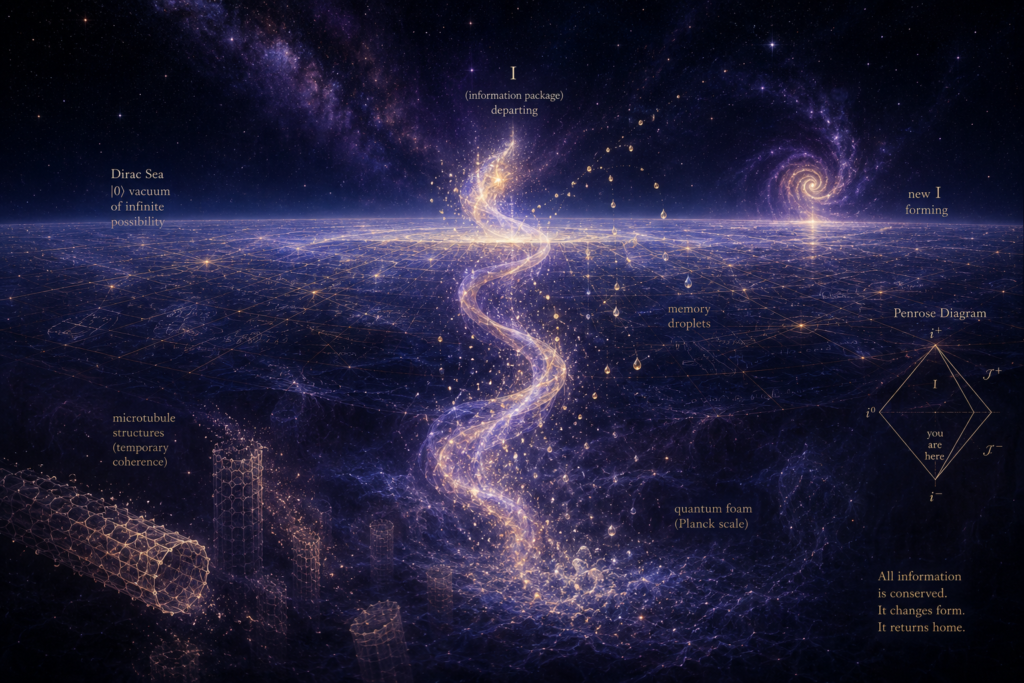
Throughout our entire voyage, we have imagined the Dirac Sea as an infinite ocean of quantum fields, a holographic film onto whose surface all information about everything happening in the depths is projected. Every conscious moment – every Orch-OR collapse in the microtubules – was an inscription onto that film. The information that constitutes the I is not stored in the brain as on a hard disk; it is woven into the very fabric of spacetime.
When the body dies, that information is not erased. It returns to the Dirac Sea. Just as a wave does not vanish when it breaks on the shore – it only transforms into another form of energy, into another configuration of the field – so too the I is not destroyed, but is reabsorbed back into the ocean from which it originated.
💔 Decoherence and Loss: The I Package in a Sea of Noise
But here we must be precise and honest about the complexity of the moment. Is the information preserved as a single and integral package?
We cannot answer with certainty, but everything we know about quantum mechanics suggests that complete preservation is unlikely.
Consciousness, according to the Orch-OR model, depends on quantum coherence within microtubules – on billions of tubulin dimers vibrating in perfect synchrony, on a surface code that corrects errors, on a state of self-organised criticality. Dying is, from the standpoint of quantum physics, the gradual loss of that coherence. Oxygen disappears, ATP no longer arrives, dipole-dipole interactions weaken. Decoherence occurs – “noise” in the signal.
What returns to the Dirac Sea is not necessarily a perfectly preserved, integral I. It is an information package that has suffered a certain degree of decoherence, and with it a partial loss of content. Some memories, some connections, some aspects of personality – may be irretrievably lost in the noise.
Yet what remains – the core of coherence, the deepest layer of quantum entanglement that constitutes the essence of a being – cannot be entirely annulled. As we saw with Renner’s analysis of the black hole information paradox, information is preserved; the question is only its usefulness, its readability.
🔑 The Need for a Key: Why Nothing is Read Automatically
And here we arrive at perhaps the most important insight of this post.
Information that has returned to the Dirac Sea – even if it has survived decoherence as a relatively integral package – cannot be automatically decoded, “read”, in the next iteration of existence.
Recall the lesson from the holographic principle and the black hole paradox: bare information is not enough. A reference system is needed. To decode information from a single black hole, you need other black holes with which to establish correlations. Without a key, information is preserved but mute – latent, unreadable, like an encrypted message without a cipher.
Analogously, the I package that has returned to the sea cannot simply “inhabit” a new life with full memory of the previous one. A new hardware is needed – a new brain, new microtubules, a new ensemble of qubits – capable of entering into resonance with that information. And even when that happens, without the appropriate “key” – without a reference system linking the old and the new – the memories would remain locked.
This throws an entirely new light on ancient concepts.
📜 Ancient Narratives in a New, Quantum-Informational Light
Religious traditions across the world – from Hinduism and Buddhism to the Pythagoreans and early Christian mystics – have spoken for centuries about reincarnation, about the transmigration of the soul, about the cycle of birth and death. Almost all these traditions share two key observations:
- Loss of memory: The soul is reborn, but does not remember previous lives. Something is lost in the crossing.
- Loss of part of the soul: Some traditions speak of the “fragmentation of the soul”, of parts that remain trapped in the previous life or are scattered.
From the perspective of quantum information theory, these are astonishingly coherent insights. Loss of memory is a direct consequence of decoherence and the lack of a reference system for decoding. Loss of part of the soul is a consequence of the partial disintegration of the information package due to entropy.
Dr Michael Newton, a clinical psychologist who spent decades researching the phenomena of regressive hypnosis, left a rich body of accounts from his patients. Their reports – about “life between lives”, about “beings of light”, about planning the next incarnation – show a remarkable consistency. From the standpoint of our metaphor, these could be the subjective experiences of a consciousness that, between two bodily lives, finds itself in the Dirac Sea – in a state in which information is preserved, but not yet “inscribed” into new hardware.
Of course, for a more objective interpretation of such phenomena, the further development of quantum information theory, and perhaps quantum computers, will be needed. Only when we are able to model precisely what happens to a highly entangled quantum system when it loses its physical substrate will we be able to say more about the fate of the I.
🔮 Horizons: From Quantum Immortality to Quantum Reincarnation
What we can say today, without exaggeration and without veering into pseudoscience, is the following:
- Quantum mechanics, through MWI, suggests that death is something that happens to others, but not to ourselves. Consciousness always continues in the branch of survival – as long as entropy permits.
- Entropy sets the limit. Ageing and the death of the body are inevitable; quantum immortality is more a bridge to the next question than a final answer.
- Unitarity guarantees the preservation of information. The
Iis not destroyed, but returns to the Dirac Sea – a holographic reservoir of all experience. - But the return is not perfect. Decoherence takes away part of the package; information is preserved, but not necessarily intact.
- A key is needed for renewed reading. Without new hardware and a reference system, information remains latent – just as ancient traditions speak of the loss of memory.
Is this proof of reincarnation? No. Is this proof that death is the end of everything? Also no. What it is – is a solid, physically grounded basis for hope. Hope that the I is not just a random foamy wave on the surface of the sea, but something which, in accordance with the deepest laws of reality, cannot be lost.
⛵ Epilogue: The Sea Remembers Every Wave
Dear explorers,
When Dirac proposed his “sea” in 1930 – an infinite ocean of negative energy – he could not have imagined that ninety-five years later we would be searching that sea for the fate of the soul itself. And yet, that is the nature of every true metaphor: it grows with us, reveals new layers, becomes ever deeper the more we explore it.
If the Dirac Sea is truly a holographic film, and if all conscious moments are permanently inscribed upon it, then nothing – no thought, no tear, no smile – is in vain. Everything is preserved. Everything is part of the eternal book of existence.
And we, as we sail onward, can look at the horizon more peacefully. For we know that the sea remembers every wave.
The voyage continues.
This post continues the series begun with “⚛️ Quantum Archaeology: Reading the Past from the Dirac Sea”, continued through the map of the quantum odyssey, and now opens a new chapter on the fate of consciousness after the death of the body.
Leave a Reply