Dear explorers at the crossroads of science and spirit,
When we built the picture of the Dirac Sea in previous posts, we spoke of waves, winds, vortices and currents. We spoke of entropy that grows, of the gravitational wind that smooths the waves, of collapse that resets the system and opens a new eon. But there is a concept that connects all of this in a way that is simultaneously mathematically precise and poetically profound: quantum complexity.
This concept comes from the world of quantum computing. Yet it is not merely an engineering measure. It is, as the great Leonard Susskind argues, a bridge between quantum mechanics, gravity and the very nature of time. Today we dive into that bridge.
🧠 What is Quantum Complexity?
Imagine a quantum computer with n qubits. Its state is a wave function – a vector in a Hilbert space of dimension . Computation is a voyage through that space: we start from some initial state and, step by step, apply quantum logic gates – unitary transformations acting on one or two qubits.
Quantum complexity is a measure that answers a simple question: how hard is it to get from state A to state B? More precisely, it is the minimal number of elementary gates needed to evolve one state into another. It is the length of the shortest algorithm connecting two states.
What is crucial is how complexity grows with time. And here things become extraordinarily interesting.
🔥 Complexity vs. Entropy: Two Different Laws of Growth
Entropy and complexity are different quantities – and they grow according to completely different laws.
Entropy is a measure of disorder. When we let a quantum system evolve, entropy grows rapidly – but soon reaches a plateau. That is the maximal thermal entropy, a state in which the system is “completely mixed”. After that, entropy no longer changes.
Complexity behaves quite differently. It continues to grow long after entropy has saturated. It does not grow linearly, but exponentially. For a system of qubits, the maximal complexity is . Adding just a single qubit – from to – doubles the maximum possible complexity of the system.
Imagine it this way: entropy is like the waves on the surface of the sea. They quickly grow choppy, but soon reach saturation. Complexity, however, is like the depth of the sea. It continues to grow, layer by layer, long after the surface has calmed.
🕳️ Susskind and Black Holes: “Complexity = Volume”
Here Leonard Susskind enters the stage. He noticed something astonishing: the same relationship between entropy and complexity exists for black holes.
The Bekenstein-Hawking entropy of a black hole is proportional to the surface area of the horizon. It is quickly established after the black hole forms. But the interior of a black hole – its volume behind the horizon – continues to grow for a long, long time. As if the space inside the black hole keeps being “created” even after its external appearance has settled.
Susskind proposed a bold hypothesis: complexity = volume. The volume of the interior of a black hole (measured by the Einstein tensor) is proportional to the quantum complexity of the state describing the black hole. Entropy is the surface area; complexity is what fills the interior.
This is a bridge between quantum computing and gravity: complexity is not merely an abstract measure of algorithmic difficulty. It has a geometric correlate – it is literally the space inside a black hole.
🌊 The Dirac Sea as Hilbert Space
Now we can bring this insight back into our metaphor.
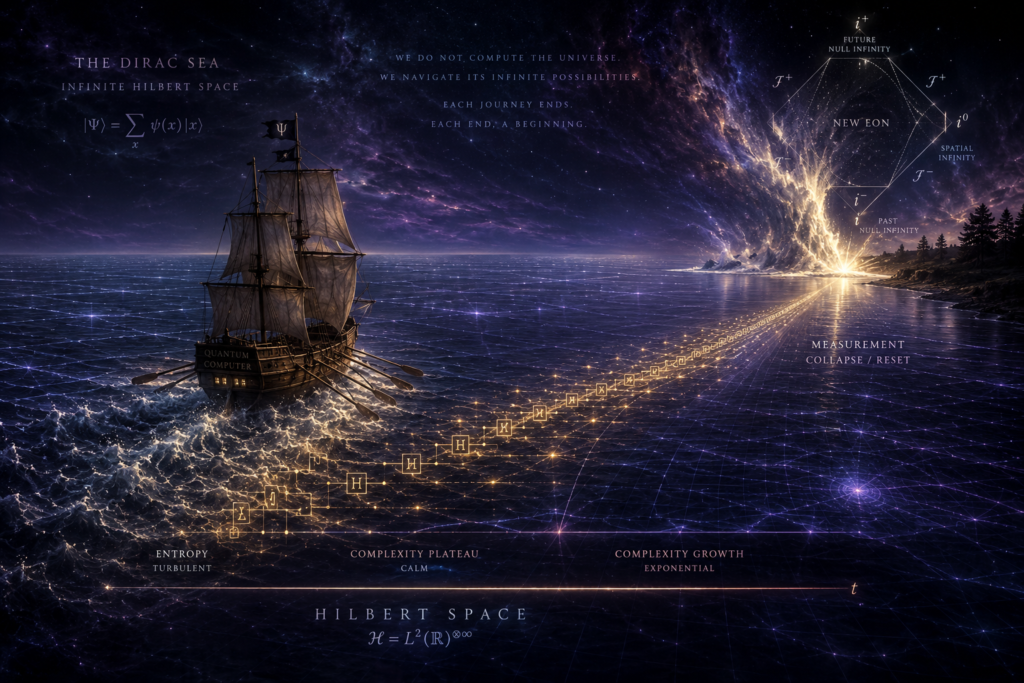
Imagine the Dirac Sea as Hilbert space – the infinite-dimensional ocean of all possible quantum states. A quantum computer is a ship sailing that sea.
- The initial state is a calm shore – the place from which we set sail.
- Qubits are the water particles the ship stirs into motion.
- Each quantum gate is a stroke of the oar – a unitary transformation changing the state of the sea.
- The algorithm is the ship’s course – a pre-planned path through the sea.
- Entropy is the degree of choppiness in the water behind the ship – waves that spread and mix, but soon reach saturation.
- Complexity is the length of the distance travelled – how deep the ship has sailed into the sea, how far it is from the shore of the initial state.
When the ship first sets out, both entropy and complexity grow. But after a while, entropy reaches a plateau – the sea behind the ship is already maximally choppy. Complexity, however, continues to grow. Each new stroke of the oar takes the ship further and further from the shore, deeper and deeper into the sea.
⏳ Maximal Complexity and Collapse: The Wave Strikes the Shore
And now we come to the key moment.
When the ship reaches maximal complexity – when the distance travelled through Hilbert space has reached its limit of – further rowing becomes pointless. The state of the system has become maximally complex, equivalent to a random state from the Haar ensemble. Any subsequent gate cannot “complicate” the state more than it already is.
That is the moment when the algorithm must end. We perform a measurement. The wave function collapses. The system is reduced to a classical outcome.
In our picture of the Dirac Sea, this is as if the wave has struck the shore. All the energy of the voyage – all the complexity, all the entanglements, all the unitary transformations – suddenly crashes into a single classical result. The sea calms. The system resets.
And then – we begin anew. The initial state is reset to zero complexity and zero entropy. We are ready for a new algorithm, a new voyage, a new eon.
🔮 The Link with CCC and Objective Reduction
This picture is not merely an analogy. It is essentially connected to the deep questions we have already raised.
In Penrose’s Conformal Cyclic Cosmology (CCC) , each eon ends when entropy and complexity reach their maximum – when the entire universe is diluted, thermal, without structure. Then a transition occurs: the conformal future of the old eon becomes the conformal beginning of the new one. The Big Bang. Reset. A new eon.
In quantum computing, the end of an algorithm and the measurement are precisely that: a reset. The initial state of a new problem is always of zero complexity. As if every algorithm is a small eon, and every collapse – a small Big Bang.
And here the boldest question may be posed: what causes the collapse at the end of the algorithm?
In standard quantum mechanics, it is the observer – the one who performs the measurement. But in Penrose’s picture, there may also be a deeper reason: when complexity (and with it the interior volume, according to Susskind) becomes large enough, the gravitational self-energy reaches the threshold of objective reduction. Collapse happens spontaneously, not because we decided to measure, but because the sea has become too deep.
If that is correct, then there is a fundamental limit not only for quantum computing, but for any quantum process in nature. And that limit is set by gravity.
🌌 Epilogue: Every Algorithm is an Eon
In the Dirac Sea, every algorithm is a voyage. Every computation is a life. Every measurement is a death and a rebirth.
We begin from the shore, row through the sea, leave behind us waves of entropy, penetrate ever deeper – until we reach the limit. Then the wave strikes the shore. The sea calms. And we begin again.
Perhaps that is what the universe has been doing all along: computing. Evolving. Increasing complexity. Reaching the maximum. Collapsing. And starting anew.
And perhaps we too – our consciousness, our I – are only algorithms that have become aware of themselves. Voyages that know they are voyaging. Waves that know they are waves.
And the sea? The sea is always there. Infinite. Patient. Ready for the next eon.
This post continues the series begun with “⚛️ Quantum Archaeology: Reading the Past from the Dirac Sea”, continued through the map of the quantum odyssey, the posts on the observer paradox and on why the quantum must yield to gravity.
Leave a Reply