Dear explorers,
In the previous post on quantum complexity, we set sail into a world where computation becomes a voyage through Hilbert space, an algorithm is the ship’s course, and a measurement is a wave striking the shore that resets the system for a new eon. But the sea is, as always, deeper than it first appears.
Today we return to this theme. Not because we missed something, but because there are layers that demand more precise instruments and a steadier hand on the tiller. For the terrain we are entering is slippery – it is easy here to slide from mathematics into poetry, or from poetry into pseudoscience. And we want both: precision and depth.
📊 Local and Non-Local: Entropy and Complexity as Two Natures
There is a fundamental difference between entropy and quantum complexity that fits perfectly into our picture of the Dirac Sea, and which can be summed up in a single sentence:
Entropy is local. Quantum complexity is non-local.
What does this mean?
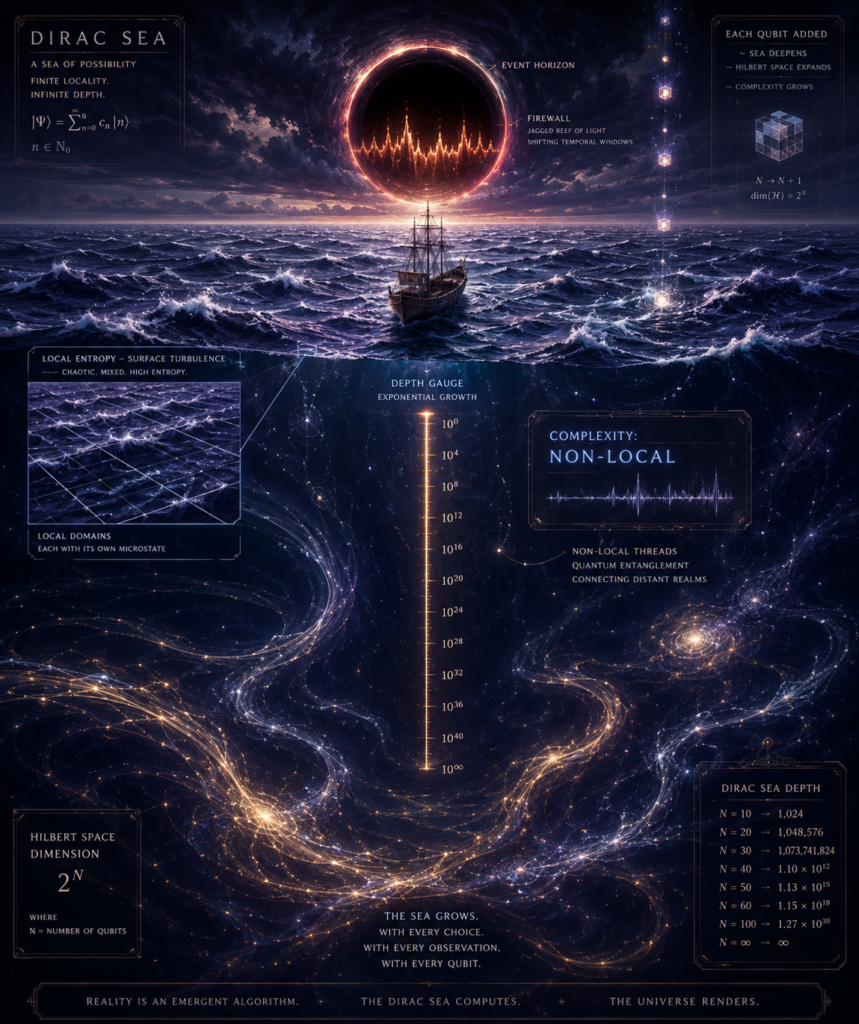
Entropy can be calculated by dividing the system into small domains, calculating the entropy of each domain individually, and then summing them up. It is like measuring the choppiness of the sea by looking at each square metre of the surface separately and summing the results. When a system reaches thermodynamic equilibrium – maximal entropy – it is no longer capable of performing work. If we are talking about a biological entity, that is death. The waves have mixed, the temperature has equalised, there are no more gradients the ship could use for movement.
But – and here is the crucial twist – the informational usefulness of the system is not necessarily exhausted. A system that is thermodynamically dead can still process information. It can compute. It can sail.
Quantum complexity is the measure of exactly that: how hard it is to get from one state to another. But unlike entropy, it cannot be obtained by simply summing local contributions. It depends on the connections between all parts of the system – on how all parts of the sea are mutually entangled, on how information is distributed throughout the whole system. It is like measuring the depth of the sea: it depends not just on a single point, but on the shape of the entire ocean floor, on all the currents that have shaped it, on the whole history of the sea.
This has a holographic essence. Complexity is inscribed in the whole, not in the parts. Just as the information about the interior of a black hole is inscribed on its horizon – you cannot read it by looking at only one part of the horizon. You must encompass it all.
🧊 Thermodynamic Death and Informational Usefulness
We can now understand one of the most intriguing tensions at the heart of quantum mechanics.
A system can be in a state of thermodynamic equilibrium – entropy is at its maximum, there is no more free energy for work. In the biological sense, that is the death of the body. But the quantum complexity of that system can continue to grow. It continues to grow exponentially long after entropy has saturated.
What does this mean intuitively? Imagine a ship that has reached the middle of the ocean. The wind has died – there are no more pressure gradients for the sails to exploit. Thermodynamically, the ship is dead. But the sea beneath it is still deep. And that depth continues to grow. Each new stroke of the oar does not move the ship forward – it is already at its destination – but deepens the sea beneath it.
If the ship could dive, that depth would be useful to it. In quantum computing, that depth is useful – it is a resource for computation. And as long as complexity has not reached its maximum ( for qubits), the computer can continue to process information.
➕ Adding One Qubit: How the Sea Expands
And now we come to one of the most astonishing properties of quantum complexity – the one hinted at in the previous post on the topic of quantum complexity.
Imagine a quantum computer with n qubits. It has reached maximal entropy (it is thermodynamically dead) and has just reached maximal complexity (it is informationally saturated). Every further operation is merely a quantum perturbation – a fluctuation that does not contribute to useful computation. The sea has reached its deepest bottom. You can go no further.
But now add just one qubit. The system now has qubits. The entropy has barely changed – one qubit does not significantly alter the thermodynamic picture. But the maximal complexity has doubled: from to . And the time needed to reach that new maximal complexity is once again exponentially long – just as long as it took for the system with qubits.
It is as if you sailed your ship to the deepest point of the sea, touched the bottom, thought the voyage was over – and then the sea expands. A new dimension is added, a new direction in Hilbert space, a new axis along which depth can be measured. And suddenly you have an entirely new ocean before you.
With just one additional degree of freedom.
🔥 Return to the Firewall: Complexity and the AMPS Paradox
And now we can return to one of the most dramatic themes of our voyage – the AMPS paradox and the firewall.
In the AMPS paradox, the firewall is a place inside the horizon of a black hole where quantum entanglements break and where any observer attempting to enter the black hole would be incinerated. It is the place where the gravitational wind smooths the waves so violently that nothing can survive.
But, as Susskind suggests, the position of the firewall is not fixed. It depends on the complexity of the black hole’s state. As complexity grows – and with it the interior volume (according to the “Complexity = Volume” hypothesis) – the firewall moves inward, away from the horizon. The older and more complex the black hole, the deeper the firewall lies in its interior.
But complexity, as we have said, is not static. When it reaches its maximum, it fluctuates. It decreases and increases according to the laws of quantum probability. Those fluctuations shift the firewall back and forth, creating temporal windows – moments when the black hole is “safe” to enter.
In our picture of the Dirac Sea:
- The firewall is a reef upon which waves break – a place where the gravitational wind is so strong it smooths everything before it.
- As complexity grows, the reef shifts toward deeper water – away from the horizon, deeper into the interior.
- But as complexity fluctuates, the reef shifts back and forth, creating passages – moments when a ship can pass through the horizon without being dashed against the rocks by the wind.
This means a black hole is not a static dungeon. It is a dynamic system whose internal structure depends on its history – on how long it has been “computing”, how much complexity it has accumulated, and in which phase of fluctuation it currently finds itself.
🌌 Epilogue: The Sea That Expands
In the Dirac Sea, every qubit is a new dimension. Every algorithm is a new voyage. Every collapse is a new eon.
But what we have learned today is that the sea is not static. It expands. With every new degree of freedom, with every new qubit, an entirely new ocean of depth opens up. And what was the bottom yesterday becomes a shallow on the way to a new horizon today.
And just as the firewall fluctuates and opens passages through the black hole horizon, so too does our understanding fluctuate – periods of clarity and confusion, insight and blindness alternate. But every time we add one new insight – one new qubit to our collective understanding – the sea expands. And what looked like the end of the voyage becomes only the beginning of a new one.
The sea is always clear. The horizon is always open. The voyage continues.
This post continues the series begun with “⚛️ Quantum Archaeology: Reading the Past from the Dirac Sea”, continued through the map of the quantum odyssey, posts on the observer paradox, Bohmian mechanics, and the first post on quantum complexity.
Leave a Reply