
Dear explorers,
In the previous post we sailed through the Andromeda paradox and discovered that already in special relativity, “now” is not absolute – that a walk toward a distant galaxy shifts “now” in that galaxy by eight days. But now we must dive even deeper. For there is an even more hidden property of reality, concealed in the very equations of quantum field theory, which has eluded full understanding for decades.
That property is negative frequency. And it leads to an idea that is simultaneously unsettling and magnificent: that at the deepest level of the Dirac Sea, time knows no direction.
🎼 The Classical Root: The Wave Equation and the Symmetry of Time
Everything begins with something seemingly innocuous. You solve the classical wave equation for a real field :
By Fourier transforming in time, you obtain modes of the form and . If we define as a positive number, oscillates with frequency , while can be treated either as an oscillation with negative frequency , or as the same positive with the sign of time reversed.
In this classical context, both signs are symmetric and entirely legitimate. But the essence already hides here: if we rewrite as , we see that it behaves as a normal positive frequency in time running backward. Already at the level of plane waves, negative frequency is equivalent to positive frequency with the direction of time reversed.
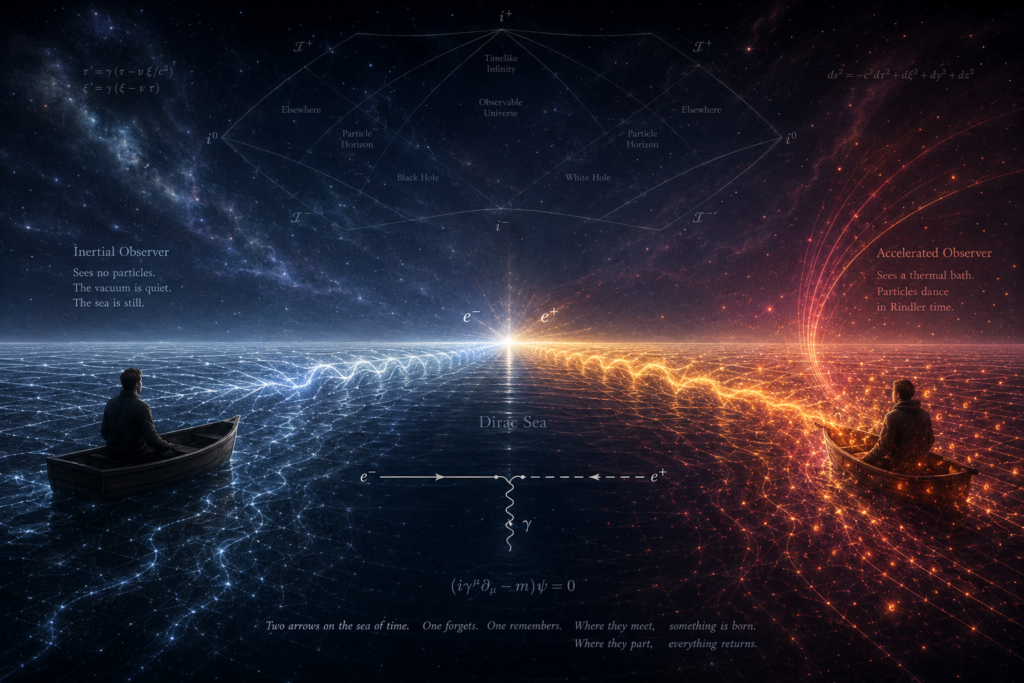
In our picture of the Dirac Sea, this means that the waves on the surface know both directions. The sea makes no fundamental distinction between an incoming wave and an outgoing wave – they are two faces of the same mathematical structure.
⚛️ Quantization: A Renaming That Changes Everything
When we quantize the field, the standard trick for obtaining positive-definite energy is to interpret the negative-frequency modes as creation operators. For a real scalar field:
where . Both terms carry the same positive energy ; only the sign in front of in the exponent differs.
The first term () annihilates a particle of energy and moves forward in time. The second term () creates a particle of energy and formally looks as though it has a negative frequency – or as if time flows backward.
In the standard formalism, we simply rename that negative frequency as the creation of positive energy. We say: it is not really propagation backward through time; it is just a mathematical artefact. But is it really?
🕳️ Dirac and the Sea: When Negative Frequencies Become Real
The situation changes dramatically when we turn to charged fields and Dirac fermions.
For the Dirac field, the solution with negative frequency () originally corresponds to a state of negative energy. That is no mathematical trick – it is a direct prediction of the equation. Dirac was faced with a choice: either to discard these solutions as unphysical, or to find a physical place for them.
His answer was brilliant: the sea. He filled all the negative-energy states, and the holes in that sea – places where a negative-energy electron is missing – became positrons. Antiparticles were not predicted; they emerged from the mathematics itself, from the necessity of fitting negative frequencies into a consistent physical picture.
In our picture of the Dirac Sea, this means that the sea is not empty. It is charged. Filled to the brim. And every time we pull a particle out of it, a hole remains – a wave that behaves as though time flows backward.
⏪ Feynman and Stückelberg: Antiparticles as Time Travelers
In 1941, Ernst Stückelberg, and later Richard Feynman, offered an equivalent but more elegant picture: a negative-frequency solution is a positive-energy particle moving backward through time.
This is no mere mathematical transformation. It is a physical picture that allows you to draw Feynman diagrams with virtual particles moving in both directions along the time axis. An electron moving forward in time? That is an electron. An electron moving backward? That is a positron.
In the time domain, the Feynman propagator reads:
The first term corresponds to a particle going from to into the future. The second term corresponds to a particle going from to backward through time. For a real field, these are identical excitations; for a charged field, it is an antiparticle traveling backward.
Thus the answer to the question “is this really propagation backward through time?” is: yes, in the context of virtual particles, where the direction of time is not fixed until a measurement is made.
In the Dirac Sea, this means that every wave has its twin – a wave traveling in the opposite direction through time. The sea does not distinguish past from future at the level of virtual excitations.
🌡️ The Unruh Effect: When Different Observers See Different Particles
And now we come to the most dramatic confirmation of this picture.
In the Rindler frame – that is, from the perspective of an accelerated observer – the positive-frequency modes for one observer become a mixture of positive and negative frequencies for an inertial observer. This relativity of frequency decomposition leads to the Unruh effect: an accelerated detector sees a thermal ensemble of particles where an inertial observer sees a cold vacuum.
This follows directly from the fact that the concept of “positive frequency” depends on the choice of time coordinate. If time is defined along the hyperbolic trajectory of an accelerated observer, the corresponding frequencies are shifted relative to the global Minkowski time.
In the language of our voyage: a negative frequency in one frame becomes a real particle in another. What is for one captain merely a mathematical artefact – a harmless term in an equation – is for another captain a real wave, a real particle, real energy.
The same mathematical structure that gives you “propagation backward” in Feynman diagrams also gives you real thermal particles in the Rindler frame. The boundary between formalism and reality dissolves.
🧠 From Negative Frequencies to Consciousness
Now we can see the whole picture.
Already in the classical wave equation, negative frequencies are symmetric to positive ones. In quantization, we rename them as creation operators – but that does not eliminate the physical fact that the term corresponds to evolution with the sign of time reversed. In the Dirac equation, they become real – antiparticles, the sea, holes. In Feynman diagrams, they become virtual particles that know no direction of time. And in the Rindler frame, they become real particles for an accelerated observer.
This is a direct extension of the Andromeda paradox and the relativity of simultaneity. If “now” is not absolute, then the direction of time at the level of elementary processes is not absolute either. Special relativity did this for time; quantum field theory did it for particles and antiparticles.
And right here we return to the deepest question of our voyage: how do the macroscopic flow of time and causality emerge from this non-causal foundation?
Penrose’s answer – which we have already laid out in previous posts – is that objective reduction (OR) breaks the symmetry. The act of wave function collapse, triggered by a gravitational threshold, selects one branch, one history, one direction of time. Consciousness is not a passive observer of a symmetric sea. It is an active participant that continually resolves superpositions and tailors the flow of time.
⛵ Epilogue: Waves That Know Both Directions
In the Dirac Sea, at the deepest level, there is no arrow of time. Waves move forward and backward. Particles and antiparticles are merely two faces of the same wave. Past and future are symmetric – until something happens.
And that something is measurement. Collapse. Reduction. Consciousness.
Every time the I experiences now, the sea becomes defined. One direction, one history, one time is selected. And it is precisely that act – that ceaseless, everyday, seemingly banal act of existence – that breaks the symmetry and creates the illusion that time flows only forward.
But we now know that is only half the story. The other half is still there, in the depths of the sea, where waves still travel in both directions, where past and future are still one.
And perhaps that is precisely what makes the Dirac Sea so magnificent: it is simultaneously symmetric and asymmetric, eternal and momentary, timeless and immersed in time.
The sea is always clear. The horizon is always open. And time – time is a wave waiting for consciousness to select it.
This post continues the series begun with “⚛️ Quantum Archaeology: Reading the Past from the Dirac Sea”, continued through the map of the quantum odyssey, posts on the observer paradox, Bohmian mechanics, quantum complexity, eigenstate thermalization, entropy, infinities, broken symmetries, dark matter, and the Andromeda paradox.
Leave a Reply