
Dear explorers,
In our previous voyage we discovered that the Dirac Sea is salty – that the Higgs field permeates the entire ocean and gives mass to the particles that swim through it. But every experienced mariner knows that beyond the question of saltiness lies an even deeper question: how deep is the sea upon which we sail? And is the bottom we have grown accustomed to truly the final one?
Today we dive into the abyss beneath the seafloor itself. For the precise mass of the Higgs boson – those famous 125 GeV measured in 2012 at CERN – tells us not only about the mass of particles. It whispers to us something far more unsettling: our vacuum, our Dirac Sea, may not be stable. Beneath its floor there may exist a chasm that could swallow everything.
🧊 Landau’s Problem: When Theory Explodes
The story begins long before the discovery of the Higgs boson, in Soviet Russia in the 1950s. Lev Landau, one of the most brilliant physicists of his era, was working with his collaborators – Abrikosov and Khalatnikov – on a problem that appeared to be a technical abstraction, but which turned out to be prophetic.
In quantum field theory, the effective charge – the coupling constant – is not a constant. It changes with the energy scale at which we perform the measurement. This is described by the renormalization group and the beta function. In quantum electrodynamics (QED), for example, the fine-structure constant α grows with energy. If one were to extrapolate it to infinite energies, the theory predicts a so-called Landau pole – an energy at which the coupling constant would formally become infinite.
This means either that QED is not a fundamental theory, or that new physics must exist before the Landau pole is reached. Fortunately, for QED the Landau pole lies at unimaginably high energies, far beyond the Planck scale, so it is practically not a problem for today’s physics.
But for a pure scalar field – precisely the kind the Higgs field is – the situation is far more serious.
For a scalar field with a interaction (exactly what the Higgs potential is), the beta function is positive:
This means that as we go to higher energies, the coupling constant grows. Landau showed that this constant diverges – becomes infinite – at a finite energy scale, the so-called Landau pole. The only way to avoid this is for to be exactly zero at all scales – but then there is no interaction at all. The theory becomes trivial: either non-interacting (useless), or inconsistent at high energies.
Before the discovery of the Higgs, this was an academic problem. Many hoped that a fundamental scalar field did not exist in nature at all, because that would mean the Standard Model lacked this unpleasant pathology.
💥 4 July 2012 and a New Hope
When the Higgs boson was discovered at CERN in 2012, physicists received confirmation that a fundamental scalar field truly exists. But with that, Landau’s torment became real, not merely hypothetical. The question arose: if the Higgs is fundamental, what prevents the entire theory from exploding at some high scale?
And then we also received a precise number: the mass of the Higgs is about 125 GeV.
And here a fascinating twist occurs.
At the energy of electroweak symmetry breaking, the coupling constant is approximately . That is not a large value. When the contributions of all the particles of the Standard Model are taken into account, especially the top quark, something unexpected happens:
- the Higgs itself tends to increase ,
- but the top quark gives a huge negative contribution and decreases .
The result is that does not grow, but slowly falls. At energies of around to GeV, it passes through zero. And when becomes negative, the Higgs potential turns inside out – and our vacuum is no longer the lowest energy state.
Thus, the Landau pole does not appear at all in the Standard Model with a 125 GeV Higgs. Instead, a different problem emerges: the potential becomes negative at very high energies. In other words:
- a heavy Higgs means the danger of triviality (the Landau pole),
- a light Higgs means the danger of vacuum instability.
🎯 A Perfectly Awkward Value
A Higgs of 125 GeV sits between these two scenarios, and the mass of the top quark is around 173 GeV. These two values together determine how the Higgs potential changes at extremely high energies.
Calculations show the following:
- had the Higgs been only a few GeV heavier (around 129–130 GeV), the vacuum would be completely stable;
- had it been a few GeV lighter, the vacuum would have become unstable;
- with 125 GeV we find ourselves exactly between those two regions. Right on the edge.
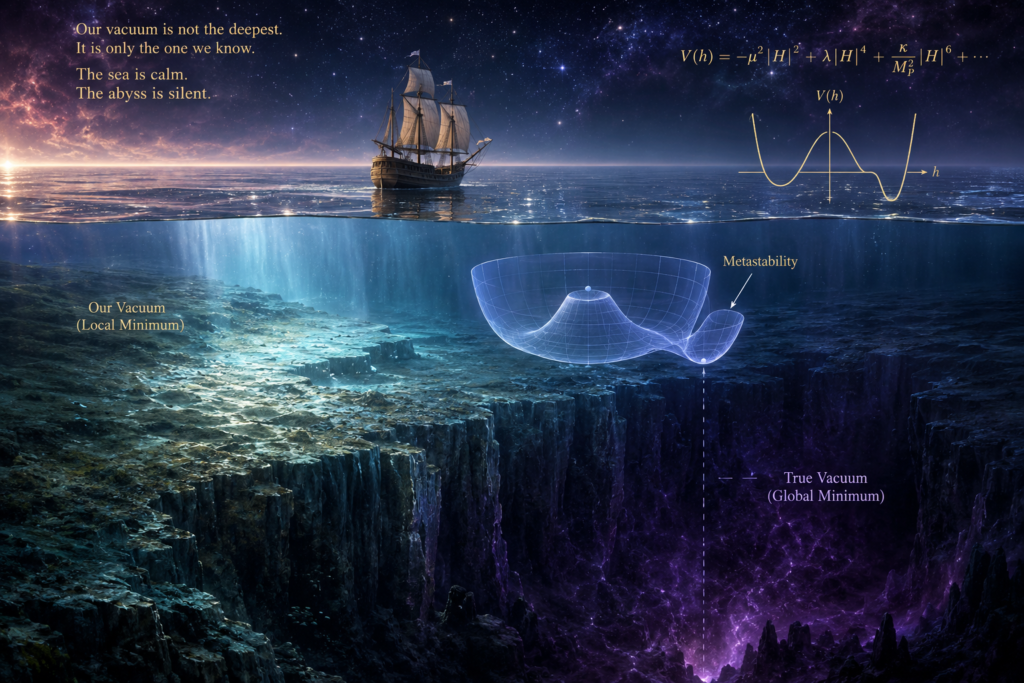
This means that at very large energies the effective Higgs potential can bend in such a way that there exists another, deeper energy minimum. Our vacuum is not necessarily the final state, but merely a local minimum. It is as if we measured the depth of the sea and discovered that the floor upon which our ship rests is not the true seafloor – it is only a vast, almost endlessly stable basin. Somewhere at much higher energies there could exist an even deeper “ocean trench” into which the Dirac Sea and our entire existence could collapse.
⏳ Metastability and the Fate of the Universe
If the vacuum is truly metastable, how long can it survive?
The calculated lifetime of its decay is unimaginably long: far, far longer than the age of the universe. Estimates give times on the order of years or even much more, depending on the assumptions. Thus, even if the vacuum is metastable, the probability of it decaying during the entire history of the universe is practically negligible.
But the very fact that we are so close to the boundary between stability and instability is fascinating. It is as though nature deliberately chose this “perfectly awkward” value.
Why? Several possibilities:
- perhaps it is pure chance;
- perhaps there exists new physics that stabilizes the Higgs potential (supersymmetry, composite Higgs, extra dimensions);
- perhaps it is a consequence of cosmological evolution or even anthropic selection within a multiverse;
- or it is a hint that the Standard Model is not a complete theory.
It is interesting that this metastability is extremely sensitive to the precise values of the masses of the Higgs boson and the top quark. A tiny change of only about 1 GeV can alter the conclusion as to whether the vacuum is completely stable or only metastable. That is why enormous effort is invested today in ever more precise measurements of these quantities.
🌊 Synthesis with Our Previous Voyages
How does this story fit into the archipelago of our voyage so far?
The Dirac Sea and the chasm. If our vacuum is only a local minimum, then the Dirac Sea – that infinite ocean of quantum fluctuations – is actually shallow. Beneath its floor there exists a chasm. Not a black hole, but something far more final: the last act of existence itself. Or, perhaps, the end of one eon and a new beginning.
Penrose’s CCC. In Penrose’s Conformal Cyclic Cosmology, each eon ends when all space becomes conformally flat, and information is remapped into a new eon. The metastability of the Higgs vacuum could be precisely the trigger for that transition. The collapse of the false vacuum into the true minimum would be an event that resets the universe – a new Big Bang.
Mirror matter and stabilization. If a mirror sector exists with its own Higgs field, perhaps the total potential – combined from both sectors – remains stable even when our sector becomes metastable. Mirror matter would thus be a cosmic fuse preventing our sea from collapsing.
Mannheim and conformal gravity. Mannheim’s theory predicts that particle masses are not fundamental, but are generated by conformal anomalies. In that picture, the question of the stability of the Higgs potential is perhaps wrongly posed – because what we call the Higgs field is only an effective manifestation of a deeper, conformal structure.
⛵ Epilogue: Above the Chasm
Dear explorers, we have measured the depth. It reads 125 GeV. And we have discovered that the sea is perhaps shallower than we thought – or, more precisely, that its floor is not the true floor.
Beneath us lies a chasm. Invisible, silent, distant at unimaginable energies. It does not threaten our everyday existence; our universe will last far, far longer than it has existed so far. But it is there. A reminder that nothing is eternal – but also that every end can be a new beginning.
For as long as a chasm exists, there exists also the possibility that the old world collapses into it and a new world is born from it. Just as Dirac once filled the sea to avoid the abyss, we now gaze into that abyss and ask: what lies at its bottom?
Our voyage continues. Until we touch the true seafloor – or until we discover that it does not exist at all.
The sea is always clear. The horizon is always open. And the chasm – the chasm waits patiently, as it always has. 🌊🔬💥
This post continues the series begun with “⚛️ Quantum Archaeology: Reading the Past from the Dirac Sea”, continued through the map of the quantum odyssey and all our previous voyages, especially the previous post on the Higgs field as the salt of the Dirac Sea.
Leave a Reply