Dear explorers,
In our voyages so far across the Dirac Sea, we have constantly returned to moments of genius of our quiet captain, Paul Dirac. His equation, his sea, his monopoles – all have been lighthouses. But there is one idea of Dirac’s that was for decades dismissed as “eccentric numerology”, only to re-emerge today, in the light of the crisis of contemporary cosmology, as prophetic.
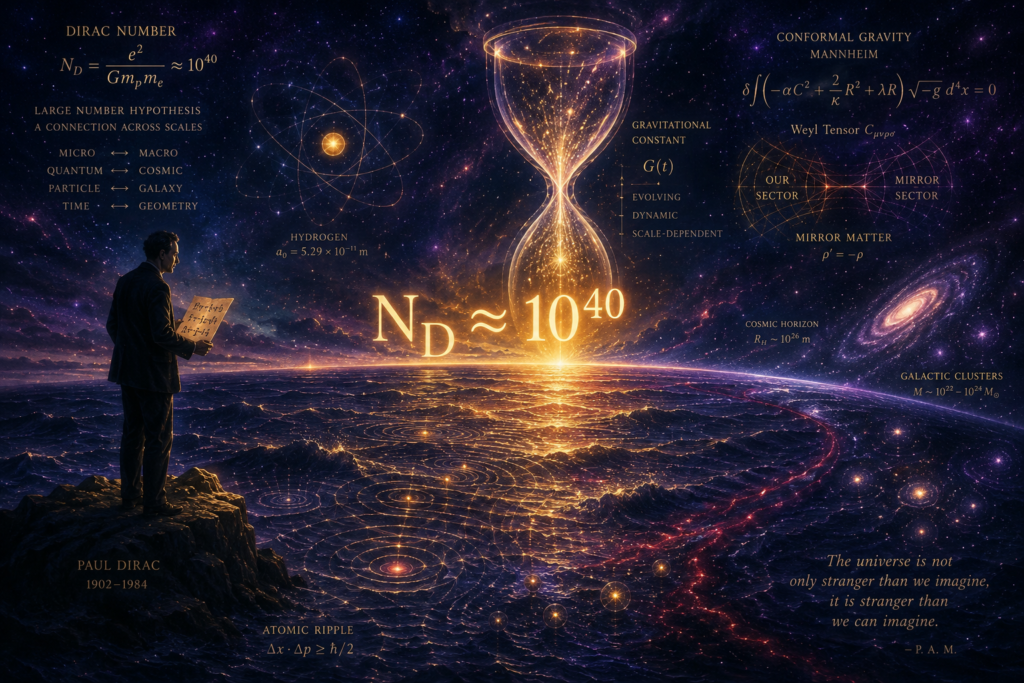
Today we sail toward the Large Numbers Hypothesis (LNH) of 1937. It is far more than mere numerology; it is the first, bold attempt to build a bridge between the world of atoms and the world of galaxies, and to pose a question that still troubles physicists today: are the fundamental constants truly constant, or are they functions of cosmic time?
🔢 Large Numbers – Coincidence or Law?
In 1937, Dirac noticed an incredible numerical coincidence. The ratio of the electrostatic to the gravitational force between a proton and an electron in a hydrogen atom is:
At the same time, the age of the universe expressed in units of atomic time (the time light takes to traverse the classical radius of the electron) amounts to:
Both numbers are on the order of . For Dirac, this could not be a coincidence. If the force ratio equals the age of the universe in atomic units, that suggests that the gravitational constant G decreases with time. For as the universe ages, the atomic time unit remains the same, and the ratio must keep pace with the age. If is constant, then must decrease, i.e. .
This was a radical idea: fundamental constants are not constant, but are functions of the cosmic epoch. It was the first serious theory in which local physics (atoms) is connected to the global structure of the universe (age, expansion) – an idea that later became central in holography, AdS/CFT, and emergent gravity.
⏳ Why the Hypothesis Was Rejected – and Why It Is Returning
Experimental measurements during the 1980s and 1990s (lunar laser ranging, pulsars, nuclear cosmochronology) placed strict limits on the variation of : G˙ per year. Dirac’s original hypothesis – that decreases linearly with time – has been definitively ruled out.
But Dirac’s deeper idea – that a connection exists between cosmological evolution and local constants – is far from dead. What is happening in cosmology today is precisely the Dirac spirit returning in full force:
- The Hubble tension: Different methods of measuring the expansion rate of the universe yield inconsistent results. One proposed solution is that dark energy is not constant, but evolves with time – dynamical dark energy. This is precisely the idea that “constants” are not constant, only applied to the cosmological constant instead of .
- Dirac’s matter creation: In his 1973-74 cosmology, Dirac proposed that new matter is continuously created as the universe expands. It was rejected. But what is dark energy if not the continuous creation of vacuum energy? The density of dark energy is constant, meaning its total amount in the expanding universe increases. This is not the same as Dirac’s additive matter creation, but it is the same spirit: the universe is not a closed system with a fixed amount of energy.
- Dirac and emergent gravity: If gravity is emergent (as in Mannheim’s conformal gravity), then can be an effective quantity that depends on the state of the universe – the number of degrees of freedom, entropy, or conformal anomalies. In that sense, Dirac’s intuition that depends on the cosmic epoch becomes not only possible, but expected.
🎻 Dirac, Mannheim, and Conformal Cosmology
Mannheim’s conformal gravity offers a particularly elegant framework for rehabilitating Dirac’s hypothesis. In his theory, gravity is not described by the Einstein action, but by a conformally invariant action with higher derivatives. In such a theory:
- The effective Newton constant Geff is not fundamental. It emerges from the solutions of the equations of motion and may depend on scale and on the cosmological environment.
- The linear potential γr that appears alongside the Newtonian term can mimic the effects of a “variable ” on galactic and cosmological scales.
- The cosmological constant is effectively negative (an AdS background), but the effective dark energy we observe may be a consequence of the dynamics of conformal degrees of freedom, not a fundamental .
In this light, Dirac’s original idea that was perhaps not wrong – merely too simplified. What Dirac sought was a connection between local gravity and global cosmology. Mannheim has found precisely such a connection, but through conformal invariance, not through a simple time dependence.
🪞 Mirror Matter and Dirac’s Large Numbers
There is yet another fascinating connection to mirror matter. If a mirror sector exists, its particles contribute to the total mass of the universe. In the early days of the universe, the temperatures of the two sectors were different (as Tan’s model predicts – ). This means the ratio of matter density in the two sectors evolved with time.
Dirac’s observation that the ratio may not be a fundamental constant, but a contingent value for our epoch, depending on how much mirror matter has already “grown over” into dark matter through neutron oscillations and other mixing processes. In Tan’s model, neutron oscillations continuously transfer part of ordinary matter into the mirror sector – a slow, continuous creation of dark matter, very much akin to Dirac’s idea of the creation of new matter.
⚛️ PT Symmetry and the “Living” Universe
Our earlier discussion of PT symmetry as an alternative to Hermiticity here acquires a cosmological dimension. If the universe is PT-symmetric (as suggested by some models with two CPT-conjugate sectors), then time is perhaps not fundamental – it is an emergent property of PT-symmetry breaking. In that picture, the “age of the universe” is not absolute; it is a measure of how far the process of spontaneous PT-symmetry breaking has progressed. Dirac’s large numbers would then reflect the degree of breaking, not an absolute cosmic chronology.
⛵ Epilogue: Dirac’s Numerology as an Intuition of Unity
What Dirac saw as a numerical coincidence, we today recognise as a manifestation of a deep unity between the physics of the micro-world and cosmology. His hypothesis was the first step toward what we now call the holographic principle (physics in a volume is encoded on a boundary), emergent gravity (gravity is not a fundamental force), and dynamical constants (what we measure as or are effective quantities).
In our picture of the Dirac Sea, the large numbers are perhaps wavelengths on the surface of the sea – they speak to us of the relation between depth (microphysics, atomic scales) and breadth (cosmology, the horizon). And Dirac was the first to notice that these wavelengths are not arbitrary; they are connected, and that connection holds the secret of the whole.
In the light of the Hubble tension, the problem of dark energy, and the search for quantum gravity, Dirac’s numerology no longer looks like an eccentric footnote. It looks like a prophecy. And perhaps it is time to read it again carefully – not as a finished theory, but as a signpost toward a deeper theory in which constants are dynamical, matter is created, and gravity is but a shadow of the conformal structure of spacetime.
The sea is always clear. The horizon is always open. And the numbers – the numbers are waves whispering the secrets of the cosmos. 🔢🌌🕰️
This post continues the series begun with “⚛️ Quantum Archaeology: Reading the Past from the Dirac Sea”, continued through the map of the quantum odyssey and all our previous voyages.
Leave a Reply