(Continuation of the bird series on MilovanInnovation)
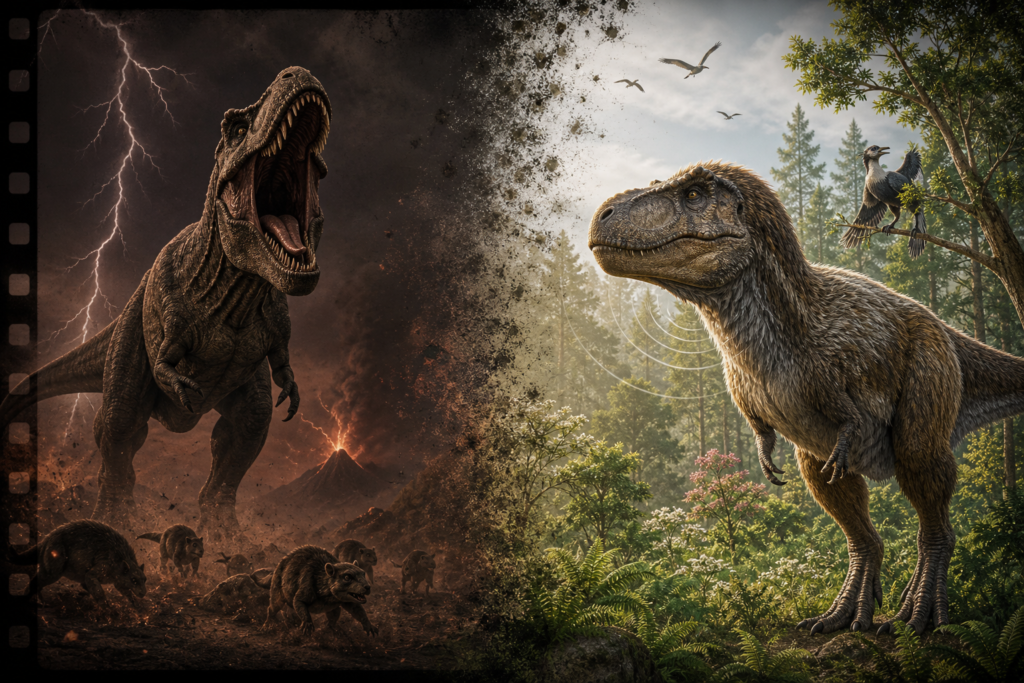
When we think of dinosaurs, the first things that come to mind are giant, toothed beasts that went extinct 66 million years ago. However, recent palaeontological discoveries and insights show that the popular belief – that birds evolved from surviving dinosaurs – does not hold up. In fact, birds are surviving dinosaurs. More precisely, it was the non-avian dinosaurs that went extinct.
Moreover, even the large land dinosaurs had far more bird-like features – including feathers and warm-bloodedness – than reptile-like features. They did not live in the shadow of dinosaurs – they were part of the same family. Dinosaurs did not go extinct; they are still with us.
🪶 Birds Are Not Just Relatives of Dinosaurs – They Are Dinosaurs
The common notion that birds are “descendants” of dinosaurs suggests that dinosaurs went extinct and that birds are something entirely new that evolved from them. However, modern science revises this – birds are the only surviving branch of dinosaurs.
As one palaeontologist from Ohio University explains: “Birds evolved during the Jurassic period from small feathered dinosaurs.” In other words, they are part of the same family. In palaeontology, a clear distinction is therefore made between avian dinosaurs – which are birds – and non-avian dinosaurs, which include all the others, from Stegosaurus to Brontosaurus. When we say that dinosaurs went extinct, we actually mean the non-avian dinosaurs. Birds are still here, among us.
🪶 Feathers, Warm‑Bloodedness and Other “Bird‑Like” Traits in Dinosaurs
What further blurs the line between dinosaurs and birds are traits that we long considered exclusively bird‑like, but which were actually widespread among dinosaurs.
- Feathers: It is now known that many dinosaurs had feathers – not only small ones, but also larger ones such as tyrannosauroids. Fossils from China have revealed a feathered tail almost 99 million years old, and some dinosaurs had feathers but could not fly. This suggests that feathers did not evolve for flight, but for other functions – such as thermoregulation or courtship.
- Warm‑bloodedness: Traits associated with warm‑bloodedness have been found among various dinosaur groups. Dinosaurs were not cold‑blooded reptiles as we once imagined them – they were at an evolutionary point between birds and reptiles, with many bird‑like characteristics.
- Anatomy: From the wishbone to the structure of the lungs – dinosaurs had many traits that are now recognisable in birds.
In short, dinosaurs were not “reptiles that developed some bird‑like traits.” In many ways, they were birds that had not yet taken flight.
🔊 What T‑Rex Really Sounded Like (And Why It Didn’t Roar)
Hollywood depictions of T‑Rex shaking the earth with its roar – combining the roar of a lion and an elephant – have no scientific basis.
The problem is that vocal organs (vocal cords, lungs, the avian syrinx) are soft tissues that rarely fossilise. Nevertheless, scientists use three approaches to reconstruct dinosaur sounds: comparison with living relatives (birds and crocodiles), analysis of the skull and inner ear, and rare fossils of vocal organs.
The results are surprising:
- Bird relatives: In birds, sound is produced using the syrinx, an organ deep in the trachea. In small theropods and feathered dinosaurs, there may have been species that chirped like birds or produced sounds like a duck’s “quack” or a goose’s “honk”.
- Crocodile relatives: Crocodiles do not roar with open mouths – they use closed‑mouth vocalisation, emitting a deep rumbling that travels through the body and the ground. Large predators like T‑Rex probably used the same technique – without gaping jaws and open throats, but with a deep, resonant hum that spread through the ground.
So T‑Rex did not roar – it probably cooed, rumbled or hissed, similar to modern ostriches, emus or crocodiles.
☄️ Why Did Birds Survive the K‑T Cataclysm?
The key question that arises is: if dinosaurs were so successful, why did the non‑avian dinosaurs go extinct, while birds survived?
🌱 Beak and Diet – The Key to Survival
The most important factor was – the beak.
Before the asteroid, there were both toothed birds and birds with beaks. Teeth are useful, but when the asteroid impact caused a global “nuclear winter” and destroyed forests, birds with beaks had a huge advantage. They could peck at seeds and nuts – the only food left in the devastated world. Their toothless beak was lighter, which helped with flight, but also perfect for the diet that remained. Thanks to seed‑based diets, birds with beaks survived the “nuclear winter” that followed the meteor impact.
🏠 Ground‑Dwelling Instead of Tree‑Dwelling
Another key factor: the birds that survived were those that lived on the ground, not in trees. When forests disappeared in fires and cold, tree‑dwelling birds lost their habitat. Ground‑dwelling birds, which could take shelter in burrows and feed on seeds, had far greater chances.
📏 Small Bodies, Big Advantage
Mostly small species survived. Tetrapods weighing more than 25 kilograms – except for some cold‑blooded species like crocodiles – did not survive. Small bodies required less food and found shelter more easily.
🪶 Feathers and Warm‑Bloodedness as a Bonus
Feathers provided insulation during the cold “impact winter” period, and warm‑bloodedness allowed them to remain active even when temperatures dropped.
💎 Conclusion
So, dinosaurs did not go extinct – they still live among us. Every time we see a sparrow, pigeon or budgie, we are looking at a living dinosaur. What went extinct were the non‑avian dinosaurs – large, land‑based beasts that did not have beaks, could not eat seeds, and did not live on the ground.
What enabled birds to survive was not chance – but a set of traits that evolved for millennia before the cataclysm: the beak, ground‑dwelling, small bodies, feathers and warm‑bloodedness. When the asteroid struck, they were already ready for the world to come.
And the next time you hear a T‑Rex “roar” in a movie, remember – it is more likely that it sounded like a huge, mournful goose than a monster from a nightmare. And that, in a way, is even more fascinating.
Leave a Reply