
When Huawei introduced HarmonyOS in 2019, the idea initially seemed almost revolutionary. It was not supposed to be just another operating system for smartphones, but a software platform capable of connecting a whole range of devices — phones, smartwatches, televisions, cars, household appliances, and other IoT systems.
What interested me most was the concept of a distributed software bus. Instead of treating each device as an isolated computer that connects to others through external protocols, HarmonyOS promised something more fundamental: several physical devices were supposed to behave as parts of a broader computing system. A phone could use the camera of another device, the screen of a television, the sensors of a smartwatch, or other available resources almost as if they were part of its own hardware configuration.
The idea was not entirely new, but it was highly ambitious. Apple had already shown how well a phone, computer, tablet, and smartwatch could work together when controlled by the same manufacturer. Huawei, however, was trying to push this integration deeper into the architecture of the operating system itself. At first, it looked like the possible arrival of a third major operating system, alongside Android and iOS.
Then came the disappointment.
Android with Chinese Characteristics?
Independent researchers who examined the early mobile versions of HarmonyOS quickly noticed something uncomfortable for Huawei’s narrative of a completely new operating system. The system was very close to Android, compatibility with Android applications remained, APK packages could be used, and a significant part of the infrastructure relied on the Android Open Source Project.
That made it entirely legitimate to ask: was HarmonyOS really a new operating system, or simply a deeply modified version of Android?
At that stage, the phrase “Android with Chinese characteristics” was not entirely unfair. Of course, things were never quite that simple. Huawei was already developing its own distributed services, development tools, and a concept designed to span many different types of devices. Still, when a phone could run Android applications with little modification, it was difficult to speak of a complete break with the Android ecosystem.
At the time, I personally lost some of my initial enthusiasm.
But the story did not end there.
When Compatibility Becomes a Burden
Compatibility is one of the most valuable properties of a large computing platform, but it can also become one of its greatest burdens. Windows carries decades of old architectural decisions. Android carries its own legacy of the Linux kernel, Java, Android Runtime, and an extremely broad hardware ecosystem. Compatibility gives users confidence, but it ties the hands of system architects.
At some point, Huawei therefore had to make a decision that is extremely risky for any software company: to break compatibility with Android applications.
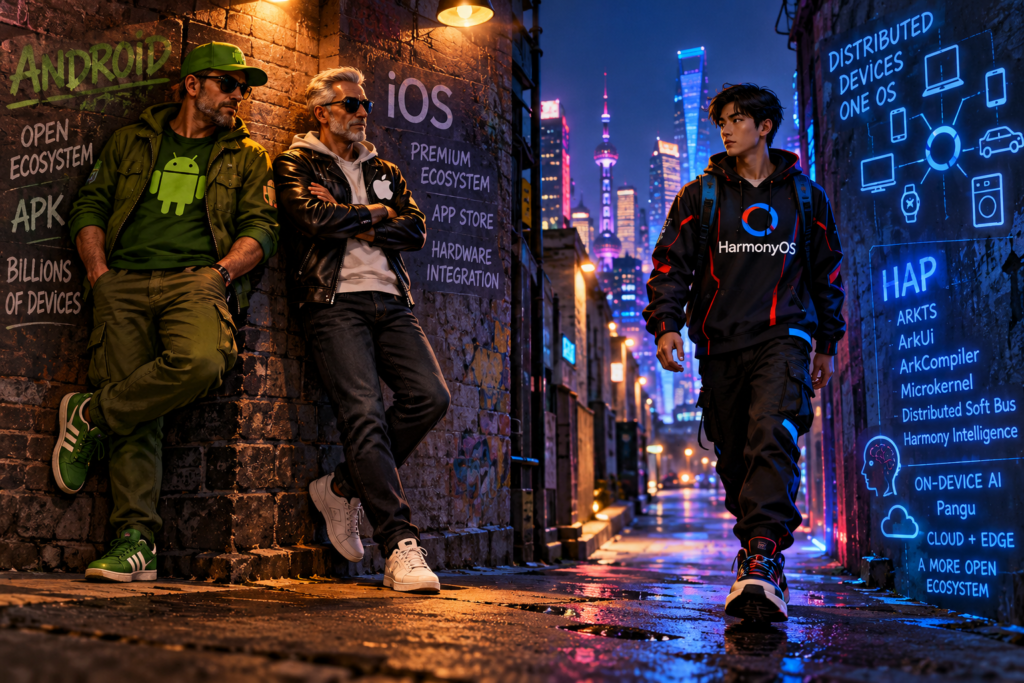
With HarmonyOS NEXT, that break became real. APK was no longer the basic application format, Android applications were no longer part of the native application model, and HarmonyOS gained its own development and execution stack. Today’s HarmonyOS 7 continues precisely along that line and targets HarmonyOS NEXT devices with its own API development cycle.
That is the point at which the story becomes much more interesting.
ArkTS: A New Language for a New Ecosystem
Huawei uses ArkTS for HarmonyOS application development. Calling it an entirely new programming language would be somewhat exaggerated because it retains the basic syntactic style of TypeScript. A programmer familiar with TypeScript will not find it alien. But beneath the familiar syntax there are important differences: ArkTS introduces stricter static checks and analysis, with the aim of making code more robust and more suitable for optimization.
Huawei has built an entire development chain around it: ArkTS, ArkUI, ArkCompiler, and its own runtime environment.
That is a much more serious step than simply changing a language or a user interface. Once you change the programming model, compiler, runtime, and APIs, you are no longer creating a different skin over an existing system. You are beginning to build your own software world.
There is also a practical consequence: developers must be persuaded to enter that world. That may be an even bigger challenge than the kernel itself. A new language is never just syntax; it means new documentation, libraries, tools, debugging methods, testing workflows, distribution models, and a market large enough to justify the extra effort.
HAP Instead of APK
The change is visible even at the application packaging level. Android applications are familiar to us through .apk, while HarmonyOS uses its own HAP format and its own component model. But the change in file extension is the least important part.
The essential difference is that an application is no longer conceived simply as a program living on a single device, but as part of a system that can use resources from different devices and different physical formats.
That brings us back to one of the most interesting original ideas behind HarmonyOS.
Distributed Soft Bus: Many Devices as One Computing Space
OpenHarmony describes the Distributed Soft Bus as the foundation for device discovery, connection establishment, data transfer, and distributed task scheduling. Above it sit distributed data management, distributed service scheduling, and device virtualization. The idea is that a camera, display, sensor, or other resource from another device can be used as an extension of the local system.
The classical model says: one device = one computer.
The Harmony idea tries to say: many devices = one distributed computing space.
Naturally, there is always a gap between an architectural idea and a perfectly implemented system. But here there is a genuine conceptual novelty. The point is not merely to connect devices over Bluetooth or Wi-Fi, but to present them as resources within a wider system.
Microkernel: A Smaller Core, More Communication
An even bolder part of the story is the microkernel philosophy that Huawei has emphasized from the beginning as one of the foundations of the HarmonyOS concept. In a classic monolithic kernel, a large number of functions run directly inside privileged kernel space. Linux is a typical example of this approach: drivers, network subsystems, file systems, and many other functions operate very close to the core of the operating system.
A microkernel tries to do the opposite. It keeps only what is truly essential inside the kernel, while moving more functionality into separate service processes. The advantage is isolation: a failure in one service or driver does not necessarily have to bring down the entire system. The disadvantage is that more communication has to move between processes, which makes IPC — inter-process communication — one of the key performance factors.
There is no free lunch here. The architecture can be more elegant, modular, and secure, but only if communication between services is efficient enough that the user does not pay for that elegance through latency and higher resource consumption.
It is important, however, not to confuse the microkernel with the Distributed Soft Bus. The microkernel organizes work inside a single device, while the Distributed Soft Bus connects multiple devices. These are not small kernels connected by some software bus, but two different layers of the same broader philosophy of distribution.
One Architecture, but Not One Identical Copy of the System
HarmonyOS was designed from the beginning to run on devices with very different levels of computing power. A smartwatch and a PC obviously cannot use an identical software stack. OpenHarmony therefore uses a modular and adaptable architecture in which different parts of the system can be included or omitted depending on the resources of the device.
That explains why my Huawei Watch GT5 can run HarmonyOS while still having nothing close to the same software system as a Huawei smartphone. The family is the same, but the family members are not identical twins.
OpenHarmony Is Not the Same as HarmonyOS
Another important distinction is often overlooked. OpenHarmony is an open-source project under the OpenAtom Foundation, while HarmonyOS is Huawei’s commercial product. OpenHarmony provides the open base, architecture, and a large number of system components, while Huawei builds its own services, development tools, user interface, AI components, and commercial ecosystem on top of that foundation.
For that reason, it is not correct to automatically equate everything found in OpenHarmony documentation with what exists in a commercial HarmonyOS smartphone. But OpenHarmony gives us a very useful view into the philosophy from which the system emerged.
AI Is No Longer an Application, but Part of the Operating System
This brings us to the part that makes HarmonyOS even more interesting today than when it was first introduced.
Huawei no longer talks about AI merely as a separate application installed on the phone, but increasingly as Harmony Intelligence and as AI functionality integrated across multiple layers of the system. In its more recent strategy, the company talks about linking Kirin and Ascend processors, Pangu and other models, and combining local and cloud-based processing. HarmonyOS is increasingly positioned as an “Agent OS,” in which an AI agent can cooperate with system services and applications.
The possibility of a local AI model is particularly interesting.
Large models of the kind we use in the cloud require enormous amounts of memory and computing power. A smartphone cannot locally run a full model from the class of very large server-side LLMs. But the phone does not need such a model either. Much smaller, optimized, and quantized models can locally perform transcription, summarization, content search, intent recognition, translation, image processing, data classification, and system control.
The advantages are significant: speed, offline operation, and privacy. If a local model can process a message, document, photograph, or voice request without sending the data to a remote server, the user gains both lower latency and better control over personal data.
On the other hand, when the task requires more complex reasoning, a large context window, or heavier computation, cloud models still have an enormous advantage.
That is why the most interesting direction is probably a hybrid model: simpler and private tasks are handled locally, more demanding ones are sent to the cloud, while the operating system decides where a particular part of the workload can be executed most efficiently.
This is where HarmonyOS once again makes sense as a distributed system. It originally tried to distribute devices and their resources. Now it may also distribute intelligence.
That can perhaps be summarized in one sentence:
HarmonyOS began as an attempt to connect devices into one computing space. With local AI, the next step is to make intelligence itself part of that space.
A Local LLM on a Phone and a Local LLM in a Company Are Not the Same Thing
It is useful to make another distinction here. When a company says that it will install DeepSeek or another LLM “locally,” that usually means a local server system with substantial GPU or AI accelerator resources. Such a system can work with internal documents, technical documentation, databases, and other sensitive information without requiring corporate data to be sent to a public cloud service.
That is particularly important in industry, where technical drawings, process recipes, procedures, production data, and business information often must not leave internal infrastructure.
A smartphone is a different category. Its local model has to be much smaller and more specialized, but in return it can react immediately, without a network connection and with a much lower privacy risk. In the future, one of the most important abilities of an operating system may be precisely the ability to decide what should be executed locally, what should run on another device, and what should be sent to the cloud.
Because of its distributed philosophy, HarmonyOS is a particularly interesting platform for such an approach.
When Constraints Begin to Change the Architecture
This is where the broader story appears.
For decades, there was a simplified view of Chinese technology: China could produce quickly and cheaply what someone else had designed, but could not create its own technological paradigm.
That view has long been insufficient.
My own experience with Chinese PLCs, servo systems, machines, and complete production lines has shown me something different. Chinese engineers very often have their own philosophy of problem solving. The solutions are not always elegant. They are not all equally reliable, and sometimes it is obvious that cost was considered more important than long-term maintainability. But just as often, I encounter highly creative and ingenious solutions, especially when resources are limited.
There may be a broader engineering lesson in that:
constraints do not guarantee innovation, but they very often force it.
Had Huawei not lost access to parts of the Western technological ecosystem, it might never have had enough reason to accept the risk of building its own application stack. Android would have continued to work, compatibility would have been easier, and the engineer’s life would have been simpler.
But the history of technology shows that some of the most interesting architectures emerge precisely when the simpler path is no longer available.
From Setun to HarmonyOS
Less than a month ago, we wrote about the Soviet computer Setun, which used ternary logic. Setun is fascinating because today it shows us an almost lost branch of computing history. Most computers followed the binary path. Setun tried something else.
HarmonyOS is not that radical at the mathematical level of computation. Its processors are still binary, its programming languages have recognizable origins, and its network protocols remain part of the global technological world. But there is an interesting parallel.
Here, we have the opportunity to observe the emergence of an alternative technological path while it is still being built.
We do not know whether HarmonyOS will become one of several major global operating systems ten or twenty years from now. Perhaps it will remain primarily a Chinese ecosystem. Perhaps its distributed ideas will leave a greater mark than the operating system itself. Some ideas may disappear, while others may become standard.
We cannot know that today.
And that is exactly why this moment is interesting.
We observe Setun as history. We observe HarmonyOS as an experiment that is still unfolding.
From Android with Chinese Characteristics to a Computing World of Its Own
The early mobile versions of HarmonyOS were justifiably met with skepticism. It was difficult to describe the system as completely new while the phone could still use a large part of the Android application ecosystem.
With HarmonyOS NEXT, the situation changed.
Its own development language and toolchain. Its own runtime. The HAP application model. Distributed services. A new kernel direction. A break with Android application compatibility. AI that is increasingly becoming a system-level function, rather than merely an addition to individual applications.
This is no longer just repainted Android.
At the same time, technical originality alone does not guarantee success. The greatest test remains the same: can such a system attract enough developers, applications, and users to become a self-sustaining ecosystem?
That is probably the most interesting experiment of all.
Not the experiment with a new kernel. Not the experiment with a new programming language. Not even the experiment with local AI.
But the experiment built around one question:
in a world where Android, iOS, and Windows have already built enormous ecosystems, is it still possible to create a major operating system almost from scratch?
If HarmonyOS succeeds, the answer will matter far beyond Huawei itself.
And if it does not, that too will be a valuable lesson about how difficult it has become to change the basic infrastructure of the digital world.
For now, all we can do is watch.
And admit that the attempt is — bold. 😎
Leave a Reply