Continuation of the series “Emergent Spacetime” and “Us in the Quantum Sea”
Dear friends, explorers at the crossroads of science and spirit,
So far, we have spoken about the Dirac Sea, the indestructibility of information, and the Resurrection as the triumph of light over darkness. But there is one everyday experience that, perhaps most directly, reveals the nature of consciousness: anesthesia.
Sleep is not a cessation of consciousness – dreams, lucidity, fluctuating levels of awareness testify to that. But anesthesia is. In less than 20 milliseconds, a person goes from full conscious experience to a state in which absolutely nothing is present – no thoughts, no sensations, no time. And then, when anesthesia ends, consciousness returns. Unrecognizable, but the same.
How is this possible? What does anesthesia tell us about what consciousness is?
💨 Two mysteries, one mechanism
Stuart Hameroff, co-author of the Orch-OR theory (together with Roger Penrose), in his 2006 paper poses the key question:
“The mechanism by which anesthetics prevent consciousness remains unknown, largely because the mechanism by which brain physiology produces consciousness is unexplained. But these two mysteries appear to share a critical common feature – both consciousness and the action of anesthetic gases are mediated by extremely weak London forces (a type of van der Waals force) acting in hydrophobic pockets within dendritic proteins.”
This is revolutionary: anesthetics do not stop the brain in the way classical drugs do. They do not form chemical bonds. They act quantumly – through weak London forces, the same ones that enable consciousness itself.
🔬 Hydrophobic pockets and microtubules
Inside neuronal microtubules – protein structures that form the internal skeleton of the cell – there are hollow, hydrophobic pockets. In them, weak London forces can act collectively and coherently. Precisely there, according to the Orch-OR model, consciousness arises: brief quantum superpositions that then objectively reduce (collapse) into conscious moments, each about 25 milliseconds long.
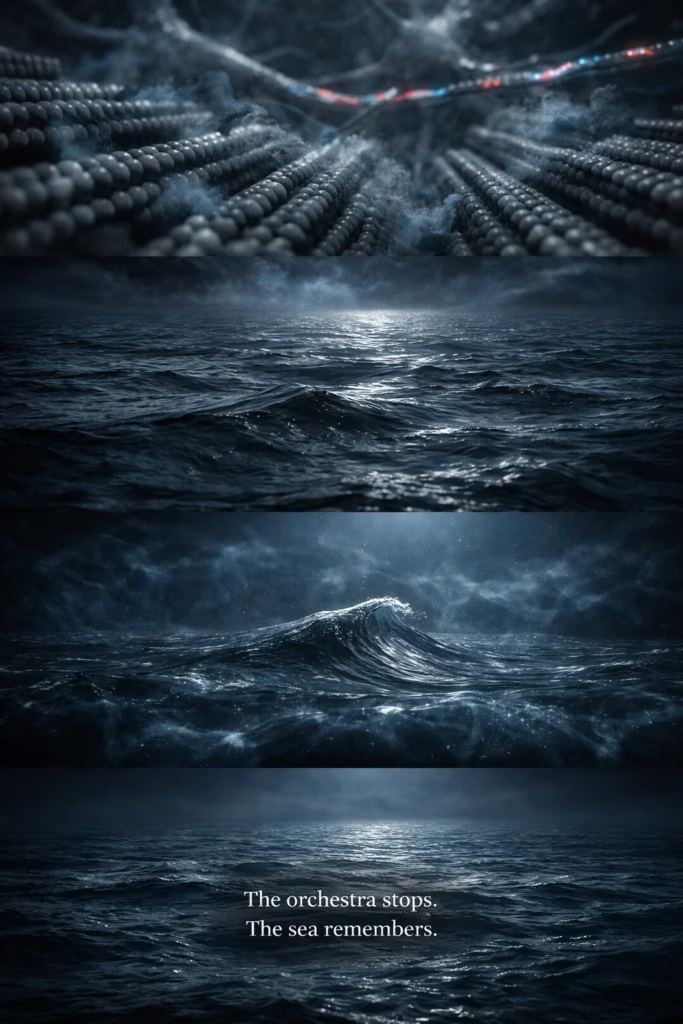
Anesthetics, when they enter these pockets, disrupt coherence through their weak forces. Microtubules stop “playing.” The orchestra falls silent. Consciousness disappears – not because the neuron is dead, but because its quantum music has been interrupted.
Recent research (Wiest, 2025; experiments at Princeton and the University of Central Florida) has confirmed that:
- Anesthetics selectively dampen quantum-like activity in microtubules.
- Macroscopic quantum entanglement in the human brain correlates with conscious states.
- Loss of consciousness under anesthesia coincides with the breakdown of γ-synchrony between frontal and posterior cortical regions – but that is a consequence, not a cause.
🧩 The discontinuity of consciousness: What remains when consciousness disappears?
This leads us to the key insight: consciousness is not continuous. It consists of a series of quantum events. Anesthesia does not “slow down” consciousness – it completely turns it off within milliseconds. That is a discontinuity.
But what happens to the information that constituted that consciousness? Does it also disappear?
Quantum mechanics says: no. Information is conserved. Even when quantum coherence in microtubules disappears, the information about that state cannot be erased – it moves to the environment. In our model, that environment is the Dirac Sea.
🌊 Return to the Dirac Sea: Penrose’s inspiration
It is little known, but Roger Penrose attended Dirac’s lectures at the University of Cambridge. Dirac’s concept of a “sea” of negative energies left a lasting impression on him. In his Conformal Cyclic Cosmology (CCC), Penrose uses precisely that idea: the Dirac Sea is the substrate into which information is “poured” at the end of each aeon, only to be reconstituted in the next.
Applied to consciousness: when anesthesia disrupts coherence in microtubules, the localized wave of consciousness disappears from the surface. But the water is not destroyed – it returns to the ocean. Information remains preserved in the Dirac Sea, ready to crystallize again into a new wave when conditions allow (when anesthesia ends).
This explains why anesthesia is not death, and why consciousness always returns – the same, yet not unchanged, because the sea has in the meantime received new information.
⚖️ What does this mean for our understanding of reality?
If consciousness is a quantum phenomenon dependent on coherence in microtubules, then:
- Consciousness is not an epiphenomenon of the neural network. It is a fundamental property of the quantum substrate – the Dirac Sea – that manifests whenever sufficient coherence exists.
- Anesthesia is not “extinguishing” consciousness in the sense of destroying it. It is a loss of localized coherence – the wave withdraws into the sea, but information remains.
- The discontinuity of consciousness is not proof that consciousness does not exist between moments. On the contrary – it is proof that consciousness exists at a deeper level, one we do not experience directly.
✨ Conclusion: The orchestra falls silent, the sea remembers
Anesthesia is the only reliable experimental model in which we can turn off consciousness and see what remains. What remains is a neuron that still functions – but without quantum coherence. What disappears is subjective experience.
This is the strongest evidence that consciousness is not ordinary computational brain activity. Consciousness is a quantum phenomenon. And quantum phenomena, as both Dirac and Penrose teach us, do not disappear – they are merely redistributed in the infinite sea of information.
So, the next time you go under anesthesia – or when you think of those who have passed away – remember: the wave disappears from the surface, but the sea never forgets the melody.
If you wish to support topics like this – research at the intersection of quantum physics, artificial intelligence, and curiosity – you can buy me a coffee. Every contribution goes directly into research, books, and unpaid hours.
buymeacoffee.com/milovaninnovation
Thank you for being part of this story.
Leave a Reply